
The guppy gravid spot is one of the easiest ways to identify a female guppy and also monitor her pregnancy. Located near the anal fin on the underside of the abdomen, this dark patch gradually changes in size and color as the developing fry grow inside the mother. For many aquarists, watching the size of the gravid spot is the one of the most reliable methods of estimating when a pregnant guppy is approaching labor.
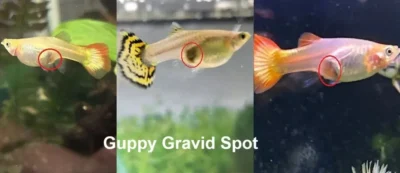
Although hobbyists often associate a dark gravid spot with pregnancy, every healthy female guppy naturally has one. Pregnancy simply makes it become larger, darker, and more noticeable. In lighter-colored guppy strains such as albino or blonde guppies, the gravid spot may appear orange, pink, or reddish rather than black because these fish produce less dark pigment.
Quick Navigation:
➜ What Is a Guppy Gravid Spot?
➜ Gravid Spot Color Changes
➜ How the Gravid Spot Changes During Pregnancy
➜ The Science Behind the Gravid Spot
➜ Signs Birth Is Near
➜ Abnormal Gravid Spots
➜ Frequently Asked Questions
What Is a Guppy Gravid Spot?
A gravid spot is a naturally pigmented area located on the lower abdomen of every female guppy, immediately in front of the anal fin. It sits directly above the reproductive organs, which is why it becomes much more noticeable during pregnancy as developing embryos grow behind it.
Many beginners think the gravid spot is created by pregnancy, but that isn’t true. Female guppies already have a gravid spot before becoming pregnant. Pregnancy simply causes the area to darken as pigment cells over the ovary become more active.
Quick Answer: The guppy gravid spot is a dark patch located just in front of the anal fin on every female guppy. During pregnancy it usually becomes larger and darker, helping aquarists estimate how close the female is to giving birth.
Why Does the Guppy Gravid Spot Change Color?
The color of a guppy’s gravid spot changes throughout pregnancy as the embryos develop inside the female. In most guppies, the spot gradually becomes darker as pigment cells over the ovary increase, and eventually the tiny black eyes of the fry may become visible through the abdominal wall as well.
Aquarium owner get worried when the see red or pink Gravid spot on the Femal Guppy. Not every female develops the same color, however. Genetics, body pigmentation, and guppy strain all influence how the gravid spot appears. While black is the most common color, lighter strains may display brown, orange, red, or even pink gravid spots.
Black Gravid Spot
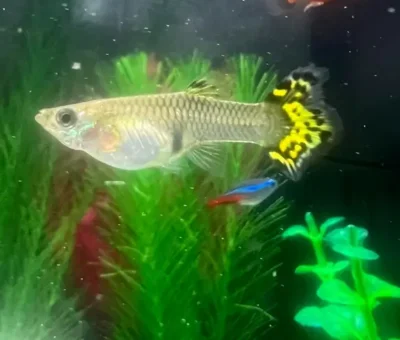
A black gravid spot is the most common appearance in standard female guppies. As pregnancy progresses, the spot usually becomes darker and larger. During the final week before birth, the developing fry’s eyes often make the area appear almost jet black.
Brown Gravid Spot
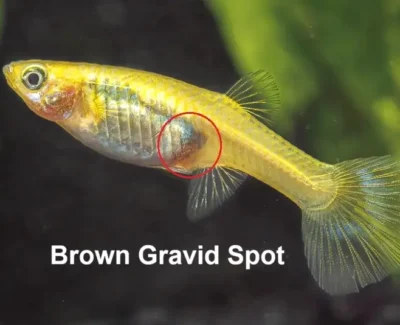
Some females naturally have a dark brown gravid spot instead of pure black. This is completely normal and is usually caused by natural differences in skin pigmentation. A brown gravid spot still darkens as the pregnancy advances.
Orange or Red Gravid Spot
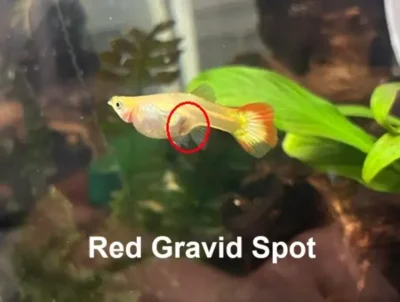
Albino, blonde, and some platinum guppy strains often have an orange, reddish, or rust-colored gravid spot instead of a black one. Because these fish produce much less melanin, the underlying blood vessels and developing embryos show through differently.
An orange or red gravid spot does not mean the fish is unhealthy. It is simply a result of the fish’s genetics.
Pink Gravid Spot
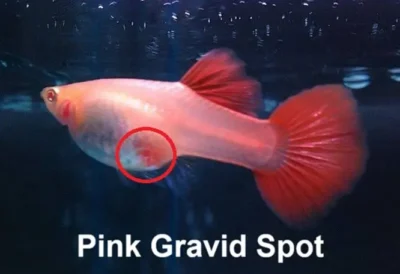
Some very light-colored guppies develop a pink gravid spot, particularly during the early stages of pregnancy. As the embryos continue growing, the pink area often becomes darker and more noticeable before birth.
How the Gravid Spot Changes During Pregnancy
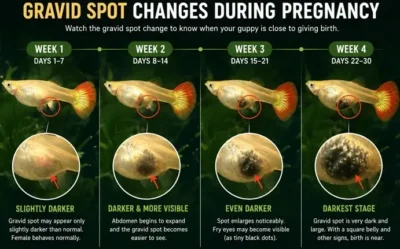
One of the easiest ways to estimate how close a female guppy is to giving birth is by watching how her gravid spot changes over time. Although every pregnancy is slightly different, the progression is usually very predictable and follows the same general timeline as the rest of gestation — see our guppy gestation period guide for the full week-by-week breakdown.
Week 1
During the first week after fertilization, the gravid spot changes very little. It may appear only slightly darker than usual, while the female continues behaving normally.
Week 2
By the second week, the abdomen begins expanding and the gravid spot becomes easier to see. The growing embryos increase the shadow beneath the abdominal wall, making the area appear darker.
Week 3
During the third week, both the abdomen and the gravid spot enlarge noticeably. In lighter-colored guppies or fancy guppy strains, experienced aquarists may even begin seeing the tiny eyes of the developing fry through the thin abdominal wall.
Week 4
As labor approaches, the gravid spot reaches its darkest appearance. Combined with a square-shaped abdomen, hiding behavior, and reduced appetite, this is one of the strongest signs that birth is only hours or days away. Proper care during these final stages can help prevent the loss of both fry and the parent, ultimately improving your guppy lifespan.
Typical Gravid Spot Timeline
➜ Week 1: Slightly darker than normal.
➜ Week 2: Spot enlarges as embryos grow.
➜ Week 3: Very dark; fry eyes may become visible in light-colored strains.
➜ Week 4: Darkest stage, usually accompanied by a square belly and labor signs.
The Science Behind the Guppy Gravid Spot
The guppy gravid spot is much more than a simple pregnancy mark, and the actual mechanism behind it is more specific than most guides explain.
The spot forms over the peritoneum, the thin internal lining that covers the ovary, near the anal fin where the developing embryos are carried throughout pregnancy. This lining contains pigment cells called melanophores. As pregnancy progresses, these melanophores become more active and increase in number directly on that lining, which is what actually makes the gravid spot darken and expand, rather than the embryos themselves blocking light through the skin, as is often assumed.
In the final stages of pregnancy, a second effect layers on top of this: the tiny eyes of the developing fry, which are naturally dark, become visible through the thin abdominal wall alongside the darkened peritoneum, making the gravid spot look almost black in many guppies.
In lighter-colored strains such as Albino, Blonde, Platinum, and some White Guppies, there is much less melanin overall. Instead of appearing black, the gravid spot often looks orange, pink, or reddish because the underlying blood vessels and developing embryos show through more easily with less pigment in the way.
This explains why the gravid spot varies so much between guppy varieties. The location and the underlying mechanism are always the same, but the amount of pigment determines whether it appears black, brown, orange, or red. Since guppies are livebearers rather than egg-layers, this internal development is also why healthy females never release eggs into the tank — see our do guppies lay eggs guide for the full explanation.
Did You Know? The gravid spot is not the babies themselves. It’s the peritoneum, the internal lining over the ovary, darkening as pigment cells there become more active. Only later in pregnancy do the fry’s own eyes become visible through the skin, adding to the dark appearance.
Signs the Gravid Spot Means Birth Is Near
A dark gravid spot alone does not necessarily mean a female will give birth immediately. The most accurate prediction comes from looking at several signs together. When the gravid spot becomes extremely dark while the belly turns square-shaped, labor is usually only a few hours or days away — see our guppy giving birth guide for the full breakdown of labor signs and what happens during delivery.
Many females also begin hiding among plants, lose interest in food, breathe more rapidly, and become restless as contractions begin. These behavioral changes, combined with a dark gravid spot, provide a much more reliable indication that birth is approaching than the spot alone.
Signs the Gravid Spot Indicates Birth Is Near
➜ Very dark gravid spot
➜ Square or box-shaped belly
➜ Fry eyes visible (in lighter strains)
➜ Hiding among plants
➜ Reduced appetite
➜ Restlessness or pacing
➜ Mild contractions and faster breathing
Abnormal Gravid Spots: When Should You Be Concerned?
Most gravid spots change gradually throughout pregnancy, but occasionally hobbyists notice unusual colors or changes that cause concern. In many cases these differences are completely harmless, while others may indicate stress, illness, or simply that the fish is not actually pregnant.
Why Can’t I See a Gravid Spot?
There are several reasons why a gravid spot may be difficult to see. Young females that have not yet reached sexual maturity often have a very faint spot, while light-colored strains such as Albino, Platinum, Snow White, and Blonde Guppies naturally display much less pigmentation than standard varieties.
Lighting also plays a role. A gravid spot is usually easiest to see under natural white aquarium lighting when viewing the fish from the side.
Can Male Guppies Have a Gravid Spot?
No. Male guppies do not have a true gravid spot because they do not possess a uterus or carry developing embryos.
Occasionally, a dark patch caused by internal organs, pigmentation, or lighting may resemble a gravid spot, but it is not related to reproduction. The easiest way to distinguish the sexes is by examining the anal fin — see our male vs female guppy guide for the full comparison. Males have a long, narrow gonopodium, while females have a fan-shaped anal fin located directly below the gravid spot.
Does the Gravid Spot Disappear After Birth?
Not completely. Every healthy female guppy naturally has a gravid spot throughout her life. After giving birth, however, it usually becomes smaller and lighter because the embryos are no longer occupying the space behind it.
If the female mates again, which often happens within hours or days after giving birth, the gravid spot gradually darkens once more as the next pregnancy develops.
Does a Dark Gravid Spot Always Mean Pregnancy?
Not necessarily. Although pregnancy is the most common reason for a dark gravid spot, some mature females naturally have darker pigmentation than others. A dark spot alone should never be used to confirm pregnancy.
The most reliable diagnosis comes from observing several signs together, including a growing abdomen, a square-shaped belly during the final week, and behavioral changes such as hiding or reduced appetite.
Quick Tip: A dark gravid spot is only one indicator of pregnancy. Always look for other signs such as an enlarging belly, a square-shaped abdomen, and changes in behavior before concluding that a female is about to give birth.
Frequently Asked Questions
What Is a Guppy Gravid Spot?
The gravid spot is a naturally pigmented area located just above the anal fin of every female guppy. During pregnancy it becomes larger and darker as pigment cells over the ovary become more active.
When Does the Gravid Spot Appear?
Female guppies are born with a gravid spot, although it is often faint in young fish. It becomes much more noticeable after the female reaches maturity and especially during pregnancy.
Why Is My Guppy’s Gravid Spot Black?
A black gravid spot usually indicates that the embryos are developing normally. During late pregnancy, the growing fry and their tiny eyes make the area appear even darker.
Why Is My Guppy’s Gravid Spot Orange?
This is normal in albino, blonde, and platinum strains, which produce much less melanin. The orange color comes from blood vessels and developing embryos showing through with less dark pigment in the way, not from illness.
Why Is My Guppy’s Gravid Spot Red?
Same cause as orange — lighter-strain females with reduced melanin show more of the underlying blood vessels and embryos through the skin. It’s a normal genetic variation, not a health concern.
Why Can’t I See My Guppy’s Gravid Spot?
She may be too young to show it clearly yet, or she’s a light-pigmented strain where it’s naturally faint. Try viewing her from the side under natural white light.
Can You See Fry Eyes Through the Gravid Spot?
Yes. In light-colored guppy strains, experienced hobbyists can often see the tiny black eyes of the developing fry during the final week of pregnancy.
Does Every Female Guppy Have a Gravid Spot?
Yes. Every healthy female guppy has a gravid spot. Pregnancy simply makes it more obvious.
Final Thoughts
The gravid spot is one of the most useful visual indicators of pregnancy in female guppies. By understanding its location, normal color variations, and how it changes throughout pregnancy, aquarists can estimate when labor is approaching without disturbing the fish.
Rather than relying on the gravid spot alone, combine it with other signs such as a square-shaped belly, hiding behavior, and reduced appetite. Looking at all of these changes together provides a much more accurate picture of where the female is in her pregnancy and helps you prepare for the arrival of healthy newborn fry.
