
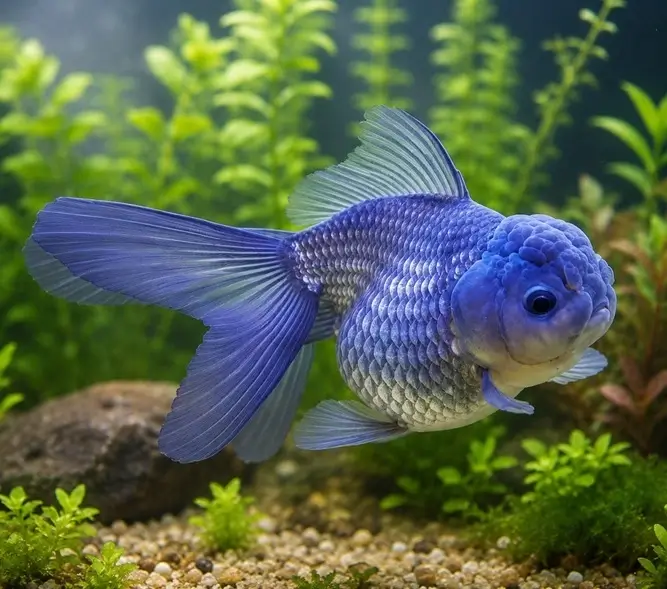
The Blue Oranda Goldfish stands out for its slate-blue to steel-gray coloring and soft metallic sheen. Its blue is usually subtle rather than vivid, and the shade can look different under different lighting or change as the fish matures.
Quick Navigation
1) Blue Oranda: Quick Facts
2) What Is a Blue Oranda?
3) Are Blue Oranda Goldfish Real or Fake?
4) The Science Behind Blue Color
5) Blue Oranda Care
6) Frequently Asked Questions
Blue Oranda: Quick Facts
| Characteristic | Details |
|---|---|
| Scientific Name | Carassius auratus |
| Variety | Oranda Goldfish (blue color variety) |
| Color | Slate-blue to metallic steel-gray |
| Adult Size | Typically 6–8 inches; some grow larger |
| Lifespan | 10–15 years with good care |
| Difficulty | Moderate |
| Tank Size | At least 30 gallons for one fish; larger is preferable |
| Temperature | 68–79°F (20–26°C) |
| Diet | Omnivore |
What Is a Blue Oranda?
The Blue Oranda is a color variety of the Oranda Goldfish. It has the rounded body, fleshy head growth known as a wen, and flowing double tail of other Orandas. Body shape and wen development vary between individuals.
Are Blue Oranda Goldfish Real or Fake?
Blue Oranda Goldfish are real. Their natural coloring is usually a muted slate-blue, metallic gray-blue, or silver-blue rather than a vivid sky-blue.
Lighting, camera settings, and photo editing can make the blue appear stronger than it looks in person. If you are buying online, a recent video of the actual fish under neutral white lighting can help you judge its color.
The Science Behind Blue Color
What Creates the Blue Shade?
A Blue Oranda’s color comes from dark pigment in its skin and tiny structures that reflect light. Together, these contribute to its soft blue-gray appearance and metallic shine.
Why Does the Color Look Different Under Different Lights?
Your Blue Oranda may look bluer under cool white lighting and grayer under warmer lighting. Camera settings and viewing angle can also affect how it looks in photos. These differences do not necessarily mean the fish’s actual color has changed.
Blue Oranda Care
Blue Orandas need the same care as other Orandas: at least 30 gallons for one fish, stable temperatures of 68–79°F (20–26°C), effective filtration with a gentle current, and regular water changes. Feed a balanced goldfish diet and choose peaceful tankmates that will not outcompete them for food.
For tank setup, water parameters, feeding, and suitable companions, see our Oranda Goldfish Care Guide.
Frequently Asked Questions
Why do Blue Orandas change color?
Their coloring can change as they mature, influenced by inherited traits. Some retain their blue-gray shade, while others become lighter or develop white, orange, or bronze tones. Good care supports healthy coloring but cannot guarantee that the blue will stay or return after fading.
Why is my Blue Oranda turning black?
Darkening has several possible causes, so do not assume it is normal growth. Check water quality, especially if new black patches appear alongside poor appetite or unusual behavior. Our Goldfish Turning Black guide explains the possible causes.
Can Blue Orandas breed with Red Cap Orandas?
Yes. They are color varieties of the same goldfish breed and can breed together. Their offspring may look different from either parent, so breeding them does not guarantee blue or red-capped fry.
What is the difference between a Blue Oranda and a Black Oranda?
The main difference is color: Blue Orandas have a muted slate-blue or metallic gray-blue appearance, while Black Orandas have black coloring. Both are Oranda color varieties with the same basic features and care needs. Either variety may change color as it matures.
Explore More Oranda Varieties: