
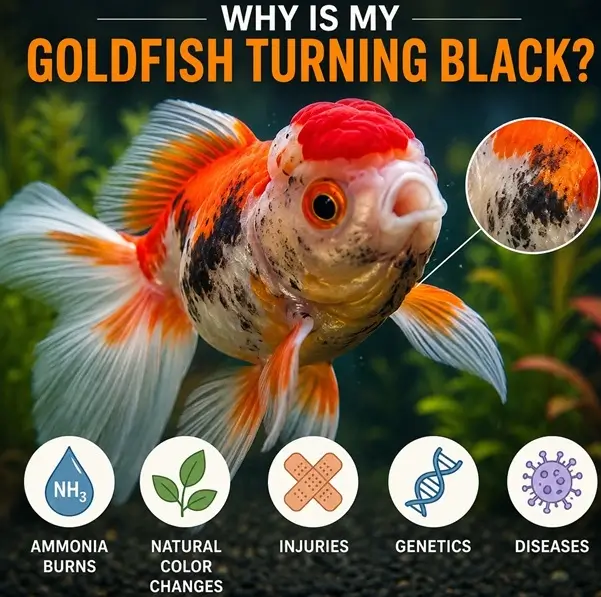
You walk over to your aquarium expecting to see your bright orange or white goldfish, only to notice that parts of its body have started turning black. Why is my goldfish turning black? Goldfish turning black, whether it’s one fish or why are my goldfish turning black together, is most commonly linked to healing after ammonia burns, although natural color changes, injuries, genetics, and certain diseases can produce similar black patches. Understanding where the black color appears, how quickly it developed, and whether your fish is behaving normally is usually the fastest way to identify the real cause.
Quick Answer
If your goldfish suddenly develops black patches or dark edges on its body or fins, poor water quality—especially ammonia—is the first thing you should investigate. Black pigmentation commonly appears while damaged skin is healing after ammonia burns. However, gradual color changes without any other symptoms are often completely natural, particularly in young goldfish or certain fancy varieties. Injuries, stress, parasites, and bacterial infections can also cause localized blackening.
Quick Navigation
➜ Why Is My Goldfish Turning Black?
➜ Why Is My Goldfish Turning Black on the Head?
➜ Why Is My Goldfish Turning Black on the Fins?
➜ Why Is Only One of My Goldfish Turning Black?
➜ Why Is My Orange Goldfish Turning Black?
➜ Why Is My Goldfish Turning Black After a Water Change?
➜ Ammonia Burns
➜ Natural Color Changes
➜ Healing After an Injury
➜ Diseases That Can Turn a Goldfish Black
➜ How Long Does the Black Color Last?
➜ How to Treat a Goldfish Turning Black
➜ How to Prevent a Goldfish From Turning Black
➜ Frequently Asked Questions
➜ Final Thoughts
Why Is My Goldfish Turning Black?
Black coloration develops when specialized pigment cells called melanophores produce or deposit melanin within damaged or changing tissue. Unlike orange, red, or white pigments, black pigmentation often appears as part of the body’s natural healing response. That is why black patches commonly develop on a fish after ammonia burns, physical injuries, or other forms of skin damage.
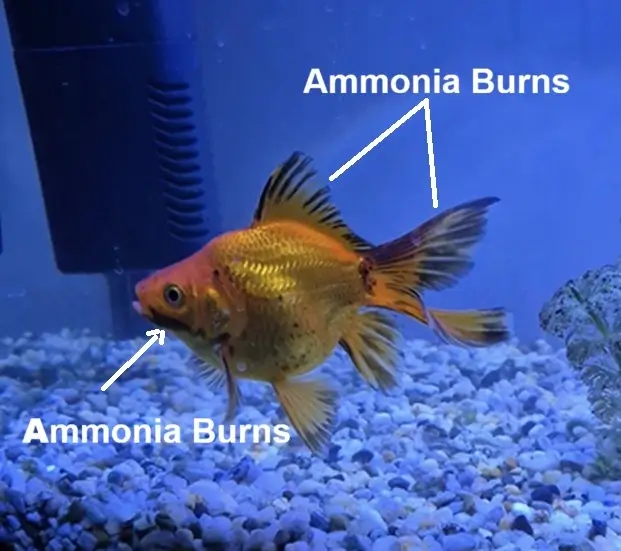
Not every black mark is a medical emergency, however. Some goldfish naturally change color as they mature, while certain varieties develop darker pigmentation as part of their genetics. The challenge is telling harmless color changes apart from those caused by poor water quality or disease.
The appearance and location of the black areas often provide the first clue.
| Appearance | Most Likely Cause | Urgency |
|---|---|---|
| Large irregular black patches | Healing after ammonia burns | High |
| Black fin edges | Healing or mild ammonia damage | Medium |
| Gradual body darkening | Natural color change | Low |
| Tiny pepper-like black dots | Black spot disease | Medium |
| Black area around a recent wound | Healing after an injury | Low |
Before assuming the worst, observe whether your goldfish is still eating, swimming normally, and interacting with its surroundings. A healthy fish that gradually changes color is very different from one that suddenly develops black patches while gasping at the surface, sitting on the bottom, or refusing food. Combining your observations with a simple water test is usually the fastest way to determine whether the black coloration is harmless or a sign that something in the aquarium needs immediate attention.
Why Is My Goldfish Turning Black on the Head?
When black coloration develops only on the head, it usually points to one of three possibilities: healing after ammonia burns, recovery from a minor injury, or a natural change in pigmentation. Looking at your goldfish’s overall behavior is often more important than looking at the color alone.
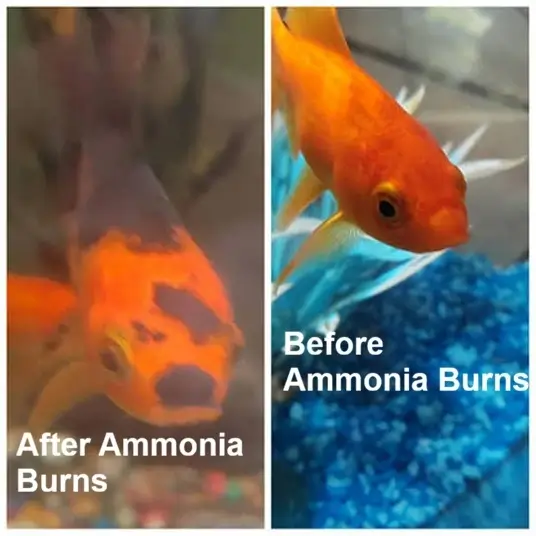
If the black patch appeared suddenly over a day or two and your goldfish is also less active, breathing rapidly, or spending more time at the surface or bottom of the tank, poor water quality should be your first suspicion. Ammonia burns commonly affect the face and gill area because these delicate tissues are constantly exposed to the surrounding water.
Fancy goldfish, particularly Orandas, deserve special attention because the fleshy head growth, known as the wen, is easily damaged. Scraping against decorations, rough netting, or minor injuries from tankmates can all heal with temporary black pigmentation before gradually returning to the fish’s normal color.
If your goldfish continues eating normally, swims actively, and water tests confirm 0 ppm ammonia and 0 ppm nitrite, the black coloration is much more likely to be harmless than dangerous.
➜ Test ammonia and nitrite immediately.
➜ Inspect the head for scrapes, missing scales, or injuries.
➜ Watch for rapid breathing, inflamed gills, or gasping.
➜ Continue monitoring the color over the next few weeks if the fish is otherwise healthy.
Why Is My Goldfish Turning Black on the Fins?
Black edges or dark streaks on the fins are among the most common forms of black pigmentation seen in goldfish. In many cases, the fins are actually healing rather than becoming diseased.
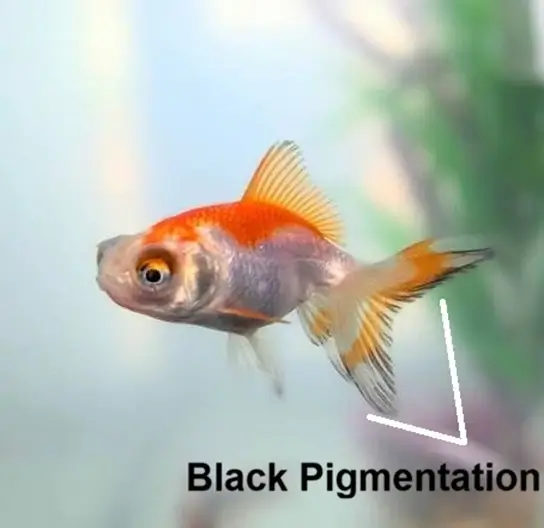
Ammonia burns frequently damage the delicate tissue along the fin edges. As those damaged areas repair themselves, melanin is deposited into the new tissue, producing black borders or streaks that gradually fade as healing progresses.
Small tears caused by aggressive tankmates or sharp decorations can create a very similar appearance. If only one fin is affected while the rest of the fish looks healthy, a physical injury is usually more likely than poor water quality.
However, if several fish in the aquarium begin developing black fin edges around the same time, the problem is much more likely to be environmental. Poor water quality should always be ruled out before assuming the fins are simply changing color naturally.
➜ Test ammonia, nitrite, and nitrate levels.
➜ Inspect the fins for tears or missing tissue.
➜ Check the aquarium for sharp decorations.
➜ Maintain excellent water quality while the fins heal naturally.
Why Is Only One of My Goldfish Turning Black?
If only one goldfish in a community aquarium develops black patches while the others remain perfectly healthy, it’s easy to assume the problem cannot be related to water quality. Surprisingly, that isn’t always true.
Individual goldfish vary considerably in their sensitivity to ammonia, stress, and injury. The weakest or most sensitive fish often develops symptoms first, while the others continue behaving normally for several days before showing any signs themselves.
On the other hand, when only one fish is affected, localized injuries become much more likely. The fish may have scraped itself on a decoration, become trapped behind equipment, or been chased repeatedly by a dominant tankmate. These injuries commonly heal with temporary black pigmentation.
Natural genetics should also be considered. Goldfish raised in the same aquarium can mature into different colors depending on the genes they inherit. One fish may gradually develop darker pigmentation while its tankmates remain bright orange or white.
| Situation | Most Likely Cause |
|---|---|
| Single black patch after bumping décor | Healing after an injury |
| Only one sensitive fish affected | Early ammonia exposure |
| Gradual darkening over several months | Natural color change |
| Fish being bullied | Stress or repeated injuries |
Rather than assuming the unaffected fish prove the aquarium is healthy, always confirm by testing the water. Water quality problems often appear in the most sensitive fish first before affecting the entire aquarium.
Why Is My Orange Goldfish Turning Black?
An orange goldfish developing black patches is one of the most noticeable color changes because the contrast is so striking. In most cases, the orange color itself isn’t the problem. Instead, the new black pigmentation usually indicates healing after ammonia burns, recovery from a minor injury, or a natural genetic color change that becomes more noticeable as the fish matures.
If the black patches appeared suddenly over a few days and your goldfish is also spending more time at the surface, resting on the bottom, clamping its fins, or eating less than usual, poor water quality should be investigated immediately. Ammonia damage remains the most common reason an otherwise healthy orange goldfish suddenly develops irregular black patches.
On the other hand, if your fish remains active, has a healthy appetite, and the color change develops gradually over several weeks or months, genetics is often the explanation. Goldfish pigments continue changing throughout life, and some orange fish naturally develop darker markings as they mature.
➜ Sudden black patches usually point toward healing or poor water quality.
➜ Slow, even darkening without other symptoms is often a natural color change.
➜ Always test ammonia and nitrite before assuming the color change is harmless.
Why Is My Goldfish Turning Black After a Water Change?
A water change itself does not normally make a goldfish turn black. However, if black patches begin appearing shortly afterwards, the fish has usually experienced some form of environmental stress rather than being directly affected by the new water.
Large temperature differences between the aquarium and replacement water can stress the skin and immune system. Sudden changes in pH, hardness, or other water chemistry can also irritate delicate tissues, particularly if a large percentage of the aquarium water was replaced at once.
Another possibility is that the water change exposed an existing ammonia problem rather than causing one. In newly established aquariums, disturbing the biological filter or washing filter media under tap water can reduce beneficial bacteria, allowing ammonia levels to rise over the following days. As damaged skin begins healing, black pigmentation may develop.
Always match the replacement water temperature as closely as possible, dechlorinate tap water before adding it to the aquarium, and avoid replacing excessively large volumes of water unless you’re responding to a genuine water quality emergency.
➜ Match the replacement water temperature carefully.
➜ Always use a quality water conditioner.
➜ Test ammonia if black patches appear within a few days of a water change.
➜ Continue monitoring your goldfish for changes in breathing, appetite, or activity.
Ammonia Burns
Ammonia burns are the single most common reason a goldfish suddenly develops black patches. In fact, many experienced fishkeepers see black coloration as one of the first clues that the fish has recently been exposed to elevated ammonia levels.
Why Ammonia Turns a Goldfish Black
Ammonia is highly toxic to fish. Even relatively low concentrations damage the protective slime coat, skin, fins, and delicate gill tissue. Fish suffering from ammonia poisoning often show other symptoms such as erratic swimming, gasping at the surface, or loss of appetite before the black patches become obvious. As those damaged tissues begin repairing themselves, the body deposits extra melanin—the dark pigment responsible for black coloration in many animals. Instead of seeing the original red or inflamed tissue, owners often notice irregular black patches developing over the healing areas.
This means a goldfish turning black can actually be a sign that healing has begun rather than proof that the condition is becoming worse. The important question is not whether the fish has turned black, but whether ammonia is still present in the aquarium.
Healthy aquariums should always maintain the following water parameters:
| Water Parameter | Recommended Level |
|---|---|
| Ammonia | 0 ppm |
| Nitrite | 0 ppm |
| Nitrate | Below 20–40 ppm |
| Temperature | 18–24°C (65–75°F) |
If ammonia is still detectable, correcting the water quality problem should be your highest priority. If your goldfish is also swimming frantically around the aquarium, read our guide on why goldfish swim erratically. If it has started lingering near the surface, our article on goldfish at the top of the tank explains why this commonly happens during ammonia poisoning. Once the aquarium stabilizes, the black pigmentation often fades gradually over the following weeks or months as healthy tissue replaces the damaged skin.
➜ Test ammonia and nitrite immediately.
➜ Perform partial water changes if either is detectable.
➜ Avoid overfeeding while the biological filter recovers.
➜ Make sure the aquarium is fully cycled before adding additional fish.
➜ Continue monitoring the black patches—they should gradually fade as healing progresses.
Natural Color Changes
Not every goldfish turning black has a medical problem. Goldfish are well known for changing color as they mature, and some continue developing new pigmentation for several years. A fish that was bright orange as a juvenile may gradually develop black, bronze, or darker markings as an adult, while others lose black pigment and become completely orange or white.
When Black Color Is Completely Normal
Natural color changes occur because pigment cells within the skin continue developing throughout the fish’s life. Genetics largely determine how those pigments are expressed, which is why two goldfish raised in the same aquarium can mature into completely different colors despite receiving identical care.
Unlike ammonia burns or disease, natural color changes happen gradually over weeks or months rather than overnight. The fish continues eating, swimming, and behaving normally, and water quality remains within healthy ranges.
Certain fancy goldfish varieties are especially prone to changing color as they mature. Some young Black Moors gradually lose their deep black coloration and become bronze or chocolate, while orange fancy goldfish occasionally develop darker patches without showing any signs of illness. If your goldfish is doing the reverse, fading from black toward orange or white rather than developing new black patches, see our guide on why goldfish turn white, which covers that side of the same color-change process in more depth.
➜ The color change develops gradually over several weeks or months.
➜ Your goldfish continues eating and swimming normally.
➜ Water tests remain within healthy ranges.
➜ No redness, ulcers, clamped fins, or rapid breathing are present.
Healing After an Injury
Physical injuries frequently heal with temporary black pigmentation. A goldfish that scrapes against rough decorations, becomes trapped behind equipment, or collides with hard surfaces may develop black patches while damaged skin and scales regenerate.
How to Tell If the Injury Is Healing
The healing process stimulates melanin production around the damaged tissue, creating dark patches that often alarm owners even though the wound itself is actually improving.
These black areas usually appear exactly where the injury occurred rather than spreading randomly across the body. As healing continues, the pigmentation gradually fades and the fish’s normal color often returns.
Inspect the aquarium carefully for anything capable of causing repeated injuries, including sharp ornaments, rough driftwood, broken plastic plants, or narrow gaps where fish can become trapped.
➜ Check for missing scales or torn fins near the black area.
➜ Remove sharp decorations or anything the fish can scrape against.
➜ Maintain excellent water quality to reduce the risk of infection. If your injured fish has also become inactive and spends most of its time resting, see our guide on why goldfish sit at the bottom of the tank.
➜ Monitor the injury for gradual improvement over the following weeks.
Diseases That Can Turn a Goldfish Black
Although poor water quality remains the most common explanation, several diseases can also produce black discoloration. These are far less common than ammonia burns but should be considered if your goldfish is also showing other obvious signs of illness.
Diseases to Watch For
Bacterial infections sometimes produce darkened tissue around ulcers or damaged skin. Certain parasites can create tiny black spots, while severe inflammation may leave darker pigmentation as damaged tissue heals. In these situations, the black color is only one symptom rather than the primary problem.
Pay close attention to your goldfish’s overall behavior. A fish that suddenly develops black patches together with erratic swimming, surface gasping, or refuses food is much more likely to have an underlying health problem than a fish that’s simply changing color naturally. A fish that continues swimming normally and eating well is much less likely to have a serious disease than one that’s gasping, losing weight, clamping its fins, or refusing food.
| Additional Symptoms | Possible Cause |
|---|---|
| Black patches + red sores | Bacterial infection |
| Tiny black pin-sized dots | Black spot disease (parasites) |
| Black patches + gasping | Ammonia poisoning |
| Black patches + not eating | Water quality problem or illness |
| Black patches + clamped fins | Stress or disease |
If your goldfish develops ulcers, open wounds, severe swelling, rapid breathing, pinecone scales, or completely loses its appetite, investigate the underlying disease rather than focusing only on the black coloration.
How Long Does the Black Color Last?
The answer depends entirely on what caused the black coloration in the first place. Black pigmentation caused by healing ammonia burns or minor injuries often begins fading within a few weeks after water quality improves, although complete recovery may take several months in severe cases.
Natural genetic color changes usually do not reverse. Once new pigmentation becomes part of the fish’s permanent coloration, it often remains for life.
If the black areas continue spreading despite excellent water quality, or your goldfish develops additional symptoms such as lethargy, weight loss, ulcers, or breathing difficulties, another underlying problem should be investigated.
Rather than watching the color alone, monitor your goldfish’s appetite, swimming behavior, breathing rate, and water parameters. If your fish also begins swimming upside down, resting on the bottom, or gasping at the surface, these additional symptoms can provide valuable clues to the underlying cause.
How to Treat a Goldfish Turning Black
The correct treatment depends entirely on why your goldfish is turning black. The black coloration itself usually isn’t the problem—it’s simply a symptom that something has already happened. Your goal is to identify and correct the underlying cause rather than trying to remove the black pigmentation.
If ammonia is present, improving water quality should always be your first priority. Fish suffering from ammonia poisoning often develop additional symptoms such as erratic swimming, gasping at the surface, or refusing food. If the black patches appeared after a minor injury, maintaining clean water is usually all that’s needed while the fish heals. If the color change is gradual and your goldfish is behaving normally, treatment may not be necessary at all.
Work through the following checklist before considering medications. Do not dump your fish with medications.
➜ Test ammonia, nitrite, nitrate, and pH using a reliable liquid test kit.
➜ Perform a 25–30% water change if ammonia or nitrite is detectable.
➜ Always dechlorinate tap water before adding it to the aquarium.
➜ Inspect the aquarium for sharp decorations or aggressive tankmates that may be causing injuries.
➜ Feed a high-quality, varied diet and avoid overfeeding while your goldfish recovers.
➜ Continue monitoring the black patches over the following weeks rather than expecting them to disappear immediately.
If your goldfish develops ulcers, pinecone scales, severe swelling, white cotton-like growths, rapid breathing, or completely loses its appetite, the problem is likely more serious than simple healing pigmentation. At that point, diagnosing and treating the underlying disease becomes more important than the color change itself.
From Experience: How to Actually Medicate a Sick Goldfish
If your goldfish needs medication for a parasite or bacterial infection rather than just a water quality fix, how you dose it matters as much as which medication you choose. This is the approach that’s worked reliably in practice, and it isn’t something you’ll find spelled out clearly in most online guides.
Treating in the main tank (lower parasite or bacterial load):
➜ Turn the filter off before adding any medication. This is the most important step, and it’s easy to overlook, if the filter keeps running, it will pull the medication out of the water through the filter media before it ever gets the chance to reach the fish
➜ Keep an air stone running the whole time instead, so the medication still circulates evenly through the tank rather than sitting in one spot and also help enough oxygen dissipation into the water.Oxygen is very important ofr a sick fish
➜ Leave the filter off for a few hours while the medication works, then turn it back on, running the filter afterward helps the medication reach and treat parasites or bacteria hiding in the filter media itself, not just the fish
Treating in a separate quarantine tank (more serious cases):
➜ Move the fish to a small quarantine tank with an air stone running
➜ Add the medication and leave it for a few hours, the same as above
➜ Afterward, do a complete water change with properly matched parameters, medicated water becomes toxic over time, and you can’t leave a fish sitting in it indefinitely, especially one that’s already struggling to breathe from illness
➜ Repeat this cycle, dose, wait a few hours, full water change, as many times as needed until the fish actually improves
Even if you’re treating a fish separately in quarantine, don’t neglect the main tank, whatever caused the illness in the first place is usually still present there, so it needs its own water changes or treatment too. And as a general rule any time you add medication to a tank, plan on a 25 to 30 percent water change the following day to clear out the medication’s own toxicity, more than that, even a full change, is fine if you’re willing to put in the extra effort. Finally, any sick fish needs to be well-oxygenated throughout treatment, an air stone isn’t optional here, illness and medication both put extra strain on a fish’s ability to breathe.
How to Prevent a Goldfish From Turning Black
Many cases of black pigmentation are completely preventable with good aquarium maintenance. Since ammonia burns remain the most common cause, maintaining stable water quality does far more to prevent black patches than any medication.
➜ Keep ammonia and nitrite at 0 ppm at all times.
➜ Perform regular partial water changes every week.
➜ Avoid overcrowding your aquarium.
➜ Feed a balanced, high-quality diet without overfeeding.
➜ Remove sharp decorations that could injure your goldfish.
➜ Quarantine new fish before introducing them to the main aquarium.
➜ Match the temperature and water chemistry during every water change.
Healthy goldfish rarely develop unexplained black patches. Maintaining excellent water quality, providing adequate space, and recognising early warning signs such as surface gasping, resting on the bottom, or erratic swimming can help prevent more serious health problems from developing.
Frequently Asked Questions
Why is my goldfish turning black all of a sudden?
Sudden black patches usually indicate healing after ammonia burns, a recent injury, or stress caused by poor water quality. If your fish is also swimming erratically, gasping at the surface, or refusing food, investigate your water quality immediately.
Why is my goldfish turning black on the fins?
Black fin edges commonly develop while damaged fin tissue is healing after ammonia burns or minor injuries. If the fins continue deteriorating instead of improving, investigate bacterial fin rot or poor water quality.
Why is my goldfish turning black on its head?
Black pigmentation on the head is commonly caused by ammonia burns, healing after a scrape, or natural pigmentation changes. If your fish is also breathing heavily near the surface, see our guide on why goldfish stay at the top of the tank.
Why is only one of my goldfish turning black?
Individual fish vary in their sensitivity to ammonia and stress. Localized injuries or natural color changes may also affect only one fish, so always test the water before assuming the problem is isolated.
Can ammonia burns turn a goldfish black?
Yes. This is one of the most common causes of black patches. As damaged skin heals, melanin is deposited into the tissue, creating temporary black pigmentation.
Is a goldfish turning black always a bad sign?
No. Many goldfish naturally change color as they mature, and healing tissue often turns black temporarily. Your goldfish’s behavior and water quality provide much better clues than the color alone.
Can black patches disappear again?
Yes. Black pigmentation caused by healing often fades over several weeks or months once the damaged tissue has recovered. Natural genetic color changes, however, are usually permanent.
Final Thoughts
A goldfish turning black is not a disease by itself but an important clue that something has changed. In many aquariums, the explanation is simply healing after ammonia burns or a harmless natural color change. In others, it may point toward poor water quality, injury, stress, parasites, or disease.
The quickest way to identify the cause is to consider three things together: where the black color appears, how quickly it developed, and whether your goldfish is behaving normally. Testing your water should always be the first step because correcting poor water quality resolves far more cases than medications ever will.
If your goldfish is also showing other symptoms such as sitting on the bottom, gasping at the surface, swimming upside down, refusing food, or swimming erratically, investigate those symptoms as well. They often provide the missing clue needed to identify the real reason your goldfish is turning black.