
A healthy fancy guppy lifespan typically runs 2 to 3 years, with temperature, genetics, and water quality all pulling that number in one direction or the other. Strains that have been bred hard and inbred heavily for a specific look tend to run shorter than less intensively bred ones, and a tank kept cool and stable can push a fish well past the average.
Quick Answer: Most fancy guppies live 2 to 3 years. A cool, stable 72°F tank can push that to 3.5 years or more. A warm 82°F tank speeds up growth and breeding but shortens life to around 18 months.
2 to 3 years is the number to actually plan around for most fancy guppies kept at home.
Quick Navigation
➜ Average Fancy Guppy Lifespan
➜ How Temperature Affects Lifespan
➜ Why Some Strains Live Shorter Lives Than Others
➜ Do Males or Females Live Longer?
➜ How to Maximize Your Fancy Guppy’s Lifespan
➜ Signs of Old Age vs Illness
➜ Frequently Asked Questions
Average Fancy Guppy Lifespan
Most healthy fancy guppies live 2 to 3 years in a well-kept tank. That’s the number to actually plan around. It’s also a meaningful range, not a single figure, because a lot of what determines where a given fish lands is genuinely in a keeper’s control: water quality, temperature stability, stocking, and stress all push the number up or down. In general, most fancy guppies, including healthy, well-cared-for ones, fall in the 2 to 3 year range, so that’s the realistic number to build your expectations around.
How Temperature Affects Lifespan
Temperature has a direct, well-documented effect on how long a guppy lives, because it controls metabolism. The colder the water, within the safe range, the slower a guppy ages; the warmer it runs, the faster.
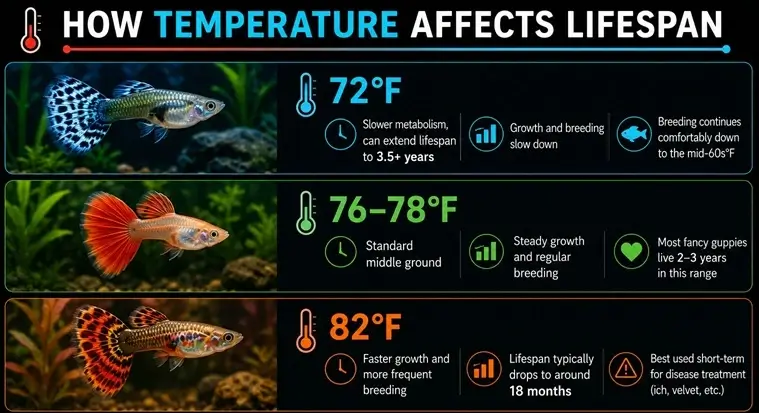
72°F: slower metabolism, can extend lifespan to 3.5 years or more. Growth and breeding both slow down, but breeding doesn’t stop, guppies will still breed comfortably down into the mid-60s°F, just less often and a bit more slowly than in warmer water.
76–78°F: the standard middle ground, where most fancy guppies land in the 2–3 year range, with steady, regular breeding.
82°F: faster growth and more frequent breeding, but lifespan typically drops to around 18 months if held there constantly. For a lot of keepers, this isn’t really a choice to begin with, it’s just the climate. In much of South Asia and similar tropical regions, room temperature naturally drifts through something close to this whole range across the year, roughly 75–78°F in winter and 80–82°F in summer, the same way our own comfortable range shifts with the seasons. There’s nothing wrong with a tank following that natural swing, slowly and without sudden jumps, rather than fighting it with a chiller to hold one number year-round.
Where 82°F genuinely earns a deliberate place, regardless of climate, is disease treatment. Raising the tank to that range on purpose for a few days is a real, useful tool against ich, velvet, and similar parasites, since the heat pushes them faster through the stage where medication can actually reach them. That’s a short-term, purposeful use of heat, not a lifestyle choice, and it’s a different thing entirely from running a tank warm year-round just to speed up breeding. See our temperature for guppies guide for the full safe range, heater guidance, and the disease-treatment protocol in more detail.
Why Some Strains Live Shorter Lives Than Others
Not every fancy guppy strain ages the same way. Two separate factors explain most of the difference:
➜ Heavy inbreeding. Strains that need intense, sustained inbreeding to lock in a specific color or fin trait pay for that consistency with reduced overall vigor, weaker immune systems, smaller batch sizes, and a shorter lifespan than a less intensively bred line. This is the same inbreeding depression mechanism covered in our guppy breeding guide. Refreshing a line with unrelated stock periodically is the standard fix, both for appearance and for the health cost that comes with breeding too narrowly.
➜ Large fins on males. Long, flowing fins and an elongated gonopodium increase drag in the water, making every burst of swimming, fleeing a startled moment, escaping a pushy tank mate, more energetically expensive than it is for a streamlined wild-type male. This is a real, physically measurable cost, not just a vague sense that “big fins seem risky.” In a home tank this doesn’t usually shorten lifespan the way genetics does, but it’s a real reason fancy males benefit from calmer tank mates and less crowded conditions than their size alone might suggest.
Do Males or Females Live Longer?
Males generally live longer than females in lifespan, mostly because of what females go through, not because of anything inherently weaker about them.
➜ Why females wear out faster. A female kept with males breeds continuously, and the physical strain of repeated pregnancy, along with the stress of being constantly pursued, takes a real toll over time.
➜ The fix. A female kept separately from males, or in a tank with a sensible male-to-female ratio so she isn’t constantly chased, will generally hold up better and live closer to a male’s lifespan. This is one of the more controllable factors on this list, stocking ratio is an easy lever to pull, and it’s worth reading our male vs. female guppy guide if you’re not yet confident telling the sexes apart to set that ratio correctly.
How to Maximize Your Fancy Guppy’s Lifespan
Most of what extends a fancy guppy’s life is the same as what extends any guppy’s life, just with a bit less margin for error given the genetics involved.
➜ Keep water parameters stable. Sudden swings in temperature, pH, or hardness are harder on a fancy guppy than on a hardier wild-type. See our guppy water parameters guide for the full targets.
➜ Feed a high-quality, varied diet. A fancy guppy’s color and fins both take real nutritional investment, and a poor diet shows up as reduced vigor over time, not just dull color. See our best guppy food guide.
➜ Avoid overcrowding. More fish means more competition, more waste, and more chronic stress, all of which shorten lifespan regardless of genetics.
➜ Choose tank mates carefully. Fin-nipping and chasing are a constant low-level stressor that a fancy guppy, with its slower swimming and large fins, is less equipped to escape than a wild-type would be.
➜ Quarantine new fish. A disease outbreak shortens lifespan a lot faster than slow aging does.
➜ Manage breeding pressure on females. A reasonable male-to-female ratio, or separating sexes entirely if you don’t want continuous breeding, protects females from the wear of repeated pregnancy.
➜ Be careful with live food. It’s a great occasional boost, but food sourced from unreliable places can introduce parasites or disease, and a single bad batch can trigger an outbreak that takes far more years off a fish’s life than the nutritional benefit ever added. A quality commercial diet as the daily staple, with live or frozen food added a few times a week rather than relied on as the main source, is the safer long-term approach.
Signs of Old Age vs Illness
It’s easy to mistake a guppy slowing down with age for a sick fish, and the two call for very different responses.
Normal aging looks like reduced activity, slightly duller color, and less interest in chasing or breeding, all happening gradually over weeks or months in a fish that’s otherwise eating and behaving normally.
Illness tends to show up faster and alongside other specific symptoms, clamped fins, visible spots or growths, rapid breathing, or a sudden, sharp drop in appetite. If a guppy declines quickly rather than gradually, or shows any of those specific signs, treat it as a health issue and check water parameters immediately rather than assuming it’s just old age. Our common guppy diseases guide covers full symptom identification.
Frequently Asked Questions
What is the average lifespan of a fancy guppy?
2 to 3 years for most fancy guppies kept in stable, well-maintained water.
Can a fancy guppy live 5 years?
It’s possible, but uncommon. 2 to 3 years is the realistic number most fancy guppies actually reach, even with good care.
Do all fancy guppy strains live the same length of time?
Not necessarily. Strains that need heavier inbreeding to keep a specific trait consistent tend to have reduced overall vigor, which can mean a shorter lifespan than a less intensively bred line.
Does temperature really affect how long a guppy lives?
Yes, directly. Cooler, stable water around 72°F can extend lifespan to 3.5 years or more, while consistently warm water around 82°F tends to shorten it to roughly 18 months.
Do female fancy guppies die younger than males?
Often, yes, mainly due to the physical toll of continuous pregnancy when kept with males. A well-managed male-to-female ratio reduces this gap significantly.
How do I know if my guppy is just old, or actually sick?
Old age is gradual, slower activity, duller color, less interest in breeding, with no other symptoms. Illness tends to come on faster and with specific signs like clamped fins or labored breathing. Check water parameters if anything changes suddenly.
Final Thoughts
A fancy guppy’s lifespan isn’t fixed, it’s the result of genetics you can’t fully control and care decisions you can. Stable, cooler water, a quality diet, careful tank mate choices, and a sensible breeding ratio for females all push the number toward the higher end of what’s realistic for the strain you’re keeping. For the full picture of fancy guppy care beyond lifespan, see our fancy guppy guide.