
Noticed tiny white spots on your guppies? Ich can spread rapidly, but early treatment can help your guppies recover. Guppy ich, also known as white spot disease or ick, is a highly contagious parasitic disease that affects guppies and other freshwater fish.
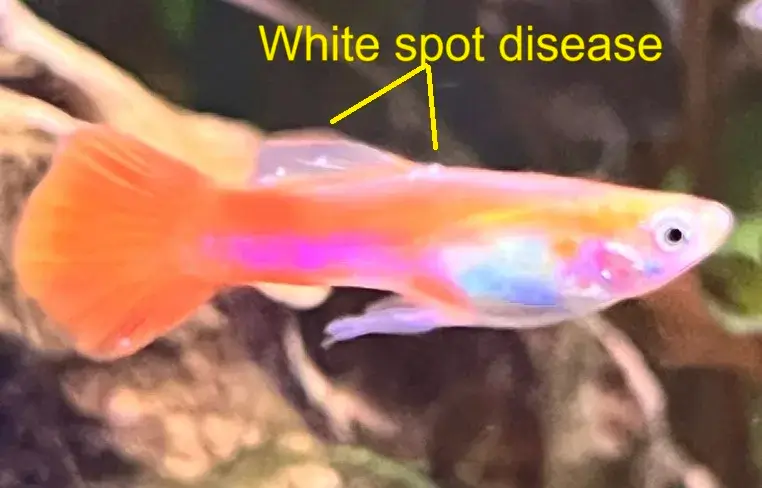
Guppies with ich develop tiny white spots on their body and fins that resemble grains of salt. The parasite infects the skin, fins and gills. Infected guppies may also rub against aquarium decorations, breathe rapidly and become less active.
Quick Navigation
1) Guppy Ich: Quick Facts
2) What Is Ich in Guppies?
3) Guppy Ich Symptoms
4) Understanding the Ich Parasite Life Cycle
5) Ich vs Other White Spots on Guppies
6) Guppy Ich Treatment
7) What Causes Ich in Guppies?
8) How Long Does Guppy Ich Take to Heal?
9) How to Prevent Ich in Guppies
10) Frequently Asked Questions
1) Guppy Ich: Quick Facts
| Feature | Details |
|---|---|
| Disease type | Parasitic infection |
| Common names | Ich, ick, white spot disease |
| Causative parasite | Ichthyophthirius multifiliis |
| Affected areas | Skin, fins and gills |
| Contagious | Yes, highly contagious |
| Common symptoms | Salt-like white spots, scratching and rapid breathing |
| Main treatment | Anti-ich medication or appropriate salt treatment |
| Treatment area | All exposed fish and the affected aquarium |
| Treatment duration | Depends on medication and water temperature |
| Recovery | Good when identified and treated early |
2) What Is Ich in Guppies?
Ich is caused by a microscopic parasite called Ichthyophthirius multifiliis. The parasite burrows into the surface tissues of the guppy’s skin, fins and gills, where it feeds and grows.
During the feeding stage, the parasite and the surrounding tissue reaction produce tiny white spots that resemble grains of salt. These spots are generally 1 mm or smaller and may initially appear on the fins before spreading throughout the body.
What makes ich particularly dangerous is how quickly it spreads. Once mature, the parasite leaves the fish, settles on the aquarium surfaces and forms a protective cyst. It then multiplies, releasing hundreds of free-swimming parasites that seek new hosts. An infection affecting one or two fish can spread throughout the aquarium within days.
Ich becomes particularly dangerous when it affects the gills, damaging the tissue and reducing the fish’s ability to absorb oxygen. Guppies with gill infections may experience breathing difficulties even before visible white spots appear on their bodies.
3) Guppy Ich Symptoms
The most recognizable symptom of ich is the appearance of small white spots scattered across the guppy’s body and fins. However, behavioral changes may occur before these spots become visible.
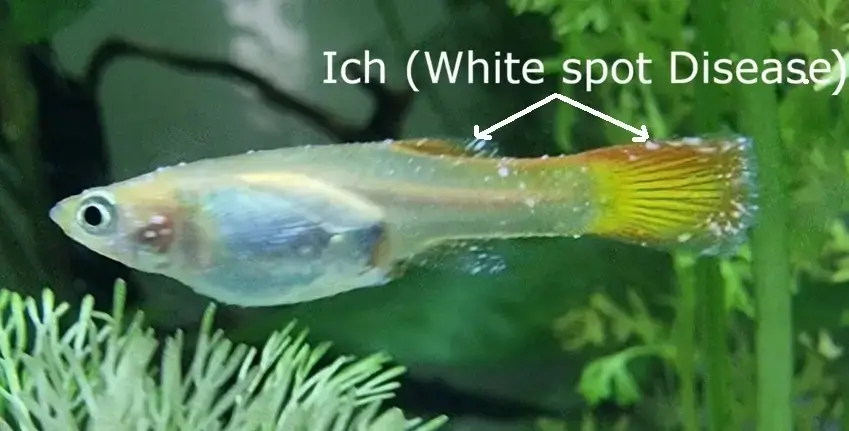
Common symptoms include:
- Tiny white spots on the body and fins resembling grains of salt.
- Fish scratching against aquarium decorations, plants and substrate.
- Sudden darting movements due to skin irritation.
- Rapid breathing or gasping at the water surface.
- Excess mucus production on the skin.
- Clamped fins.
- Hiding and reduced swimming activity.
- Loss of appetite.
- Lethargy and weakness.
The scratching behavior of the fish, known as flashing, occurs when the parasites irritate the skin and gills of the fish. As the infection progresses, more and more white spots may appear across the body of the fish.
4) Understanding the Ich Parasite Life Cycle
Understanding the life cycle of ich is essential for successful treatment. Most anti-ich medications are effective against the free-swimming parasites rather than those protected within the fish’s tissues or reproductive cysts.
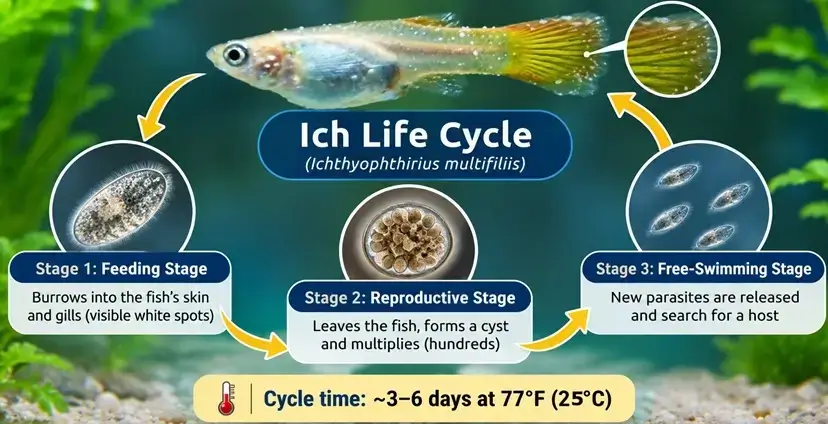
The ich parasite goes through three main stages.
Stage 1: Feeding Stage
The parasite burrows into the surface tissues of the fish, where it feeds and grows. This is the stage responsible for the visible white spots on guppies.
During this stage, the parasite is protected by the fish’s tissue and is generally resistant to aquarium medications.
Stage 2: Reproductive Stage
Once the parasite matures, it leaves the fish and settles on the aquarium surfaces. It forms a protective cyst and divides repeatedly, producing hundreds of new parasites.
The disappearance of white spots during this stage may give fishkeepers the false impression that their guppies are recovering.
Stage 3: Free-Swimming Stage
The reproductive cyst releases newly developed parasites into the aquarium. These parasites actively search for a fish to infect. If they manage to find a host, the life cycle begins again.
Water temperature influences how quickly the parasite completes its life cycle. At around 77°F (25°C), the cycle may take approximately 3–6 days, while cooler temperatures can prolong it.
5) Ich vs Other White Spots on Guppies
Not all white spots on guppies are caused by ich. Several parasitic, bacterial and fungal conditions can produce similar symptoms.
| Disease | Appearance |
|---|---|
| Ich | Small, distinct white spots resembling grains of salt |
| Velvet disease | Fine golden, yellow or rust-colored dust |
| Epistylis | White or gray growths that may appear raised or irregular |
| Columnaris | Irregular white or gray patches, often around the mouth, back and fins |
| Fungal infection | Fluffy, cotton wool-like growth |
| Lymphocystis | Larger, irregular, wart-like or cauliflower-like growths |
Important: Ich and Epistylis can look similar, but raising the water temperature may worsen Epistylis-associated bacterial infections. Confirm the diagnosis before increasing the temperature.
Correct diagnosis of disease is important and if the diagnosis is uncertain, microscopic examination may be necessary.
6) Guppy Ich Treatment
Successful treatment involves eliminating the free-swimming parasites, maintaining good water quality and preventing reinfection throughout the parasite’s life cycle.
Step 1: Confirm the Diagnosis
Examine the guppy’s body and fins for small, distinct white spots resembling grains of salt.
Look for additional symptoms such as scratching, clamped fins, rapid breathing and reduced activity.
Seek advice from an aquatic veterinarian if the diagnosis is uncertain or if the fish is gasping severely.
Step 2: Test and Improve Water Quality
Test the aquarium water and correct any water quality problems before beginning treatment.
Ammonia: 0 ppm
Nitrite: 0 ppm
Nitrate: Ideally below 20 ppm
pH: Stable and within the recommended range for guppies.
Perform a water change using dechlorinated, temperature-matched water. Gently vacuum the substrate to remove accumulated waste and some of the reproductive cysts.
Step 3: Treat All Exposed Fish
When ich is identified in an aquarium, assume that the other fish have also been exposed to the parasite.
Treat the affected aquarium with a suitable medication if it is safe for all the species.
If the medication is unsuitable for the aquarium’s plants, shrimp or snails, move all exposed fish to a suitable treatment tank.
Step 4: Raise the Water Temperature and Increase Aeration
Gradually raise the aquarium temperature to 82–84°F (28–29°C), provided the medication instructions allow it and the aquarium inhabitants can tolerate it. Avoid raising the temperature above 84°F (29°C).
Warmer water accelerates the ich parasite’s life cycle, allowing the parasites to reach their vulnerable free-swimming stage sooner.
Increase aeration using an air stone and improve surface agitation before raising the temperature since warm water holds less oxygen.
Step 5: Choose an Ich Treatment Method
Guppy ich can be treated using anti-ich medication or aquarium salt. The choice of treatment depends on the severity of the infection and the tolerance to each treatment method by the aquarium inhabitants.
Option 1: Anti-Ich Medication (Recommended)
Use medication specifically formulated to treat freshwater white spot disease. This is generally the preferred treatment method, particularly for established or severe ich infections.
Common treatment ingredients include:
| Medication | Use in Ich Treatment |
|---|---|
| Malachite green | Commonly used against external protozoan parasites, including ich |
| Formalin | Used to control susceptible free-living stages of external parasites |
| Malachite green and formalin combination | Widely used in commercial freshwater ich medications |
| Copper-based medication | Can treat ich but requires careful monitoring of copper levels and water chemistry |
- Remove activated carbon from the filter before dosing, as it can absorb certain medications and reduce their effectiveness. Keep biological filtration and aeration running.
- Malachite green, formalin, and copper can be fatal to snails, shrimp, and certain tankmates (like plecos or loaches). Check the manufacturer’s instructions before treating a community aquarium.
- Commercially available medications for freshwater ich include Hikari Ich-X and API Super Ick Cure. Both Hikari Ich-X and API Super Ick Cure specifically recommend removing activated carbon.
- These products have different dosing schedules and treatment durations. Always follow the instructions provided with the specific medication.
Option 2: Aquarium Salt (Alternative Treatment)
- Aquarium salt can be used as an alternative to anti-ich medication, particularly in guppy-only aquariums or tanks containing salt-tolerant fish.
- Unlike the low concentrations of salt used for general supportive care, effective salt treatment for ich requires a sufficiently high concentration.
- Veterinary guidance recommends a salt concentration of 5 grams per liter (approximately 19 grams per US gallon) for seven days at a water temperature of 75°F (24°C) or higher, provided the fish can tolerate the increased salinity.
- Guppies generally tolerate salt better than many freshwater fish. However, this treatment concentration may be unsuitable for certain tank mates, live plants, shrimp and snails.
- Dissolve the aquarium salt in water and introduce it gradually. Measure the salt by weight rather than using teaspoons, as the weight varies with crystal size.
- Before using therapeutic salt concentrations in a community aquarium, ensure that all tank inhabitants can tolerate the recommended salinity.
Step 6: Can You Combine Aquarium Salt and Anti-Ich Medication?
Aquarium salt and anti-ich medication are generally used as separate treatment methods, as either approach may be effective on its own.
In severe cases of ich, a combination of aquarium salt and anti-ich medication may be considered, provided the manufacturer’s instructions explicitly allow their combined use and all tank inhabitants can tolerate the treatment.
Combining treatments unnecessarily may increase stress on infected fish. If you are unsure about medication compatibility or the appropriate salt concentration, consult an aquatic veterinarian before combining treatments.
Step 7: Complete the Treatment Course
Ich treatment may take 7–14 days, depending on the water temperature and severity of the infection.
Do not stop treatment as soon as the last visible white spot disappears. Reproductive cysts may still be present in the aquarium, releasing new parasites.
Continue treatment for the recommended period after all visible signs disappear. For example, Hikari Ich-X recommends three additional days of treatment. Follow the medication manufacturer’s dosage, water change schedule and treatment duration to prevent reinfection.
Once treatment is complete, gradually return the aquarium temperature to its normal range of 75–79°F (24–26°C) and add the activated carbon back to the filter.
Step 8: Monitor Recovery
Signs that guppies are responding to ich treatment include:
- No new white spots developing.
- Existing white spots gradually disappearing.
- Reduced scratching and rubbing.
- Breathing returning to normal.
- Improved appetite.
- Increased swimming activity.
Continue monitoring your guppies after treatment, as damage caused by the parasite can lead to secondary bacterial or fungal infections.
If the infection continues to worsen despite correct treatment, seek aquatic veterinary advice and reconsider the diagnosis before switching medications.
7) What Causes Ich in Guppies?
Ich occurs when the parasite Ichthyophthirius multifiliis is introduced into the aquarium. The parasite may already be present in the aquarium. Poor water quality, sudden temperature changes and stress can weaken the guppy’s immune system, increasing its susceptibility to infection.
Common causes and contributing factors include:
Introducing infected fish: Adding a new fish without quarantine is a common way for ich to enter an aquarium.
Sudden temperature changes: Rapid temperature changes during water changes, transportation or heater failure can stress guppies.
Poor water quality: High ammonia, nitrite and accumulated organic waste weaken the fish’s natural defenses.
Overcrowding: High stocking densities increase stress and allow parasites to find new hosts easily.
Contaminated aquarium equipment: Nets, siphons and containers used in infected aquariums can transfer the parasite.
Contaminated plants and decorations: Plants, gravel and decorations transferred from infected aquariums may carry reproductive cysts.
Poor nutrition: An unbalanced diet can weaken the guppy’s immune response.
8) How Long Does Guppy Ich Take to Heal?
With appropriate treatment, ich can be controlled within approximately 7–14 days, although some cases require a longer treatment period.
Recovery time depends on:
- The severity of the infection.
- Water temperature.
- The medication being used.
- The extent of skin and gill damage.
- The overall health of the guppy.
The disappearance of white spots does not confirm that the aquarium is free of ich. Always complete the recommended treatment course.
Skin and fin damage may take longer to heal, even after the parasite has been eliminated.
9) How to Prevent Ich in Guppies
Preventing the introduction of the parasite and maintaining a healthy aquarium are key to reducing the risk of ich.
- Quarantine new fish for at least 2 weeks.
- Avoid sudden water temperature changes.
- Maintain good water quality.
- Avoid overcrowding.
- Avoid adding fish store water to the aquarium.
- Quarantine new plants from tanks containing fish.
- Disinfect contaminated aquarium equipment.
- Provide a nutritious, balanced diet.
These practices also help reduce the risk of other common guppy diseases.
10) Frequently Asked Questions
Can guppy ich go away on its own?
No. Although the white spots may disappear as mature parasites leave the fish, the infection is not gone. The parasites multiply in the aquarium and release hundreds of new parasites that can reinfect the fish. Without proper treatment, ich can spread rapidly and become fatal.
Is ich contagious to other fish?
Yes. Ich is highly contagious and can infect nearly all species of freshwater fish. An infected guppy can spread the parasite to other fish in the aquarium within a few days.
How long does ich take to kill a guppy?
Severe ich infections can kill guppies within a few days, particularly when the parasites damage the gills. Survival depends on the severity of the infection and the guppy’s overall health.
Can ich affect guppy fry?
Yes. Guppy fry are susceptible to ich and can deteriorate rapidly during severe infections. Use medication that is suitable for fry, maintain good water quality and provide adequate aeration.
Can ich survive in an aquarium without fish?
Ich requires a living fish to complete its life cycle. At tropical water temperatures of 75–79°F (24–26°C), leaving the aquarium completely fishless for approximately one to two weeks ensures all free-swimming parasites die off before adding new fish.
Can humans get ich from guppies?
No. The ich parasite does not infect humans. However, contaminated hands and aquarium equipment can transfer the parasite between aquariums.
Can guppies develop ich more than once?
Yes. Although guppies that recover from ich may develop some immunity, they are not guaranteed lifelong protection. Reinfection can occur following exposure to the parasite.