
The Thai Oranda Goldfish is one of the most stunning and exotic members of the fancy goldfish family. Known for its wen, round body, and flowing fins, this variety has been selectively bred in Thailand for superior color, size, and overall quality. Thai breeders keep producing new varieties as well, giving each one its own name once it becomes popular enough in the hobby.
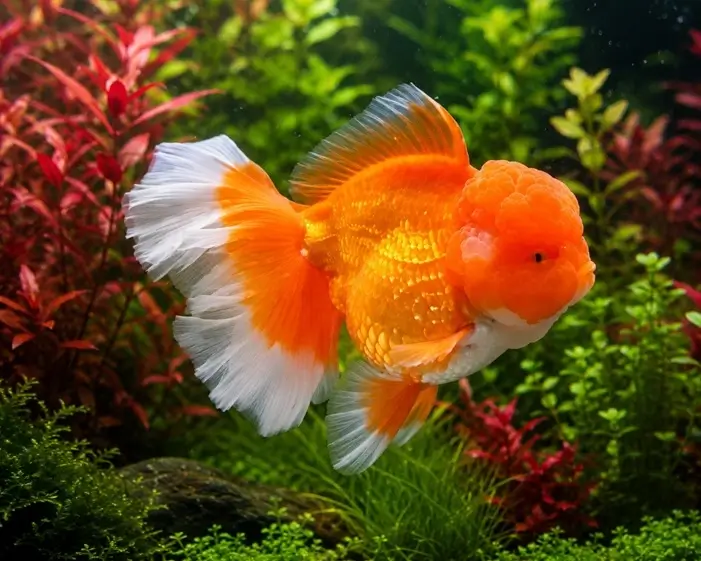
Unlike standard Orandas, Thailand Orandas are admired for their refined features, vibrant color patterns, and their graceful swimming style. Their personalities are highly appealing. They are peaceful, playful, and almost look “puppy-like” in how they interact with humans. If cared for properly, Thai Orandas can become the centerpiece of your aquarium for 10–15 years, and in some cases, they may even live up to 20 years.
Quick Navigation
➜ What Makes Thailand Orandas Special?
➜ Popular Types of Thailand Oranda Goldfish
➜ Based on Color and Variety:
➜ Black Thai Oranda
➜ Red and Black Thai Oranda
➜ Panda Thai Oranda
➜ Tri-Color Thai Oranda
➜ Apache Thai Oranda
➜ Red Cap Thai Oranda
➜ Calico Thai Oranda
➜ Red Cap Black Body Oranda
➜ Tiger Oranda
➜ Based on Tail and Fin Types:
➜ Thai Long-Tail Oranda
➜ Thai Short-Tail Oranda
➜ Rosetail Oranda
➜ Based on Overall Body Size:
➜ Small Breed Thai Oranda
➜ Medium Breed Thai Oranda
➜ Standard/Large Thai Oranda
➜ Giant/Jumbo Oranda
➜ Why Thai Oranda Goldfish Are Expensive
➜ Thai Oranda vs Chinese Oranda
➜ Thai Oranda Care Guide
➜ Life Span & Size of Thai Oranda Goldfish
➜ Breeding Thai Oranda Goldfish
➜ Choosing and Buying a Thai Oranda
➜ FAQs on Thai Orandas
➜ Final Thoughts
What Makes Thailand Orandas Special?
Exquisite Colors: Thailand Oranda Goldfish are available in red, orange, black, white, panda patterns, and even tri-color combinations.
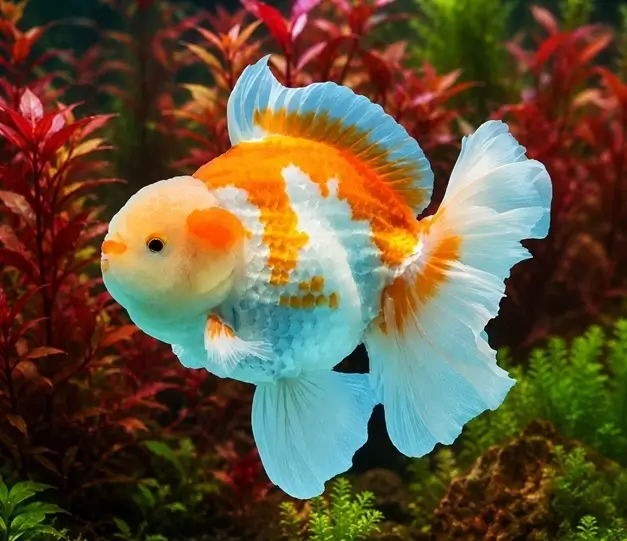
• Flowing Fins: Their split tails and long dorsal fins create a flowing, elegant movement.
• Wen Development: The wen is often larger and more refined than in regular Orandas.
• Size: The adults grow 8–12 inches, with jumbo varieties exceeding this size.
• Personality: Gentle, curious, and perfect for community tanks with other fancy goldfish.
Popular Types of Thailand Oranda Goldfish
New Thai Oranda Goldfish names keep showing up as specific color combinations or body types gain popularity in the hobby, so this list isn’t a fixed, official catalog. It reflects what breeders and sellers are actively naming and offering right now.
Broadly, these types fall into three categories:
1) Color and pattern
2) Tail and fin shape
3) Overall body size
1) Color and Pattern Varieties:
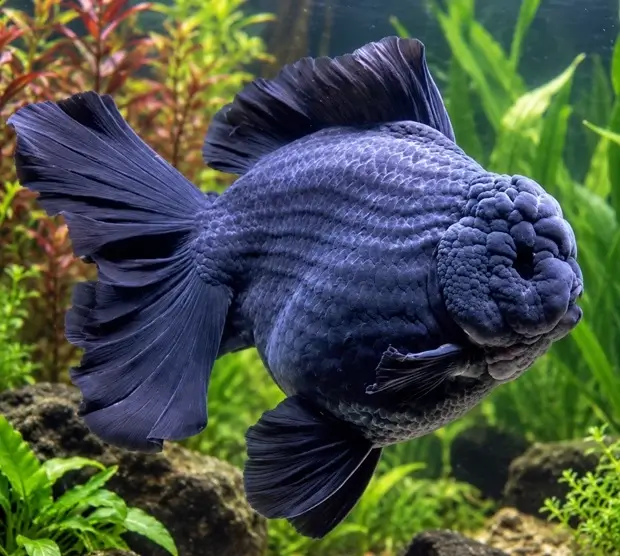
Black Thai Oranda
Black Thai Oranda is a type of Oranda goldfish known for its large jet black body, big head growth, and flowing long tails. They are one of the most popular Black Oranda goldfish varieties, prized for their striking appearance and large size.
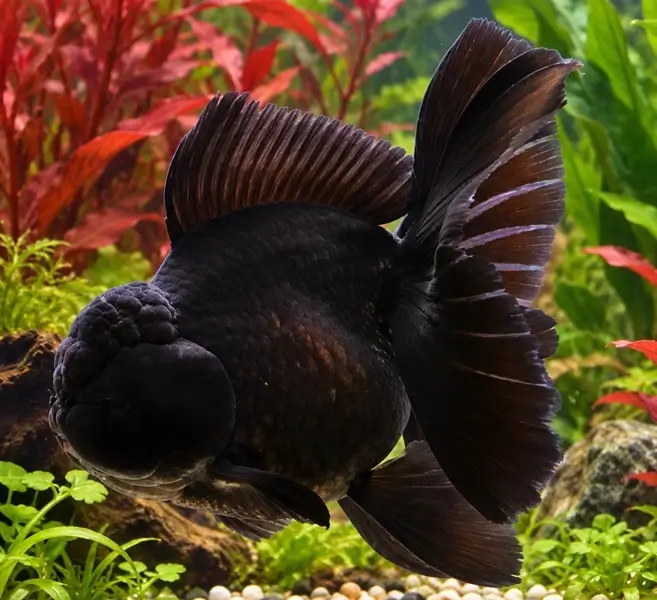
Black Thai Oranda can grow up to 12 inches long if kept in a large aquarium tank and has a lifespan of 10-15 years if proper care is taken.
Red and Black Thai Oranda
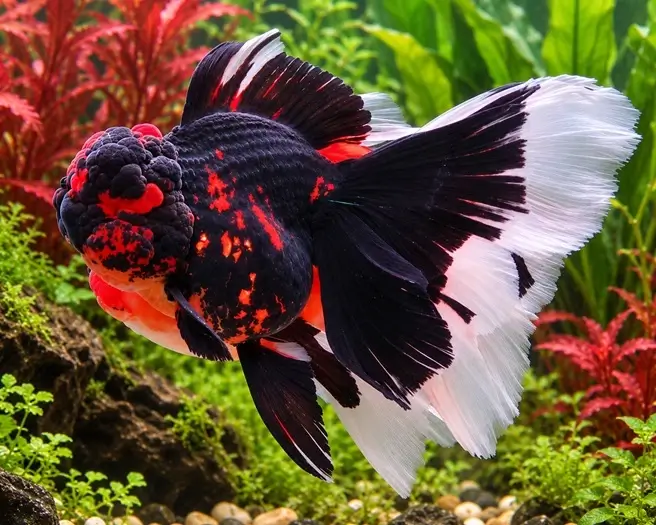
The Red and Black Thai Oranda is a stunning variety of Thai Oranda goldfish known for its elegant black body with vibrant red accents, which gives it a beautiful appearance and makes it more popular among goldfish enthusiasts.
Panda Thai Oranda
The Panda Thai Oranda is a beautiful and unique variety of Thai Oranda goldfish. It is characterized by its black-and-white coloration, which resembles a panda bear.
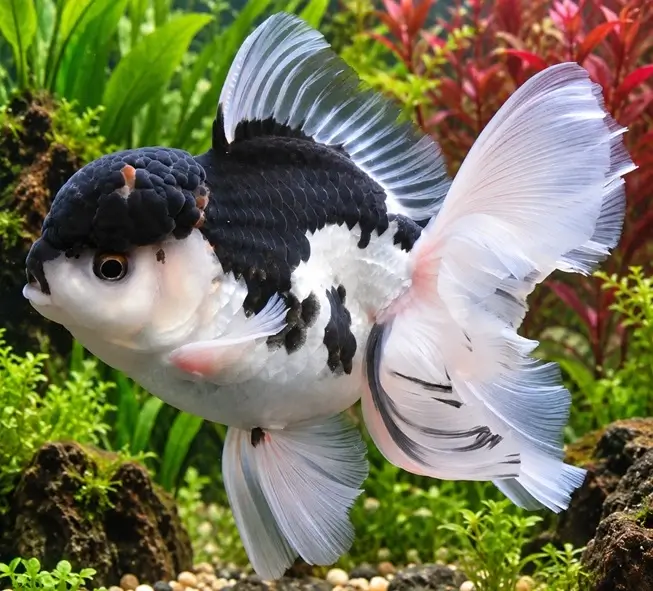
Panda Thai Orandas have a round body with a large, fluffy head growth. The head can be solid black, solid white, or a combination of both colors. The tail fin is fan-shaped and can be either black or white. Panda Thai Orandas are peaceful community fish and are often highly priced for their beauty.
Tri-Color Thai Oranda
Tri-color Thai Oranda goldfish are a beautiful variety of Thai Oranda characterized by their three distinct color patterns.
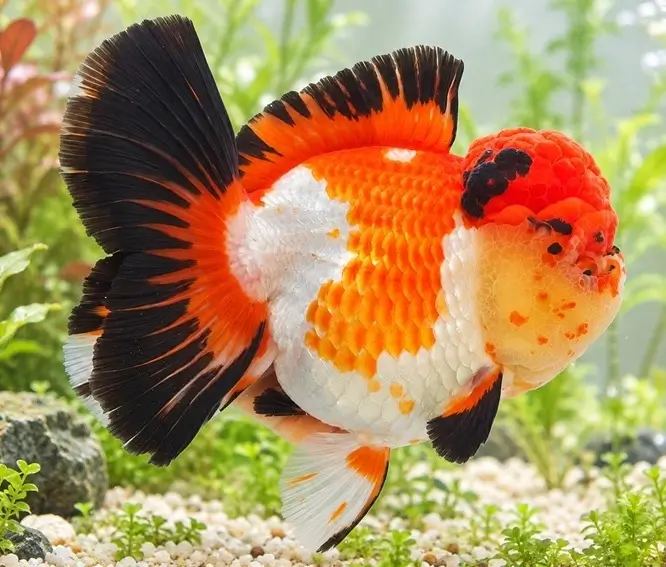
They typically display a combination of red, white, and black colors, creating an eye-catching appearance. Their coloration and head growth make them highly sought after among goldfish enthusiasts.
Apache Thai Oranda
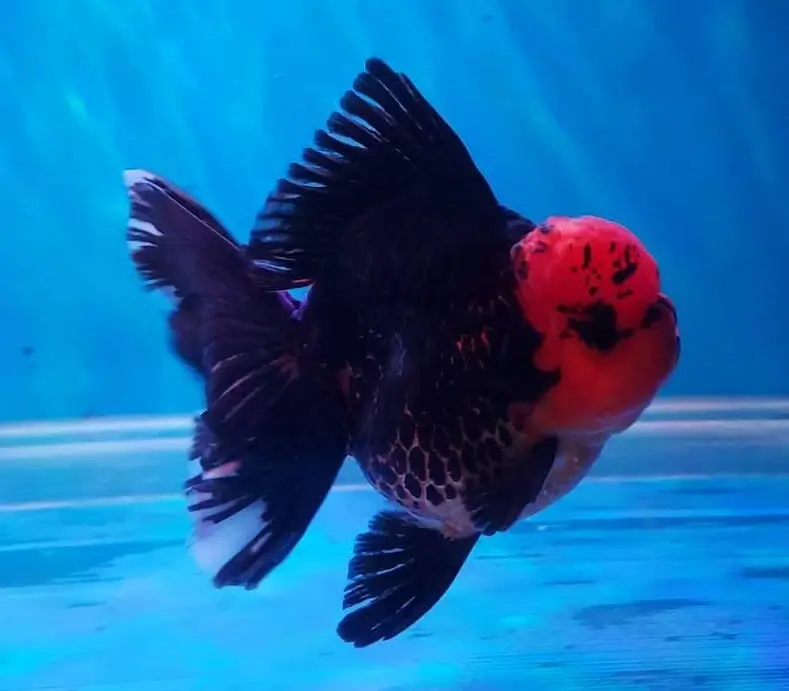
The Apache Thai Oranda fish is a variety of the Oranda goldfish, known for its vibrant red and black coloration. These fish are bred in Thailand, and their unique appearance and swimming style make them a beautiful addition to any goldfish tank.
Red Cap Thai Oranda
A white metallic body with a distinct, red wen isolated on top of the head, one of the most recognizable Oranda patterns.
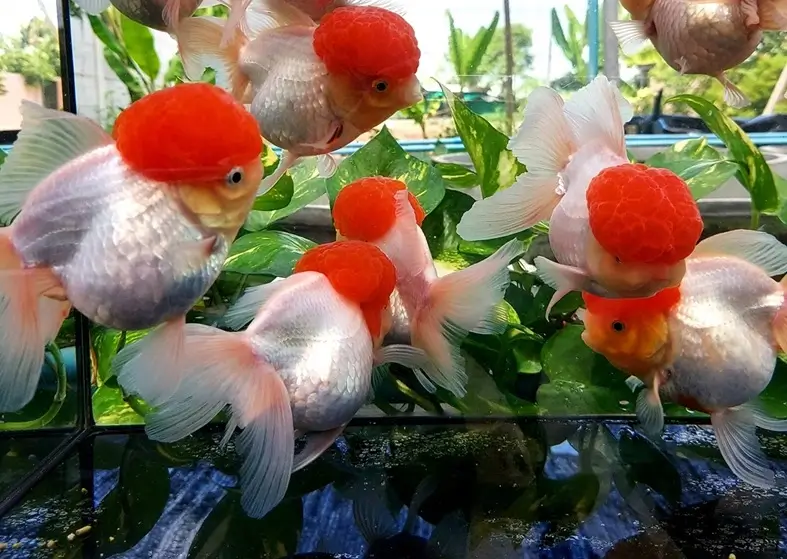
Thai-bred Red Caps are especially prized for how clean the contrast is between the pure white body and the wen, with little to no red bleeding onto the body, along with the larger, more rounded wen typical of Thai breeding lines. See our full Red Cap Oranda guide for more detail on care, wen development, and pricing.
Calico Thai Oranda
A mix of red, orange, black, and white speckled across the body, with no two fish sharing quite the same pattern. The speckling tends to shift and rearrange somewhat as the fish matures.
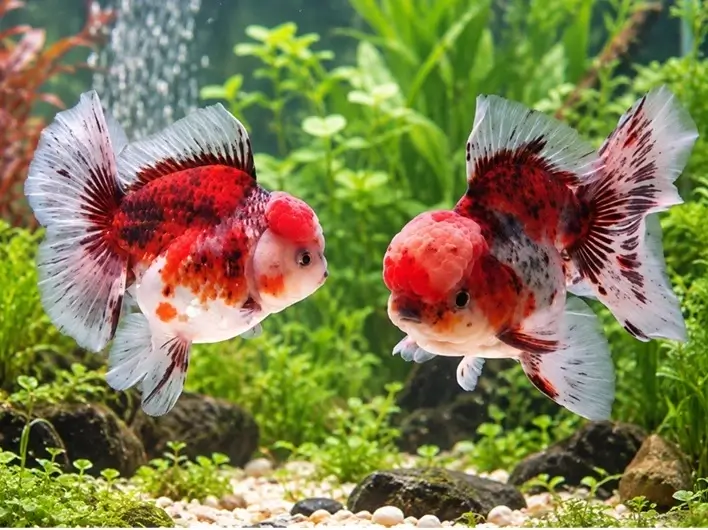
So a young calico oranda pattern isn’t necessarily a preview of how it will look as an adult. This is a trait calico orandas shares with other calico-patterned goldfish varieties generally, not something unique to Thai Orandas specifically.
Red Cap Black Body Oranda
This variety reverses the usual Red Cap pattern, pairing a fully black body with the same isolated bright red wen on top of the head. It’s a distinct and recognized Oranda pattern in its own right rather than a variation of the standard white-bodied Red Cap. The contrast between the black body and red wen tends to stand out even more sharply than on a white-bodied Red Cap, since there is no white base color to soften the transition between the two.
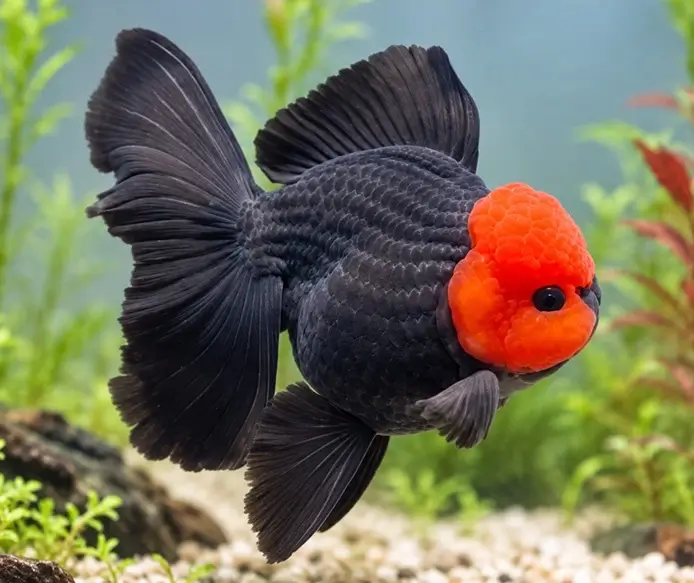
As with Black Oranda generally, the black coloring can occasionally develop patches of orange or red on the body over time, which is a normal color shift rather than a flaw.
Tiger Oranda
With bold red and black striping across the body, resembling a tiger’s pattern, which tends to become more pronounced as the fish matures. The striping sets it apart from Apache Oranda, which shares the same red-and-black color combination but shows up as blockier patches rather than defined stripes.
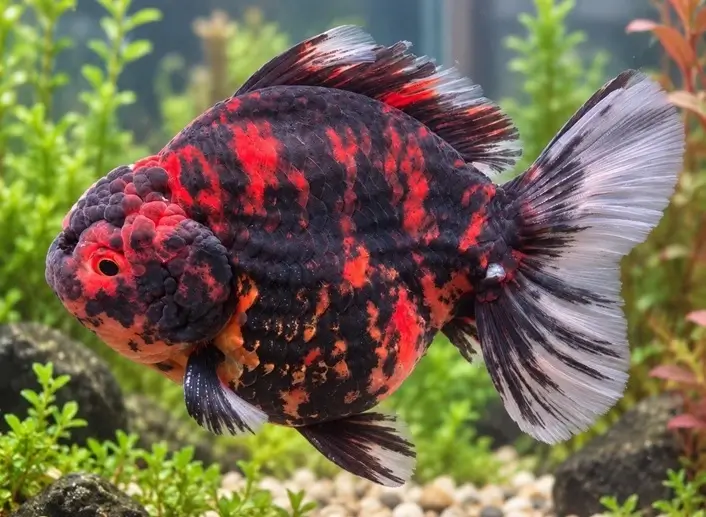
As with most striped or patterned goldfish, no two Tiger Orandas end up with quite the same stripe layout, so each fish is genuinely one of a kind.
2) Tail and Fin Types:
Beyond color, Thai Orandas can also be classified by their tail and fin shape, since Thai breeding programs have pushed finnage in a few distinct directions.
Thai Long-Tail Oranda
They have a wide, flowing tail with two broad lobes that stay spread out rather than coming to a point, moving gracefully as the fish swims.
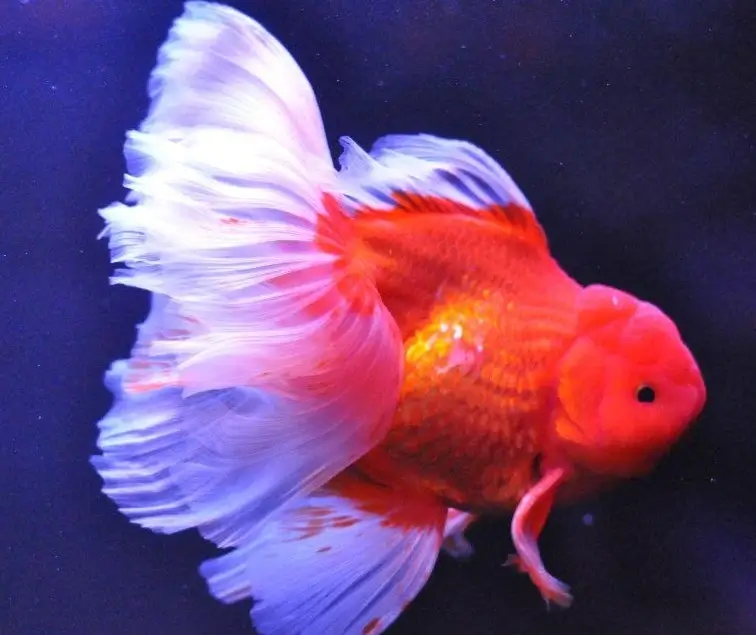
The large fins underneath also help keep the fish balanced, since carrying that much tail can make swimming trickier without them.
Thai Short-Tail Oranda
They have a shorter, stiffer tail paired with a compact, muscular body, giving these fish a more upright, controlled swimming style than the flowing Long-Tail type.
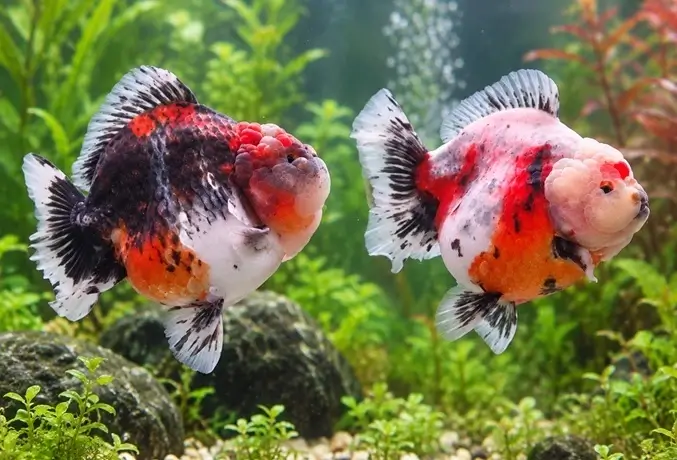
Breeders raising this variety often focus more heavily on cheek and face wen growth, so a well-bred Short-Tail can end up with an even bigger head growth than its Long-Tail counterpart.
Rosetail Oranda
Thai Rosetail Orandas have a tail with tightly ruffled, overlapping layers that resemble the petals of a rose, instead of flowing out in one smooth spread like the Long-Tail type.
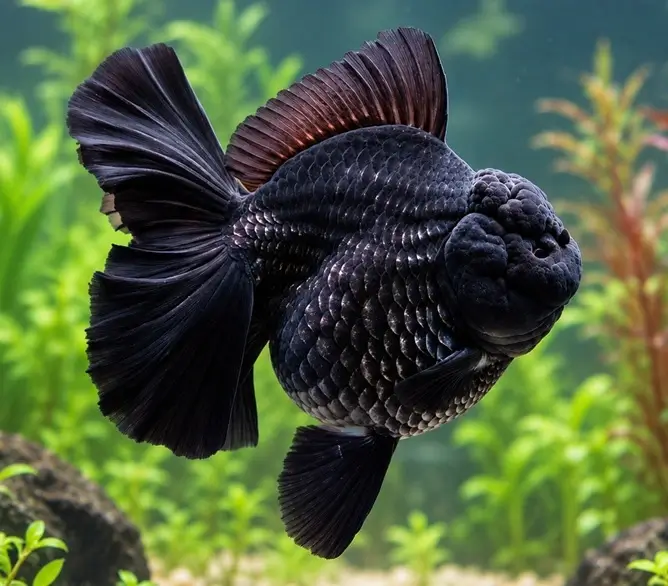
On a well-bred fish, this ruffling can grow dense enough to spread across the fish’s entire rear end. The tighter, more compact shape does mean less mobility than a flowing tail, so a Rosetail Oranda tends to swim a bit slower and more deliberately than its Long-Tail counterpart.
3) Overall Body Size:
Beyond color and tail shape, breeders also raise Thai Orandas to fit specific size classes, mainly to suit different tank sizes buyers are working with.
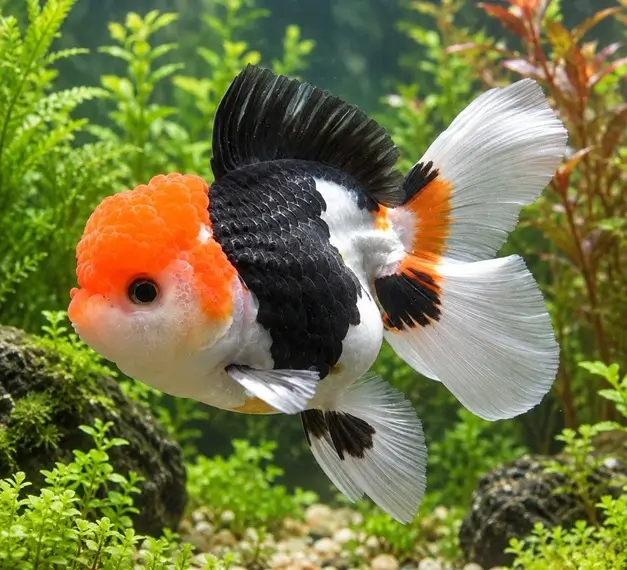
Small Breed Thai Oranda
This breed is capped around 2.5 to 3.5 inches as an adult, bred to keep the same round body and well-developed wen as larger varieties, just at a size that suits a smaller tank.
Medium Breed Thai Oranda
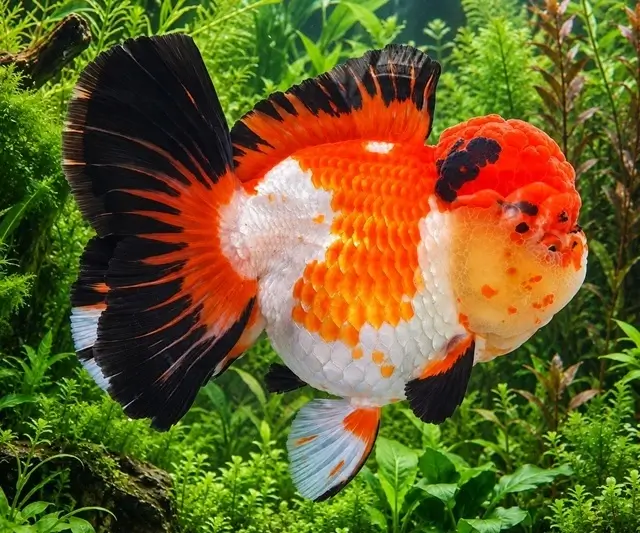
The medium breed is capped around 4 to 4.5 inches, sitting between the small and standard/large classes.
Standard/Large Thai Oranda
These are bred for maximum growth rather than a fixed ceiling, commonly reaching 6 to 8 inches and sometimes 10 to 12 inches or more with excellent care. See the Life Span & Size section below for the full growth breakdown.
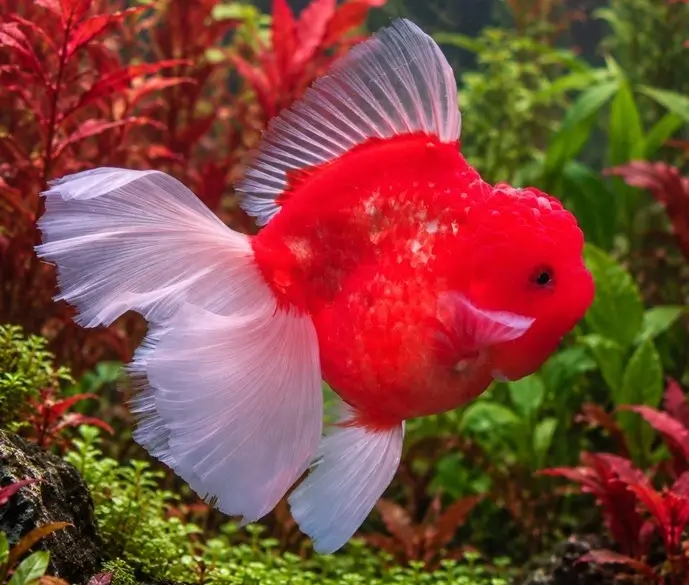
Giant/Jumbo Oranda
Some breeders push size even further, offering fish bred specifically to reach 5.5 to 7 inches or more while still juveniles, aimed at buyers wanting the largest possible adult size. Jumbo Orandas can reach around 12 inches or more including the tail.
Why Thai Oranda Goldfish Are Expensive
Thai Oranda goldfish are considered premium fancy goldfish in the hobby, and their higher price is mainly due to selective breeding and strict quality standards. Breeders in Thailand carefully develop fish with large, symmetrical wen (head growth), strong and round body structure, and vibrant coloration. Another key factor is the low selection rate. Out of hundreds of juvenile fish, only a small percentage are selected to be sold as export quality. This makes high-grade Thai Orandas relatively rare. In addition, international shipping, quarantine, and handling costs increase the final price, especially in countries like the United States. As a result, Thai Orandas are often priced significantly higher than locally bred varieties.
Thai Oranda vs. Chinese Oranda (Standard Oranda)
While Thai and Chinese Orandas belong to the same species, the difference lies in breeding quality, not genetics. Thai Orandas are selectively bred in Thailand for superior size, color, and wen development. They’re known for a well-developed wen, a balanced round body shape, and consistent breeding standards, since they’re typically bred specifically for export and considered premium-grade fish. Chinese Orandas (sometimes just called “Standard Oranda”) originated in China and are more widely available and often more affordable. While some high-quality specimens exist, they generally have less pronounced wen growth and more variation in body structure, and quality can vary widely from one fish to the next.
Quick Comparison:
| Trait | Thai Oranda | Chinese Oranda |
|---|---|---|
| Wen | Large, structured | Smaller |
| Body | Round, premium | Less defined |
| Price | High | Moderate |
| Quality | Export-grade | Mixed |
If you are looking for show-quality fish, Thai Oranda is usually the preferred choice. In short, Thai Oranda goldfish are a premium version of Oranda Goldfish.
Thai Oranda Care Guide
Thai Orandas need more attention to tank size, water quality, and diet than a common goldfish, mostly because of their compact body shape, prized wen, and bright colors.
Tank Setup
• Minimum tank size: 30 gallons for one fish, 50+ gallons if keeping them in groups
• Filtration: an external canister filter for large tanks, plus air stones or gentle bubblers to maintain oxygen levels. Avoid strong water currents, since Orandas aren’t powerful swimmers
• Substrate: smooth gravel or sand, which passes through safely if the fish happens to ingest some while foraging
• Decor: soft plants and open, wide swimming space rather than dense or sharp decorations
Water Parameters
• Temperature: 70–82°F (21–28°C)
• pH: 6.8–7.8
• Hardness: 5–19 dGH
• Ammonia & Nitrite: as close to 0 ppm as possible
• Nitrate: below 20 ppm
Diet & Feeding
Thai Orandas are omnivores and do best on a varied diet.
• Staple food: high-quality, slow-sinking goldfish pellets
• Vegetables occasionally: shelled peas, spinach, lettuce, zucchini
• Occasional treats: bloodworms, brine shrimp, daphnia
• Feeding routine: 2 to 3 small meals a day, only what they can finish in about 5 minutes, since overfeeding contributes to both swim bladder problems and water pollution
• For wen growth specifically: a protein-rich diet supports healthy wen development. Bloodworms, brine shrimp, and daphnia, alongside pellets formulated for head growth, are commonly used, though overfeeding for the sake of wen growth causes the same water-quality problems as overfeeding generally
Tank Mates
• Best matches: other soft, slow-moving fancy goldfish like Ranchu, Lionhead, Ryukin, and Black Moor
• Avoid: fast swimmers and aggressive fish like cichlids, or fin-nippers that will stress the Oranda by constantly nipping at its fins
Common Health Issues
• Swim bladder disorder: often caused by overfeeding, usually resolved by feeding digestible foods like peas and sometimes a short fast
• Ich (white spot disease): tied to stress and water quality; treat early with aquarium salt or medication
• Fin rot: caused by poor water quality; treat with clean water and medication
• Bacterial and fungal infections: more common in Orandas due to the wen’s structure trapping debris; keeping water clean is the main prevention
Read our Goldfish Diseases guide to learn more about goldfish diseases in depth.
Life Span & Size of Thai Oranda Goldfish
With proper care, Thailand Orandas can live 10–15 years, and some exceptional ones may exceed 20 years. Tank size, water quality, and diet all play a role in how close a fish gets to that upper range, covered in full in the Care Guide above.
Thai Oranda goldfish size depends heavily on which breed classification you are starting with. Standard and large varieties are the ones that reach 6 to 12 inches (15–30 cm), including the tail, while small and medium breeds are raised specifically to stay well under that range, so it’s worth knowing which type you have before expecting a particular size.
For standard and large varieties, most reach around 6 to 8 inches in a typical home aquarium, but with proper care and high-quality feeding, they can grow much larger. Under ideal conditions, it is possible for them to reach 10 to 12 inches, especially in spacious tanks or pond setups. From personal experience, I have raised Thai Oranda goldfish that grew to approximately 10–12 inches, which is considered a large and healthy size for this variety.
Growth depends on several key factors, including tank size, water quality, diet, and genetics. Providing a spacious environment, maintaining clean water, and feeding nutrient-rich food helps maximize their growth potential, though a small or medium breed fish won’t exceed its capped size regardless of care, since that limit comes from its genetics, not the environment.
Breeding Thai Oranda Goldfish
Breeding Thai Orandas can be rewarding but requires planning.
Steps for Breeding
1. Select healthy adult pairs (1 year+).
2. Increase tank temperature gradually from 25°C to 28°C to mimic spring.
3. Provide spawning mops/plants for eggs to stick to, which helps encourage the female Thai Oranda to lay her eggs.
4. Females can lay up to 1,000 eggs over a day or two.
5. Remove parents after spawning to prevent them from eating the eggs.
6. Eggs hatch in 2–4 days; fry swim freely after 5–7 days.
7. Feed fry with baby brine shrimp or powdered food.
Choosing and Buying a Thai Oranda
Thai Oranda goldfish are priced between $50 and $300 on average, with premium and show-quality fish reaching $300 to $500 or more. Smaller 2-3 inch fish tend to be the most affordable, medium-sized 4-6 inch fish fall in the mid-range, and larger fish above 6 inches, especially those with strong body shape and well-developed wen, command the highest prices, sometimes $500 and up for specimens in the 8-12 inch range.
Price mainly comes down to body symmetry, coloration, wen development, health, and lineage, rather than size alone.
Where to Buy
In the US, Thai Orandas are commonly sold through specialized online stores, independent breeders, and hobbyist communities. Known sellers include Jimmy Goldfish, Coast Gem USA, Goldfish Fanatics, and Zhao’s Fancies, alongside active sales in Facebook groups where breeders and collectors showcase their fish directly.
Since these are positioned as premium ornamental fish, focus on quality and seller reputation rather than price alone, to make sure you’re getting a healthy, well-bred fish with strong growth potential.
FAQs on Thai Orandas
Are Thai Orandas beginner-friendly?
Yes, if you’re ready to invest in filtration, a large tank, high quality food and consistent water care.
Do they need heaters?
Yes, especially if room temperatures fall below 70°F.
Can they live in ponds?
Yes, in warmer climates with proper aeration and space.
How can you tell if a goldfish is genuinely Thai-bred and not just labeled that way?
Look at the wen and body shape rather than just trusting the listing. A genuine Thai-bred fish typically has a noticeably larger, more structured wen, a rounder, more premium-looking body along with color and a higher price point than a standard Chinese Oranda sold under the same name. They often look the cutest of all goldfish.
Do small or medium breed Thai Orandas need a smaller tank than standard ones?
Somewhat, but not as much as you’d think. A small breed capped around 3 inches still needs a decent-sized tank, since it’s still a goldfish underneath, producing the same waste and needing the same amount of oxygen, just in a smaller body. You can use a smaller tank than the 30-gallon minimum recommended for standard or large Thai Orandas, but a small or medium breed still isn’t a fish for a tiny setup.
Will a Thai Oranda’s fins or wen get damaged easily?
The wen is more vulnerable than the fins. It’s soft, living tissue that can catch on sharp decor or develop infections if water quality slips. The long, flowing fins on Long-Tail and Rosetail varieties are more prone to nipping from aggressive tank mates than to damage from decor, which is part of why choosing peaceful tank mates matters more for this kind of fish.
Final Thoughts
The Thai Oranda goldfish is a breathtaking fish that combines beauty, grace, and personality. With their flowing tails, brilliant colors, and charming behavior, they are often seen as the showpiece of aquariums. While they need careful maintenance, the reward is years of joy watching them grow, thrive, and brighten your home. If you want a fish that’s both exotic and full of character, the Thai Oranda is an excellent choice.