
A goldfish parked at the surface, especially one visibly gulping or “kissing” the water line, is telling you something specific, and it’s usually not the same thing as a fish floating there upside down or sitting listlessly at the bottom. Why is my goldfish at the top of the tank? Goldfish at the top of the tank, or why are my goldfish at the surface, almost always comes down to the water not holding enough oxygen for the fish to breathe comfortably, though a few other causes can look similar at first glance.
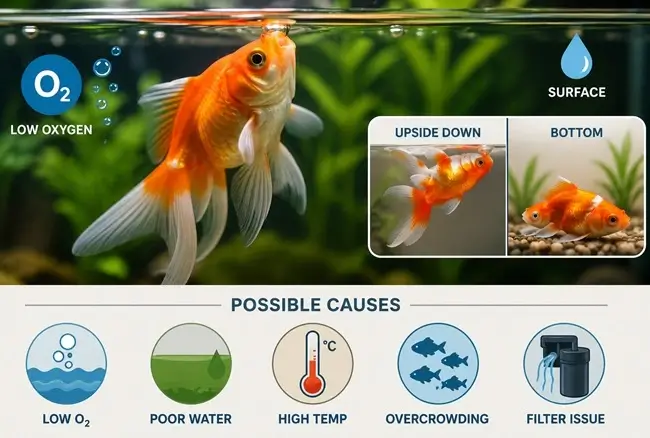
Quick Answer: Goldfish gather at the top of the tank most often because of low dissolved oxygen, poor water quality (high ammonia or nitrite), overcrowding, or warm water, all of which push fish toward the surface where oxygen is easiest to reach. It can also simply mean feeding time, or occasionally a swim bladder issue if the fish looks like it’s struggling to stay upright rather than just breathing. Testing your water and checking aeration are the two fastest ways to rule in or out the most common causes.
Quick Navigation
➜ Why Is My Goldfish at the Top of the Tank?
➜ Goldfish at the Top of the Tank Gasping or Gulping for Air
➜ Goldfish at the Top of the Tank After a Water Change
➜ Factors That Make a Goldfish Stay at the Top of the Tank
➜ Poor Water Quality and Ammonia
➜ Overcrowding and Tank Size
➜ High Temperature and Low Oxygen
➜ Disease and Parasites
➜ Could It Be a Swim Bladder Problem Instead?
➜ Is It Just Hunger or Feeding Time?
➜ Do Goldfish Sleep at the Top of the Tank?
➜ Quick Checklist: Goldfish at the Top of the Tank
➜ Frequently Asked Questions
Why Is My Goldfish at the Top of the Tank?
Fish breathe dissolved oxygen, not the oxygen bound up in the water molecule itself, and dissolved oxygen is always highest near the surface, where air and water actually meet. A goldfish that isn’t getting enough oxygen elsewhere in the tank will naturally gravitate toward that top layer, the same reason you’ll often see fish hovering right near an air stone or bubbler.
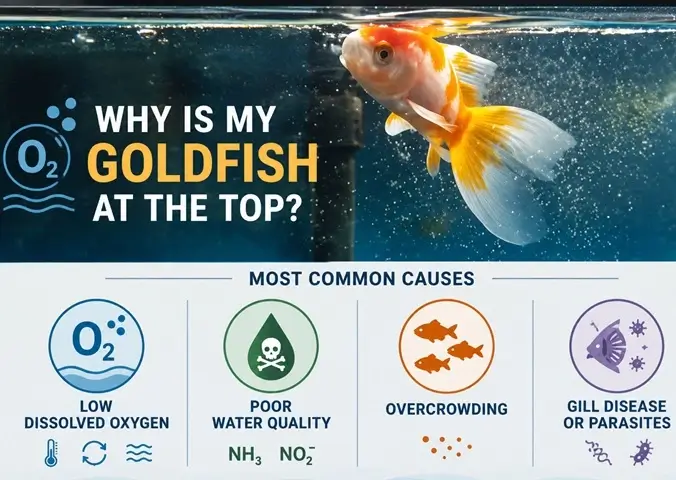
The most common underlying causes are:
➜ Low dissolved oxygen — often from warm water, poor circulation, or a tank that’s simply too still
➜ Poor water quality — especially elevated ammonia or nitrite, which both raises a fish’s oxygen demand and damages the gills
➜ Overcrowding — more fish producing more waste and competing for the same limited oxygen supply
➜ Disease or parasites — occasionally affecting the gills directly
If it’s just one fish and the rest of the tank seems fine, the problem is more likely specific to that fish’s gills or health. If multiple fish are all doing it at once, it’s almost always something wrong with the tank itself, not any one fish.
Goldfish at the Top of the Tank Gasping or Gulping for Air
Visible gasping, gulping, or repeatedly breaking the surface with the mouth, sometimes called “piping,” is the clearest sign this is truly about oxygen, not just a fish choosing to hang out near the top. This is worth treating as urgent rather than something to watch for a few days.
➜ Add an air stone, bubbler, or increase your filter’s surface agitation — do this immediately
➜ Test ammonia and nitrite — right away, since both compound the oxygen problem by damaging gill function
➜ Check your water temperature — warmer water holds noticeably less oxygen than cooler water
➜ If you have a lot of fish for the tank size — this is a strong sign overcrowding is a contributing factor
➜ Add live plants — for better oxygen concentration in your tank
➜ If water quality, temperature, and aeration all check out and the gasping continues — the fish’s own gills may already be damaged or infected, from a prior ammonia burn, bacterial gill disease, or gill flukes, making it hard to absorb oxygen even in good water, see the Disease and Parasites section below
What to expect: gasping caused by low oxygen alone usually eases within hours of adding proper aeration, this is one of the fastest problems to resolve in this whole guide. If ammonia or nitrite is also elevated, expect a fuller 24 to 48 hour recovery window once you’ve done a water change, similar to other ammonia-related issues. If gasping continues despite everything testing clean, gill damage or infection is the more likely explanation, and the recovery timeline depends on which specific cause is actually responsible, covered in the Disease and Parasites section below.
Goldfish at the Top of the Tank After a Water Change
If this started right after a water change specifically, the new water itself is the more likely trigger, not a coincidence. Insufficient dechlorination, a temperature mismatch with the existing tank water, or a sudden pH shift can all stress a fish enough to send it toward the surface, sometimes within the hour.
➜ Confirm the replacement water was fully dechlorinated — before it went in, not just left to sit briefly
➜ Check that the new water’s temperature was closely matched — to the tank’s existing temperature, a swing of even a few degrees can be enough
➜ Test pH before and after future water changes — if this keeps happening, a big source-water mismatch is worth knowing about going forward
➜ If this was a full or very large water change — check that the filter and its beneficial bacteria weren’t disrupted in the process, a full change can sometimes reset the tank’s biological cycle and trigger an ammonia spike similar to a brand new, uncycled tank
➜ Avoid feeding for 24 to 48 hours — a stressed fish digests poorly, and uneaten food just adds to the water quality load
What to expect: if it was simple temperature or dechlorination stress, surface gasping and hovering typically settle down within a day or two as the fish adjusts and the water stabilizes. If the biological cycle itself was disrupted by a full water change, expect it to take longer and behave more like a new tank, ammonia can climb over several days as the bacteria colony re-establishes, so keep testing daily rather than assuming one water change fixed it. If gasping continues past a couple of days either way, treat it as a genuine water quality or oxygen problem rather than simple adjustment stress, and work through the Factors section below.
Factors That Make a Goldfish Stay at the Top of the Tank
These four causes are the ones actually worth checking, in roughly the order most likely to apply.
Poor Water Quality and Ammonia
High ammonia, nitrite, or nitrate stresses a goldfish’s whole system and interferes with how efficiently the gills can extract oxygen from the water, on top of whatever oxygen is actually available. This is one of the most common root causes behind fish sitting at the surface, even in a tank that looks perfectly clean.
➜ Test ammonia, nitrite, nitrate, and pH — with a liquid test kit rather than assuming clear water means safe water
➜ Perform a 25 to 30 percent water change — using a proper dechlorinator if any reading is elevated
➜ Check whether overfeeding, a dead fish, or a struggling filter is the source — of the extra waste, our Goldfish Turning Black guide covers the fin and skin darkening that often shows up alongside this exact kind of ammonia exposure
➜ Retest within 24 hours — rather than waiting a full week to confirm the change actually worked
What to expect: most ammonia and nitrite-related surface gasping improves within 24 to 48 hours of correcting water quality. If gill damage already occurred, full recovery can take one to two weeks, and it’s worth watching for secondary infection during that window.
Overcrowding and Tank Size
More fish means more waste and more competition for the same oxygen supply, and it’s an easy factor to underestimate since goldfish are often sold small but grow considerably larger than most people expect.
➜ One gallon per inch of adult fish length — is a reasonable starting guideline, though this is a rough baseline, not a precise formula
➜ Plan around your goldfish’s adult size — not the one or two inches it measured at the pet store
➜ A wider, shallower tank — offers more surface area for oxygen exchange than a tall, narrow one of the same total volume
➜ A bowl is the worst-case setup — for this specific problem, small volume and minimal surface area mean oxygen depletes fast, goldfish really need a proper filtered tank, not a bowl, long term
➜ In a pond, gasping at the surface is often seasonal — warm summer water holds less oxygen, and dense algae blooms can consume oxygen overnight, check both before assuming overcrowding
➜ Adding an air pump or live plants — can help buy some breathing room while you plan for more space or fewer fish
What to expect: if overcrowding is really the cause, surface gasping often continues to some degree until the actual stocking level changes, additional aeration helps but doesn’t fully solve a tank that’s simply carrying too many fish for its size.
High Temperature and Low Oxygen
Warm water physically holds less dissolved oxygen than cool water, so a tank that’s running hot, from a malfunctioning heater, a hot room, or direct sunlight on the glass, can push fish to the surface even when nothing else is wrong.
➜ Check your heater and thermostat — are actually reading and holding the intended temperature
➜ Move the tank out of direct sunlight — if that’s a realistic contributing factor
➜ Increase surface agitation and aeration — during hot weather specifically
➜ In an emergency, small amounts of cooler water — can help bring temperature down gradually, never all at once
What to expect: if a faulty heater or hot room was the cause, surface gasping typically eases within hours once the temperature is brought back into a safe range, oxygen levels rise quickly as water cools. Bring temperature down gradually rather than all at once, no more than 1–2°F per hour, since a fast swing is its own separate stressor on top of the one you’re trying to fix.
Disease and Parasites
If water quality tests clean, aeration is solid, and the tank isn’t overcrowded, but one or more fish are still struggling to breathe, gill disease or parasites are worth considering next.
➜ Bacterial gill disease — can change the physical shape of the gills, directly reducing how much oxygen a fish can absorb, usually treated with an antibiotic course from a vet once confirmed
➜ Gill flukes — parasites that live directly on or in the gill tissue, interfering with oxygen uptake, treated with a praziquantel-based medication, often a single dose repeated after about a week
➜ Look closely for other symptoms — white spots, excess mucus, discoloration, or labored breathing that seems disproportionate to the water conditions
➜ A vet or aquatic specialist consult — is worth pursuing here rather than guessing at treatment, the wrong medication for the wrong parasite won’t help
What to expect: fluke-related breathing trouble often improves within 3 to 5 days of starting treatment, though the repeat dose a week later is what actually prevents it coming back. Bacterial gill disease is slower and less predictable, improvement on the right antibiotic typically takes one to two weeks, and gill tissue that’s already been damaged doesn’t always fully recover even once the infection clears.
From Experience: How to Actually Medicate a Sick Goldfish
If your goldfish needs medication for a parasite or bacterial infection rather than just a water quality fix, how you dose it matters as much as which medication you choose. This is the approach that’s worked reliably in practice, and it isn’t something you’ll find spelled out clearly in most online guides.
Treating in the main tank (lower parasite or bacterial load):
➜ Turn the filter off before adding any medication. This is the most important step, and it’s easy to overlook, if the filter keeps running, it will pull the medication out of the water through the filter media before it ever gets the chance to reach the fish
➜ Keep an air stone running the whole time instead, so the medication still circulates evenly through the tank rather than sitting in one spot, and it also helps enough oxygen dissolve into the water, which matters even more for a sick fish
➜ Leave the filter off for a few hours while the medication works, then turn it back on, running the filter afterward helps the medication reach and treat parasites or bacteria hiding in the filter media itself, not just the fish
Treating in a separate quarantine tank (more serious cases):
➜ Move the fish to a small quarantine tank with an air stone running
➜ Add the medication and leave it for a few hours, the same as above
➜ Afterward, do a complete water change with properly matched parameters, medicated water becomes toxic over time, and you can’t leave a fish sitting in it indefinitely, especially one that’s already struggling to breathe from illness
➜ Repeat this cycle, dose, wait a few hours, full water change, as many times as needed until the fish actually improves
Even if you’re treating a fish separately in quarantine, don’t neglect the main tank, whatever caused the illness in the first place is usually still present there, so it needs its own water changes or treatment too. And as a general rule any time you add medication to a tank, plan on a 25 to 30 percent water change the following day to clear out the medication’s own toxicity, more than that, even a full change, is fine if you’re willing to put in the extra effort. Finally, any sick fish needs to be well-oxygenated throughout treatment, an air stone isn’t optional here, illness and medication both put extra strain on a fish’s ability to breathe.
Could It Be a Swim Bladder Problem Instead?
A fish sitting near the top but visibly struggling to stay upright, floating on its side, or drifting rather than swimming with purpose, is a different issue from oxygen-seeking behavior. That pattern points toward swim bladder disorder rather than gasping for air, and it needs a different fix, fasting for 24 to 48 hours followed by deshelled peas, not more aeration.
Our Goldfish Swimming Upside Down guide covers swim bladder disorder in full, including exactly how to tell it apart from a simple oxygen problem.
Is It Just Hunger or Feeding Time?
Not every fish at the surface is in distress. Goldfish are quite responsive to routine, and many will rise to the top specifically at usual feeding times or when they notice you approaching the tank.
➜ If the fish settles back down to normal swimming after being fed — and doesn’t linger at the surface afterward, this is harmless
➜ This pattern is usually tied to a specific time of day — or your presence near the tank, not constant
➜ No gasping, no labored breathing — just interested, active behavior around feeding
Do Goldfish Sleep at the Top of the Tank?
Goldfish typically rest near the bottom or hovering just above the gravel, not at the surface, so a goldfish that seems to be resting right at the top is worth a second look rather than assuming it’s normal. Since goldfish have no eyelids, their eyes stay open even while resting, and a fish that is truly sleeping will usually respond quickly to light or noise.
➜ A fish that wakes and swims normally — when the lights come on or you approach is likely fine
➜ A fish that stays listless, unresponsive — or continues resting at the surface during active hours is more concerning
➜ Frantic gasping, rather than calm resting — always points toward oxygen or water quality rather than sleep
Quick Checklist: Goldfish at the Top of the Tank
➜ Look closely first — is the fish gasping and gulping, or just hovering calmly? This determines which section above actually applies
➜ Add an air stone or increase surface agitation — immediately if there’s any visible gasping
➜ Test ammonia, nitrite, nitrate, pH, and temperature — the same day, don’t wait to see if it resolves on its own
➜ Perform a 25 to 30 percent water change — with a proper dechlorinator if anything tests elevated
➜ Count your fish against your tank’s actual volume — and reconsider stocking if it’s actually overcrowded
➜ If water quality and oxygen are both fine — look closely for gill damage, parasites, or other symptoms before assuming it will pass
Frequently Asked Questions
Is it normal for goldfish to stay at the top of the tank?
Occasionally, and briefly, especially around feeding time, yes. Constantly, or with visible gasping, no, that points toward an oxygen or water quality problem that’s worth addressing rather than waiting out.
Why are my goldfish at the top of the tank?
When multiple fish show the same behavior simultaneously, it’s almost always a tank-wide issue, oxygen, water quality, or overcrowding, rather than something specific to one fish’s health. Test the water first.
Why are my goldfish at the top of the water or surface?
This is the same behavior as being at the top of the tank, just described differently, the fish is positioning itself where dissolved oxygen is highest. The same causes apply: low oxygen, poor water quality, overcrowding, or warm water.
My goldfish is at the top of the tank but not gasping, is that still a problem?
Not necessarily. If there’s no visible gulping or labored breathing and the fish otherwise swims and eats normally, it may just be curiosity, feeding-time anticipation, or resting. Persistent surface time without gasping is still worth a water test, just with less urgency than visible gasping.
Why is my goldfish at the top of the tank after a water change?
See the dedicated Goldfish at the Top of the Tank After a Water Change section above, it’s usually the new water itself, dechlorination, temperature, or pH, rather than a separate problem.
Can too many fish cause goldfish to gasp at the surface?
Yes. More fish means more waste and more competition for the same dissolved oxygen, and an overcrowded tank can show surface gasping even when water tests come back only mildly elevated, simply because there isn’t enough oxygen to go around.
Final Thoughts
A goldfish at the top of the tank is telling you something specific about oxygen availability, not the same broad “something’s wrong” signal as a fish sitting at the bottom. Testing water quality and checking aeration are the two fastest ways to confirm the cause, and most oxygen-related cases improve within hours once corrected. For a fish that’s struggling to stay upright rather than gasping for air, see our Goldfish Swimming Upside Down guide instead. If it’s the opposite, parked at the substrate rather than the surface, our Goldfish at the Bottom of the Tank guide covers that, and for frantic darting or circling, see our Goldfish Swimming Erratically guide. If appetite loss is also part of the picture, our Goldfish Not Eating guide covers that overlap directly.