
A goldfish that suddenly starts darting around, spinning in circles, or repeatedly bashing into the glass can look like it’s having some kind of episode, and sometimes it truly is a medical emergency. Why is my goldfish swimming erratically usually comes down to one of a few distinct causes, water quality being the most common, but not the only one, and figuring out which pattern you’re actually seeing is the fastest way to narrow it down.
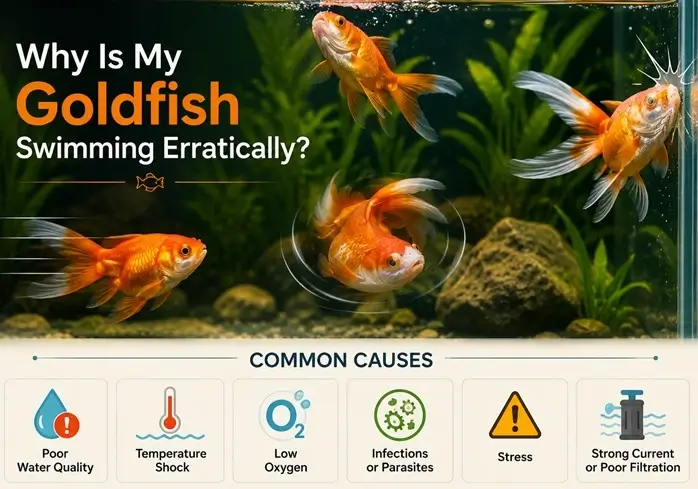
This guide covers frantic darting, circling, glass surfing, unusually fast swimming, and unusually slow swimming, since these look similar at a glance but often point to different problems.
Quick Answer: Erratic, frantic, or darting swimming in goldfish is most often caused by ammonia or nitrite poisoning, with parasites and sudden temperature or pH swings as the next most common causes. Swimming in circles more specifically points toward ammonia poisoning, an inner-ear or neurological issue, or swim bladder disorder. Test your water immediately, this is the fastest way to rule in or out the most common cause.
Quick Navigation
➜ Why Is My Goldfish Swimming Erratically?
➜ Could It Be Parasites Instead of Water Quality?
➜ Why Is My Goldfish Swimming in Circles?
➜ Why Is My Goldfish Swimming Into the Glass?
➜ Why Is My Goldfish Swimming So Fast?
➜ Why Is My Goldfish Swimming Slowly?
➜ Is My Goldfish Just Playing?
➜ How to Fix Erratic Swimming and Other Problems: Quick Checklist
➜ Frequently Asked Questions
Why Is My Goldfish Swimming Erratically?
Goldfish Swimming Erratically, frantic, crazy, darting rapidly around the tank, jerking, or moving in a way that looks distressed rather than deliberate, is most commonly linked to ammonia or nitrite poisoning. High ammonia damages the gills directly, and a goldfish reacting to that damage often swims frantically, sometimes near the surface where oxygen exchange is easier, sometimes with visible ammonia burns (dark or red patches) in more severe cases, our Goldfish Turning Black guide covers those dark patches specifically if that’s what you’re seeing.
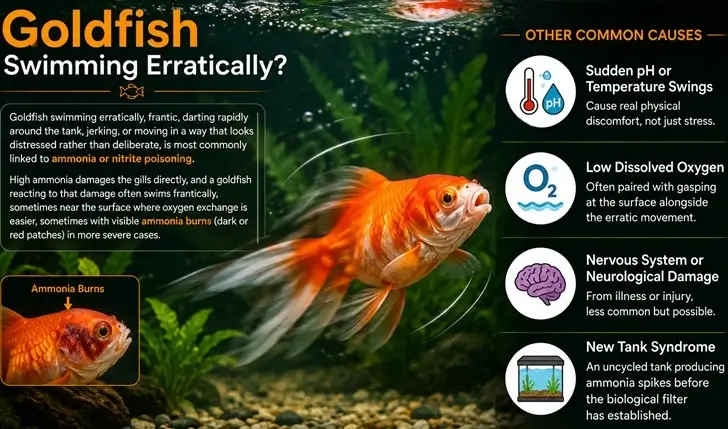
Other common causes of this same general pattern include:
➜ Sudden pH or temperature swings, which cause real physical discomfort, not just stress
➜ Low dissolved oxygen, often paired with gasping at the surface alongside the erratic movement
➜ Nervous system or neurological damage from illness or injury, less common but possible
➜ New tank syndrome, an uncycled tank producing ammonia spikes before the biological filter has established
Test ammonia, nitrite, nitrate, pH, and temperature immediately rather than guessing. If ammonia or nitrite show any reading above 0 ppm, stop feeding, perform a 25 to 50 percent water change with dechlorinated, temperature-matched water, and add an ammonia-neutralizing conditioner to buy time while the biological filter catches up. Increase surface agitation or add an air stone, since stressed gills need more available oxygen, not less.
What to expect: if ammonia or nitrite was the cause and you’ve corrected it, erratic swimming typically calms down within 24 to 48 hours. Retest every 12 hours for the first two days rather than waiting a full day, since a second water change is often needed before levels stabilize. If gill damage already occurred (visible as darkened or reddened gill tissue), full healing can take one to two weeks, and it’s worth watching for secondary infection during that window rather than assuming recovery is complete once the frantic swimming stops.
Could It Be Parasites Instead of Water Quality?
If your water tests come back clean but the erratic swimming continues, parasites are the next most likely explanation, and they tend to come with a distinct additional behavior: “flashing,” where the fish rubs or scrapes itself against gravel, decorations, or the tank walls, trying to relieve an itch the parasite is causing.
➜ Ich (white spot disease) — visible white specks on the body and fins, alongside flashing and erratic movement
➜ Gill or skin flukes — harder to see directly, but often paired with color fading, excess mucus, or labored breathing
➜ Anchor worms or fish lice — visible external parasites that cause the same rubbing-and-scratching pattern
Treatment depends on which parasite is actually present, so a close visual inspection under good light matters more here than with a simple water quality problem, an antiparasitic treatment aimed at the wrong organism won’t help.
➜ Ich — raise temperature gradually to 82–86°F (no more than 1–2°F per hour), which speeds up the parasite’s life cycle, combined with a malachite green or formalin-based treatment for the full labeled course, typically 10 to 14 days depending on temperature
➜ Gill or skin flukes — treated with a praziquantel-based medication, often as a single dose repeated after about a week to catch newly hatched parasites
➜ Anchor worms or fish lice — usually require manual removal with tweezers for visible worms, followed by a course of the appropriate antiparasitic to prevent reinfestation
What to expect: flashing and erratic movement from Ich often visibly improve within 3 to 5 days of raising temperature and starting treatment, but the full course still needs to be completed, stopping early when symptoms fade is one of the most common reasons Ich comes back within a few weeks. Fluke-related symptoms typically ease within a similar window, though the repeat dose a week later is what actually prevents relapse.
From Experience: How to Actually Medicate a Sick Goldfish
If your goldfish needs medication for a parasite or bacterial infection rather than just a water quality fix, how you dose it matters as much as which medication you choose. This is the approach that’s worked reliably in practice, and it isn’t something you’ll find spelled out clearly in most online guides.
Treating in the main tank (lower parasite or bacterial load):
➜ Turn the filter off before adding any medication. This is the most important step, and it’s easy to overlook, if the filter keeps running, it will pull the medication out of the water through the filter media before it ever gets the chance to reach the fish
➜ Keep an air stone running the whole time instead, so the medication still circulates evenly through the tank rather than sitting in one spot, and it also helps enough oxygen dissolve into the water, which matters even more for a sick fish
➜ Leave the filter off for a few hours while the medication works, then turn it back on, running the filter afterward helps the medication reach and treat parasites or bacteria hiding in the filter media itself, not just the fish
Treating in a separate quarantine tank (more serious cases):
➜ Move the fish to a small quarantine tank with an air stone running
➜ Add the medication and leave it for a few hours, the same as above
➜ Afterward, do a complete water change with properly matched parameters, medicated water becomes toxic over time, and you can’t leave a fish sitting in it indefinitely, especially one that’s already struggling to breathe from illness
➜ Repeat this cycle, dose, wait a few hours, full water change, as many times as needed until the fish actually improves
Even if you’re treating a fish separately in quarantine, don’t neglect the main tank, whatever caused the illness in the first place is usually still present there, so it needs its own water changes or treatment too. And as a general rule any time you add medication to a tank, plan on a 25 to 30 percent water change the following day to clear out the medication’s own toxicity, more than that, even a full change, is fine if you’re willing to put in the extra effort. Finally, any sick fish needs to be well-oxygenated throughout treatment, an air stone isn’t optional here, illness and medication both put extra strain on a fish’s ability to breathe.
Why Is My Goldfish Swimming in Circles?
Circling is worth treating as its own category rather than folding into general erratic swimming, since it points toward a slightly different, more specific set of causes. Ammonia poisoning can absolutely cause circling, particularly rapid circling with the fins held tight against the body, but circling on its own, without other signs of erratic darting, more often suggests one of the following:
➜ An inner-ear or neurological infection affecting the fish’s sense of balance
➜ Swim bladder disorder, which can cause a spiraling or circling motion rather than a clean upside-down flip
➜ Whirling disease, a parasite that primarily affects trout and salmon but can occasionally appear in goldfish, most common in younger fish
Test water quality first regardless, since it’s both the most common and the easiest to rule out, and follow the same water change and aeration steps covered above. If parameters are clean and the circling persists, watch for other symptoms, buoyancy problems point toward the swim bladder guide linked below, while disorientation and difficulty swimming straight point more toward an infection needing veterinary input, since inner-ear and neurological infections generally require a prescribed antibiotic course rather than an over-the-counter treatment.
What to expect: ammonia-related circling follows the same 24 to 48 hour improvement window as general erratic swimming once water quality is corrected. An inner-ear or neurological infection is much slower and less predictable, improvement, if it happens, often takes one to three weeks on the right antibiotic, and some neurological damage doesn’t fully reverse even with treatment. That uncertainty is exactly why ruling out water quality first matters, it’s the cause with the fastest, most reliable recovery.
For buoyancy-specific circling or spiraling, our Goldfish Swimming Upside Down guide covers swim bladder disorder in full detail.
Why Is My Goldfish Swimming Into the Glass?
Repeatedly swimming into or along the glass, often called glass surfing, is a behavioral signal rather than a direct medical symptom, though the underlying trigger is frequently still something in the environment.
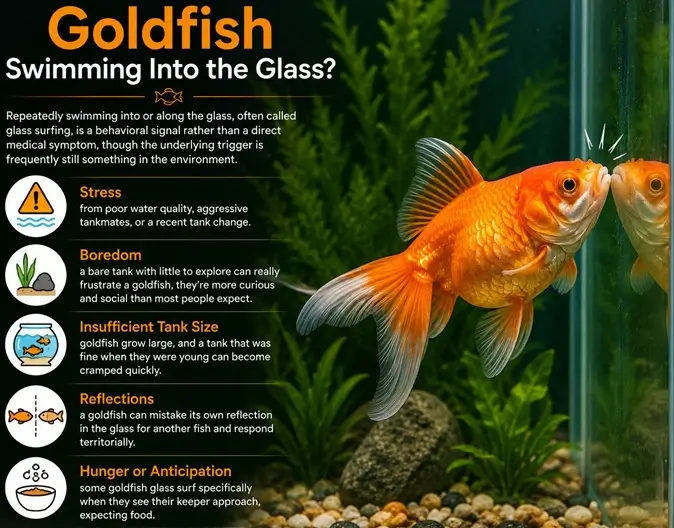
Common causes include:
➜ Stress — from poor water quality, aggressive tankmates, or a recent tank change
➜ Boredom — a bare tank with little to explore can really frustrate a goldfish, they’re more curious and social than most people expect
➜ Insufficient tank size — goldfish grow large, and a tank that was fine when they were young can become cramped quickly
➜ Reflections — a goldfish can mistake its own reflection in the glass for another fish and respond territorially
➜ Hunger or anticipation — some goldfish glass surf specifically when they see their keeper approach, expecting food
Occasional, brief glass surfing usually isn’t cause for concern. Persistent or constant glass surfing is the version worth actually addressing, and the fix depends on which trigger applies:
➜ If water quality tests poorly, follow the same water change and dechlorination steps above
➜ If the tank is undersized, common goldfish need at least 20 gallons for the first fish and 10 more per additional fish, fancy varieties can often manage with somewhat less but still need real swimming room
➜ If reflections seem to be the trigger, particularly worse at night with lights off and a dark room behind the tank, adding a background to the back and sides of the tank often resolves it within days
➜ If boredom looks likely, add live or silk plants, smooth rocks, or a simple rearrangement of existing décor, goldfish do notice and respond to a more varied environment
What to expect: stress-driven glass surfing, from water quality or a recent tank change, typically eases within a few days to two weeks once the specific stressor is resolved. Boredom-driven glass surfing is slower and less predictable to fix, since it depends on actually re-engaging the fish rather than correcting one clear problem, expect to try more than one change before it fully stops.
Why Is My Goldfish Swimming So Fast?
Fast, sustained swimming is a real, distinct pattern from erratic darting, and it’s worth telling apart before assuming something’s wrong. A goldfish that’s zooming around fast but moving with clear direction and purpose, playing in filter current, chasing bubbles from an air stone, or shooting from one end of the tank to the other, is very often just being playful, goldfish are more socially active than they’re usually given credit for.
Fast swimming becomes a genuine concern when it’s paired with other signs, gasping at the surface (pointing toward low oxygen or poor water quality), visible distress or panic rather than playfulness, or fast swimming that started suddenly alongside a water change or new addition to the tank. In that case, test ammonia, nitrite, and dissolved oxygen, and add an air stone or increase surface agitation right away, since oxygen-related distress can escalate quickly.
What to expect: if playful, there’s nothing to fix. If it’s oxygen or water-quality driven, improvement is usually fast once corrected, often within a few hours to a day, since restoring dissolved oxygen and clearing ammonia acts faster than most other fixes in this guide.
Why Is My Goldfish Swimming Slowly?
Unusually slow or sluggish swimming points in a different direction than fast or erratic movement. The most common causes are:
➜ Cold water — goldfish metabolism slows significantly as temperature drops, and slower swimming in a pond or unheated tank during cooler months is often completely normal
➜ Poor water quality — the same ammonia and nitrite issues that cause erratic swimming in some fish can cause lethargy in others, test and correct the same way
➜ Illness — slow, listless swimming is one of the earliest and least specific signs of infection or disease, worth watching for other symptoms developing alongside it
➜ Normal rest — goldfish do rest, particularly overnight, and a fish that swims normally once approached or during the day isn’t necessarily unwell
What to expect: if the cause is cold water and you’re able to gradually raise the temperature (no more than 1–2°F per hour) to the goldfish’s normal range, activity usually picks back up the same day. If it’s water quality, expect the same 24 to 48 hour improvement window covered earlier. If it’s early illness, timeline depends entirely on what develops next, watch closely over the following few days rather than assuming it will resolve on its own.
Is My Goldfish Just Playing?
It’s worth ending on this because it’s easy to miss: not every unusual swimming pattern means something’s wrong. Goldfish are more socially interactive and curious than most people assume, and rapid swimming, chasing bubbles, playing in current, or brief bursts of speed around the tank can simply be a healthy, happy fish enjoying its space. Spawning behavior in spring can also look alarming the first time you see it, males will nudge and chase females to encourage egg release, and males often develop small white spots on the head (breeding tubercles) during this time that can be mistaken for Ich.
The distinguishing factor is usually context: a fish that’s otherwise eating normally, breathing normally, and returns to typical behavior isn’t showing the same pattern as one that’s truly distressed. When in doubt, test the water, it costs nothing and rules out the most common real cause either way.
How to Fix Erratic Swimming and Other Problems: Quick Checklist
Work through these in order rather than jumping to medication:
➜ Test ammonia, nitrite, nitrate, pH, and temperature immediately
➜ If any reading is off, perform a partial water change with dechlorinated, temperature-matched water and stop feeding temporarily
➜ Increase aeration, especially if you notice gasping at the surface alongside the erratic behavior
➜ Closely inspect the fish for white spots, excess mucus, redness, or visible parasites
➜ Check whether the behavior is circling specifically, glass surfing specifically, or general fast/frantic movement, since each points toward a different section above
➜ If water quality is clean, no parasites are visible, and the behavior continues for more than a few days, consider a vet consult, particularly if it’s paired with other symptoms like bloating, pinecone scales, or loss of appetite
Frequently Asked Questions
Why is my goldfish swimming into the glass and also acting frantic?
This combination points more strongly toward water quality than glass surfing alone does. Test ammonia and nitrite first, since frantic movement combined with glass-surfing behavior is a common ammonia poisoning pattern, not just boredom or stress on its own.
Why is my goldfish swimming downwards or sinking?
This is usually a buoyancy issue rather than an erratic-swimming problem, most often linked to swim bladder disorder or trapped digestive gas. Our Goldfish Swimming Upside Down guide covers this in full, including the fasting-and-peas approach that resolves most cases.
My goldfish is swimming weird but seems otherwise healthy, should I worry?
Not necessarily. If it’s eating normally, breathing normally, and the odd swimming is brief or intermittent rather than constant, it may just be play, exploration, or normal spawning behavior. Persistent, worsening, or distressed-looking movement is what actually warrants testing the water and investigating further.
Can ammonia poisoning be reversed?
Yes, if caught early. A large water change, halted feeding, and increased aeration typically bring ammonia-related symptoms under control within a few days. Gill damage from prolonged high ammonia exposure is more serious and takes longer to recover from, if it recovers fully at all.
How do I tell ammonia poisoning apart from parasites?
Ammonia poisoning tends to show up alongside a recent water quality problem, new tank, missed water change, overfeeding, and often comes with darkened gills or burns in severe cases. Parasites are more often signaled by visible flashing, rubbing against objects, white spots, or excess mucus, with water parameters testing clean.
Final Thoughts
Erratic, circling, fast, slow, and glass-surfing behaviors all look alarming, but they don’t all mean the same thing, and testing the water is almost always the right first move regardless of which pattern you’re seeing. Ammonia and nitrite explain the majority of cases, parasites and neurological issues explain most of the rest, and a healthy, playful fish accounts for more of the “unusual” behavior than people expect. For buoyancy-specific symptoms like floating, sinking, or swimming upside down, see our Goldfish Swimming Upside Down guide. If your fish is gasping at the surface instead, our Goldfish at the Top of the Tank guide covers that specifically, and for a fish parked unresponsively at the substrate, see our Goldfish at the Bottom of the Tank guide. If appetite loss is part of the picture too, our Goldfish Not Eating guide covers that overlap in full.