
A goldfish fry tank setup has different priorities than an adult goldfish tank. For tiny goldfish fry, the main priorities are clean water, gentle water movement, and stable conditions.
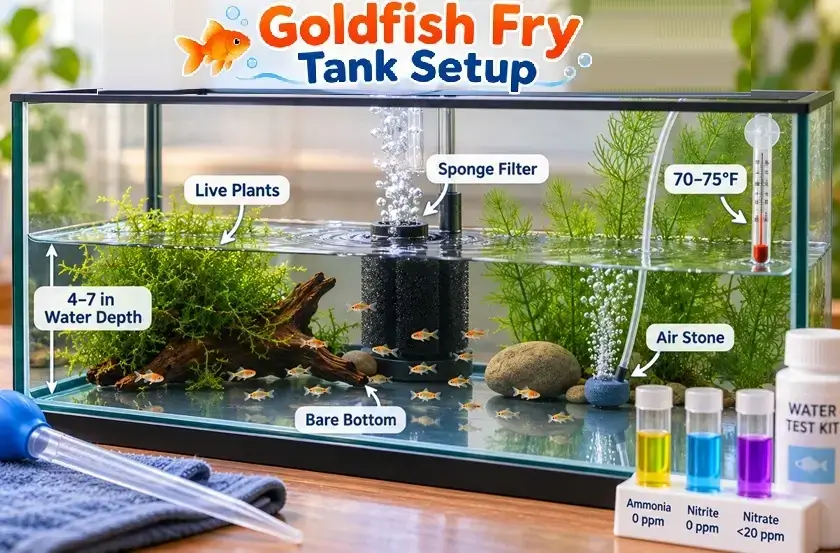
Once the fry become free-swimming, they need access to the water surface to inflate their swim bladder for the first time. A clear water surface and gentle water movement make this easier during their early days.
Quick Navigation
1) Set Up the Tank Before the Eggs Hatch
2) Water Depth and Tank Size
3) Substrate: Why Bare Bottom Works Best
4) Temperature
5) Filtration
6) Water Change Schedule
7) Live Plants and Natural Decorations
8) Frequently Asked Questions
Set Up the Tank Before the Eggs Hatch
Ideally, the fry tank should be prepared before the eggs hatch, rather than setting it up at the last minute.
Use a mature sponge filter or established filter media from a healthy aquarium to introduce beneficial bacteria.
Simply running a new tank for a week or adding water from an established tank won’t necessarily cycle the tank.
Make sure the water is dechlorinated, the temperature is stable, and ammonia and nitrite are at 0 ppm.
Avoid transferring filter media or equipment from a tank with active diseases or parasites, as these can also be introduced into the fry tank.
Water Depth and Tank Size
For the first few weeks, keeping the water around 4–7 inches deep makes it easier for tiny fry to reach the surface and find food. However, this isn’t a strict requirement, as goldfish fry can also grow successfully in deeper tanks and ponds.
A 10-gallon tank is a good starting point for a small batch of around 10–15 fry, although the number it can support depends on their size and water quality.
As the fry grow, gradually increase the water depth and move them into a 20-gallon or larger grow-out tank when needed.
Larger batches will need additional tanks or more space.
Substrate: Why Bare Bottom Works Best
A bare-bottom tank, with no gravel or sand, works best for newly hatched goldfish fry. It makes uneaten food, waste, and dead fry easy to spot and remove before they affect water quality.
Once the fry are around 1–2 months old, you can add a few large (1–2 inches), smooth, rounded stones if you prefer a more natural-looking setup.
Make sure the stones are too large for the fish to swallow, and clean around them regularly, as waste can collect underneath.
Temperature
A steady temperature of 70–75°F (21–24°C) supports healthy hatching and early fry growth. Keeping goldfish fry indoors makes it easier to maintain a stable temperature, especially when outdoor temperatures fluctuate between day and night.
Sudden temperature changes can stress young fry, so maintaining stability is more important than keeping the water at an exact temperature.
Filtration
A sponge filter is the safest choice for goldfish fry because it provides gentle filtration without sucking in the tiny fish.
If you are using a power filter or hang-on-back filter, cover the intake with a fine sponge or fry-safe mesh to prevent fry from being sucked inside.
Keep the water flow gentle, as strong currents can exhaust young fry. Check the intake covering regularly to prevent clogging.
An air stone can also help improve oxygenation by gently moving the water surface. Just make sure the bubbling isn’t too strong for the fry.
For more details, see our guide on whether goldfish fry need a filter.
Water Change Schedule
Goldfish fry tanks need regular water changes because the fry are fed several times a day, and uneaten food and waste can build up quickly.
A partial water change once every three days is a reasonable starting point, but the actual frequency should depend on water quality.
Test the water regularly for ammonia, nitrite, and nitrate, and increase water changes if needed. Ammonia and nitrite should remain at 0 ppm.
Remove uneaten food and visible waste using a small airline tube or turkey baster, taking care not to suck up the fry. Always use dechlorinated replacement water at a similar temperature.
Live Plants and Natural Decorations
Live plants and natural decorations can create a more comfortable, less stressful environment for goldfish fry by providing shelter and places to explore.
Plants such as Java moss, hornwort, and anacharis are good options. They absorb nutrients such as ammonium and nitrate, helping maintain water quality, and release oxygen during daylight.
Over time, natural surfaces like smooth stones and driftwood develop algae and biofilm, which support beneficial microorganisms that growing fry can graze on.
You can keep the tank bare-bottomed while adding a few plants and decorations. Just avoid overcrowding the tank, and remember that plants cannot replace proper filtration and regular water changes.
Frequently Asked Questions
Can I raise goldfish fry in the same tank as the adults?
It’s not recommended for newly hatched fry. Adult goldfish often eat their own eggs and fry. You can introduce your fry to the adult tank once they grow too large for the adults to swallow.
Do goldfish fry need a heater?
Not always. If the room temperature is stable and the water stays around 70–75°F (21–24°C), a heater may not be necessary. However, an aquarium heater helps maintain a steady temperature when room temperatures fluctuate between day and night.