
Goldfish poop tells you more about their health than you can casually observe day to day. The poop color, texture, and frequency all reflect what’s actually going on inside the fish. Most of what looks alarming can be completely normal, and a couple of the most common “warning signs” people search for aren’t nearly as concerning as it may sound.
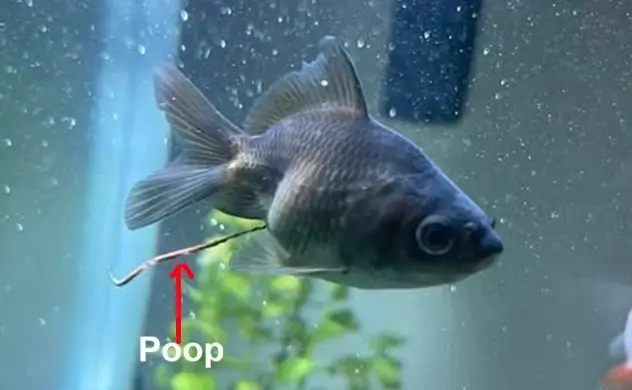
In this article i will tell you what normal goldfish poop should look like, what the different colors and textures mean about your goldfish along with other questions related to goldfish poop.
Quick Navigation
1) What Does Goldfish Poop Look Like?
2) Goldfish Poop Color Chart
3) Why Do Goldfish Poop So Much?
4) Is White, Stringy Poop a Sign of Parasites?
5) Long or Trailing Poop: What It Actually Means
6) Why Is My Goldfish’s Poop Floating?
7) How Often Should Goldfish Poop?
8) Is Goldfish Poop Toxic to Other Fish?
9) How to Clean Goldfish Poop From Your Tank
10) FAQ
11) Final Thoughts
What Does Goldfish Poop Look Like?
Goldfish poop varies a lot depending on diet, but healthy waste is short to medium in length, solid, sinks to the bottom, and breaks apart quickly in the water rather than floating or trailing for long stretches behind the fish.
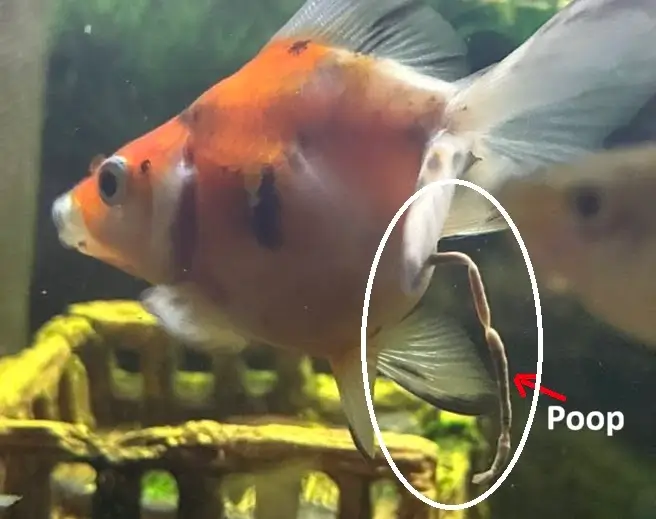
Goldfish Poop Color:
Goldfish don’t have a stomach, so food isn’t broken down by digestive acids before it passes out. The color coming out is basically the color that went in.
• Green means they ate algae or vegetables.
• Brown or dark means they ate protein-rich pellets, flakes, or frozen worms.
• Red or pink means they ate red-tinted flakes, pellets, or live bloodworms.
Shape and Texture:
Firm, solid, medium to short strings that come in segments, eventually sinking to the bottom of the tank. They break apart in the water over time.
Length:
Can trail behind them for a bit, especially in younger, fast-growing ones that eat constantly. It should still break off into manageable pieces rather than staying attached for long.
Abnormal Appearance:
• White or clear, stringy poop, which is thin, almost always just means the gut is empty. You need to worry when it comes with weight loss, a bloated belly, or lethargy, as it could indicate the presence of parasites or bacteria inside.
• Long, thick strands that won’t break apart usually mean overfeeding.
• Floating poop usually means trapped air, often from surface feeding or dry food.
Each of these gets its own full explanation in the sections below.
Goldfish Poop Color Chart
Here’s what different colors of goldfish poop actually look like in a real tank, along with what each one means.
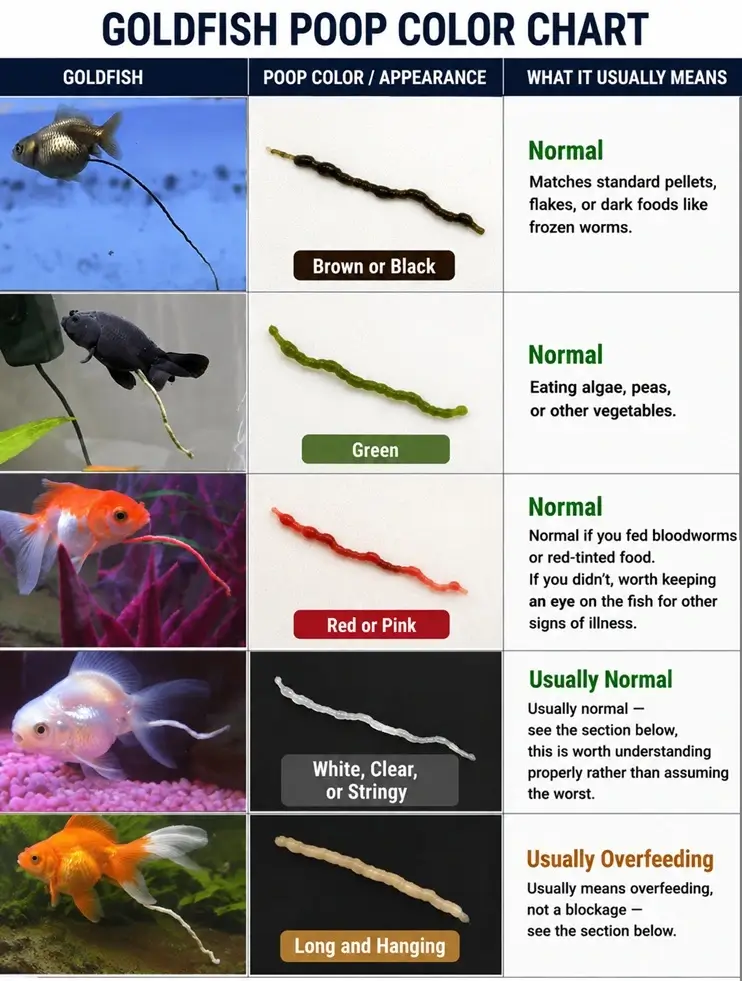
| Color / Appearance | What It Usually Means |
|---|---|
| Brown or black | Normal — matches standard pellets, flakes, or dark foods like frozen worms |
| Green | Normal — eating algae, peas, or other vegetables |
| Red or pink | Normal if you fed bloodworms or red-tinted food. If you didn’t, worth keeping an eye on the fish for other signs of illness. |
| White, clear, or stringy | Usually normal — see the section below, this is worth understanding properly rather than assuming the worst. There might be parasites or a bacterial infection. |
| Long and hanging | Usually means overfeeding, not a blockage — see the section below |
Why Do Goldfish Poop So Much?
• Goldfish don’t have a true stomach to process food slowly. Food moves straight from the mouth into the intestine, where nutrients get absorbed and waste gets pushed out, usually within hours, all in one continuous process.
• Constant grazing means constant output. A goldfish that has access to food throughout the day, one way or another, will produce waste throughout the day too, not in a few discrete “meals worth” the way many other pets do.
• Goldfish aren’t efficient at converting food into body mass since there is no stomach. A large portion of what they eat comes back out as waste rather than being used by the body.
• Overfeeding makes it worse. Many owners feed more than the fish actually needs, which directly increases how much waste ends up in the tank.
Is White, Stringy Poop a Sign of Parasites?
This is one of the most repeated pieces of advice in the hobby, and it’s more misleading than most people realize.
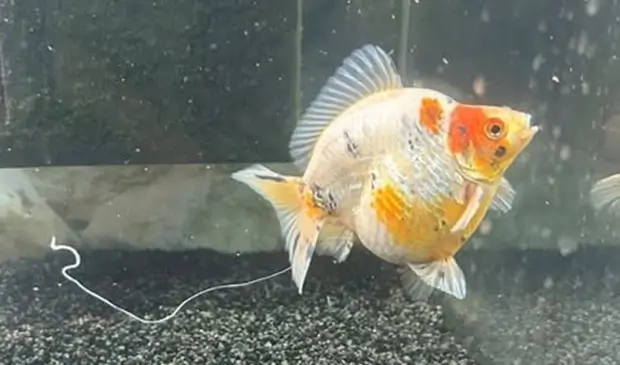
• In the large majority of cases, white or clear stringy poop simply means the fish’s gut is empty. A goldfish’s intestine is naturally coated in mucus to help waste move through smoothly. When there’s food to bind that mucus together, it takes on the color of the food. When there’s no food, you’re just seeing the mucus itself, which looks thin, pale, and stringy.
• If the fish is healthy and active, don’t worry about it. Only start suspecting parasites or bacterial infection if you also see other signs of illness, like weight loss, a bloated or sunken belly, lethargy, or loss of appetite. Genuine internal parasites are more likely when long, stringy white poop shows up alongside those disease symptoms, not on its own. See our goldfish Camallanus worms guide and goldfish Hexamita guide for what those actually look like.
• A simple test can help settle it if you’re genuinely unsure. Scoop the suspect waste out with a turkey baster and put it in a small cup of still water. If it’s truly just an empty fecal cast, it will stay still. If it’s a live parasite like a Camallanus worm, it will continue moving on its own even in calm water.
Long or Trailing Poop: What It Actually Means
Long poop is not the same thing as white stringy poop. It’s a normal color, brown, green, whatever the fish ate, it’s just one long, unbroken piece instead of breaking apart.
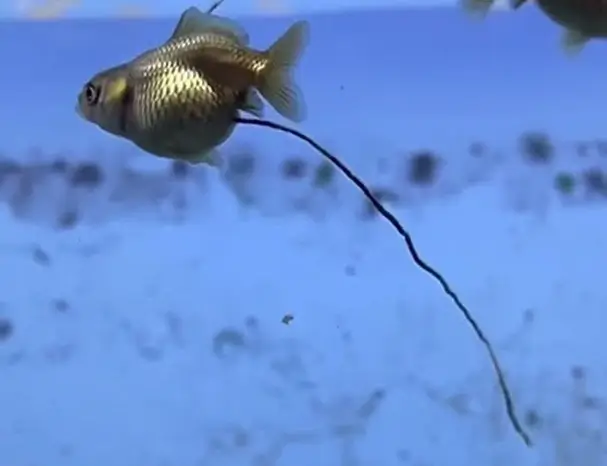
• Overfeeding is the most common cause. Too much food moving through at once tends to come out as one long connected piece rather than separating naturally.
• It’s especially common in young, fast-growing goldfish, who eat frequently and process food quickly. A long strand on its own, in a fish that is active and eating normally is usually nothing to worry about.
• Poor-quality food can be part of it too. Cheap goldfish food often relies on fillers like corn or wheat chaff instead of real fiber sources, and that lower-quality diet can contribute to longer poop. Some food is made mostly for high protein and skips vegetable matter almost entirely. Sticking to a recognized food brand helps.
• If the pattern is persistent, try feeding smaller amounts of food, which is the simplest fix for overfeeding.
Why Is My Goldfish’s Poop Floating?
• Trapped air is almost always the cause. Goldfish are fast, eager eaters, and gulping air at the surface during feeding is common, especially with floating flakes or pellets. That swallowed air ends up trapped inside the poop, making it float like a small balloon instead of sinking.
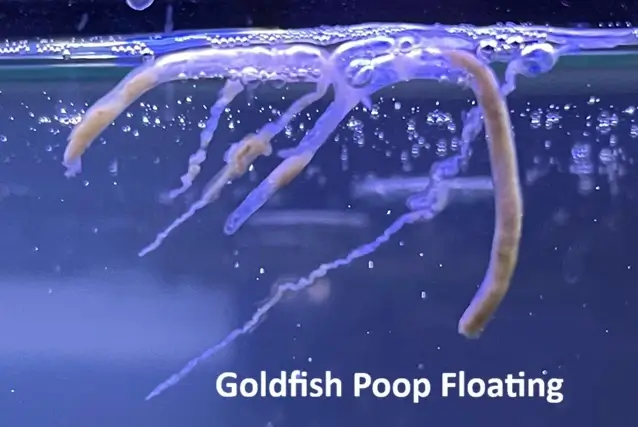
• Dry food can also cause this. When a fish gulps down dry food, it expands in the gut as it absorbs water, and gas gets produced as the fish tries to digest it. That gas can end up trapped right inside the poop itself, which is what makes it float.
• Switching to a slow-sinking pellet removes the main source of surface air-gulping as well as food expanding and producing air in the gut. This is usually enough to resolve occasional floating poop on its own, or bloating problems due to gas.
• If the fish is also struggling to swim normally — floating on its side, or unable to stay submerged, it points toward a swim bladder issue rather than just floating waste. See our goldfish swim bladder disease guide for what to do next.
How Often Should Goldfish Poop?
Very often. Goldfish are genuinely high-output fish, and that’s completely normal given how their digestion works. Even though you may only feed them twice a day, they keep grazing on leftovers, or even their own fresh poop, since it still has some nutrients left in it.
• Waste production is nearly continuous in a fish that has regular access to food, often within about 30 minutes to 90 minutes of eating.
• Frequent, solid, short-to-medium waste is a sign of a healthy, actively eating fish, not a problem to fix.
• A fish that suddenly stops pooping is more worth paying attention to than one that poops a lot, since it points to a reduced appetite or a digestive slowdown, particularly in cold water.
Do Goldfish Eat Their Poop?
Not deliberately, and it’s rarely a real problem, but it does happen occasionally.
• There’s actually some nutritional value left in it. Since goldfish digest food inefficiently to begin with, some undigested nutrients pass straight through and end up in the waste. That inefficient digestion also leaves behind a scent from the food. Being opportunistic eaters, goldfish will sometimes nibble at their own poop and spit it out once they don’t like the taste.
• Accidental nibbling is one of the most common reasons it happens. Poop is often the same color as the food that produced it, and the lingering scent of that food is what leads a fish to nibble at it by accident.
• A genuinely hungry, underfed fish is more likely to actually eat it, rather than just grabbing and spitting it out. If you’re seeing this often, it usually points to feeding too little or too infrequently, not a behavioral quirk.
It’s not something to actively worry about occasionally, but it’s not something to encourage either. If it’s a regular pattern, especially in a tank with poor water quality, waste can carry bacteria or parasites that might enter the fish’s body and cause disease.
What Eats Goldfish Poop?
Nothing, despite what pet stores often imply when they sell certain fish as a “cleanup crew.”
• Plecos, corydoras, shrimp, and snails don’t actually eat fish waste, even though they are commonly marketed that way. What they are really after is algae, leftover food, and decaying plant matter, not feces itself. It looks as if they are eating poop while grazing over the leftover food underneath the tank.
• They sometimes pick through waste looking for food particles, since goldfish poop can still contain some. When they do this, they typically spit the actual fecal matter back into the tank, breaking it apart into smaller pieces.
The only real way to remove waste from a tank is through gravel vacuum and regular water changes, combined with biological filtration.
Is Goldfish Poop Toxic to Other Fish?
Not directly, but it becomes a real problem if it’s allowed to build up in the tank which turns into ammonia.
• Solid waste breaks down into ammonia as it decomposes in the tank, and ammonia is genuinely toxic to fish at even fairly low concentrations.
• Goldfish specifically produce a heavy bioload relative to their size, precisely because of how much and how often they eat and pass waste. So the heavy bioload produces ammonia very quickly which can be toxic to the goldfish itself and other fish in the tank.
Strong filtration, adequate tank size, regular water changes, proper nitrogen cycle with adequate beneficial bacteria are what actually keep this waste from becoming dangerous.
How to Clean Goldfish Poop From Your Tank
• Use a gravel siphon vacuum to pull waste out from the substrate directly, gently stirring the gravel as you go so nothing stays trapped underneath.
• Spot-clean frequently, depending on your tank size, rather than letting waste accumulate until your next scheduled cleaning.
• Perform a partial water change weekly, roughly 25–30% depending on your stocking level and tank size, to keep pace with how much waste goldfish produce. While making water changes siphon the waste underneath the tank.
Upgrading your tank filter to a larger one, like a canister filter, and having adequate plants can help clear up waste and toxins in the goldfish tank.
FAQ
Why is my goldfish’s poop stuck to it?
A short trailing period after passing waste is normal, but poop that stays attached for an extended time usually means the fish is eating more solid protein based food with less fiber in it. Sometimes long, white, stringy poop alongside other symptoms could mean parasites or bacteria. Read our Goldfish Diseases guide to know more.
Why is my goldfish’s water turning brown?
The most common causes are organic waste breaking down faster than your filter can keep up with, tannins leaching from driftwood or certain decorations, or a brown algae bloom. Check what’s in the tank first, then make sure your filter and water change schedule are keeping pace, along with any algae eater additions required to remove brown algae.
Why does my goldfish have brown residue trailing behind it?
A brownish trail right behind the fish is usually just its normal waste color from a standard diet. It’s not something to worry about on its own unless the fish also seems off in other ways.
Do goldfish pee as well as poop?
Yes, they pee as well as poop. Because goldfish live in freshwater, water constantly enters their body through the skin and gills, and their kidneys work continuously to filter out that excess water which gets released as urine through the vent.
Final Thoughts
Goldfish poop really is a useful health indicator, but most of what circulates online overstates it a bit. Color usually just reflects diet. White stringy poop, on its own, almost always just means an empty gut unless you see other symptoms like lethargy or not eating. Watch the whole fish, not just what comes out of it, and most of what you’ll see is nothing to worry about.
