
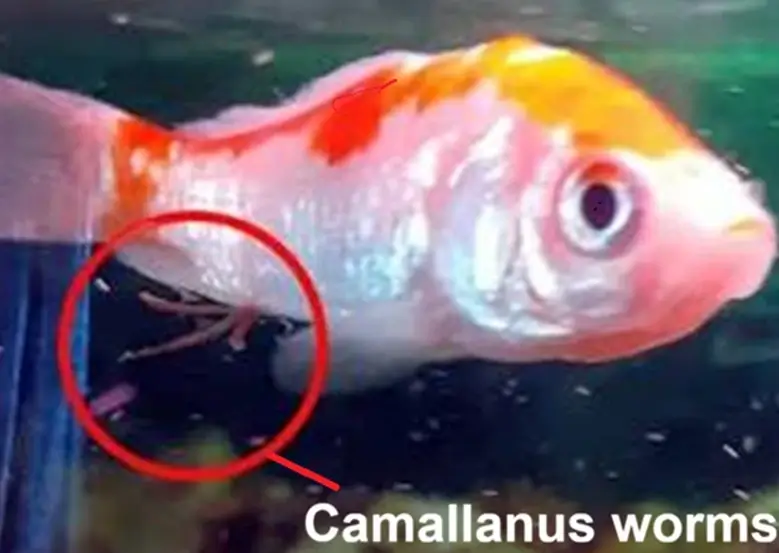
Goldfish Camallanus worms, also known in the hobby as “red worms,” are one of the few internal parasites you can actually see with your own eyes, though usually not until the infection is already well underway. If you have spotted thin, bright red, thread-like worms poking out of your goldfish’s vent, this strongly suggests a Camallanus infection.
Here is the one thing worth knowing before anything else: a single treatment may not clear the entire infection. Medications like levamisole can act on worms inside the fish, but some developing stages may survive the first treatment. That is why a repeat dosing and proper tank cleaning are important to prevent the infection from coming back.
Quick Navigation
1) What Are Camallanus Worms?
2) Camallanus Worms – Quick Facts
3) Camallanus Worms Symptoms
4) Camallanus Worms Life Cycle
5) What Causes Camallanus Worms in Goldfish?
6) Camallanus Worms Treatment
7) How to Prevent Camallanus Worms
8) FAQ
9) Final Thoughts
What Are Camallanus Worms?
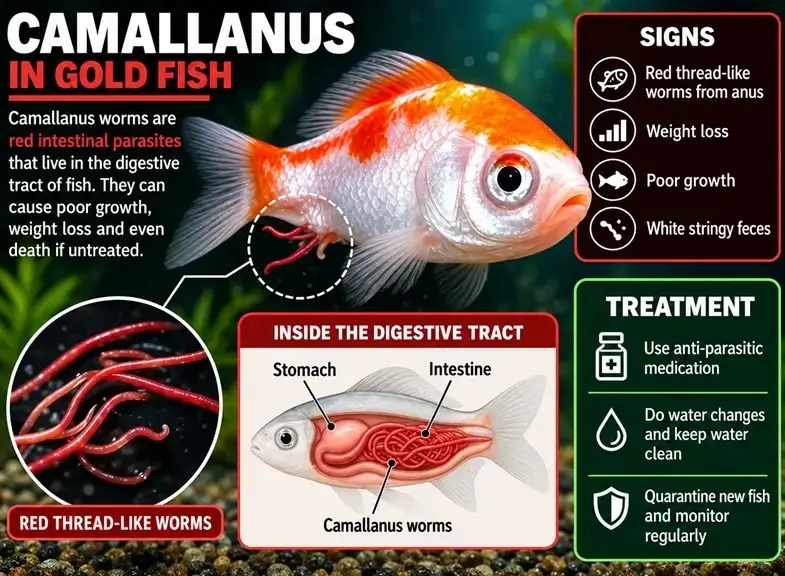
Camallanus worms are parasitic nematodes (roundworms) that live inside a fish’s digestive tract, attaching to the intestinal wall and feeding on the fish’s blood.
• Their red color comes directly from what they eat. Because mature worms feed on blood, they appear as bright red or pinkish threads. This is also why they are commonly called “red worms” rather than by their scientific name.
• What you see protruding from the vent is usually part of an adult female worm releasing live larvae into the aquarium. Other worms may still be present inside the fish.
• Several different Camallanus species exist, each with somewhat different host ranges, but the species most commonly seen in aquarium fish, including goldfish, is Camallanus cotti.
• Well-maintained fish can carry a light infection without showing symptoms. Poor water quality, overcrowding, and stress can make an existing infection more harmful, but they don’t cause the parasite to appear in the first place.
Camallanus Worms – Quick Facts
| Attribute | Details |
|---|---|
| Type | Internal parasitic nematode (roundworm) |
| Visible? | Usually only once the infection is well established and red thread-like worms may protrude from the vent. |
| Common Name | “Red worms,” because mature worms appear red from feeding on blood. |
| Contagious? | Yes — spreads through larvae, often via infected crustaceans; Camallanus cotti can also infect fish directly. |
| Life Cycle Length | Under a month at 77°F for Camallanus cotti |
| Main Treatment | Levamisole; fenbendazole is another treatment option. |
| Treatment Length | Repeat treatment is usually needed; timing depends on the medication used. |
Camallanus Worms Symptoms
• Red, thread-like worms protruding from the anal vent — the most characteristic sign of Camallanus worms, although it usually appears only once the infection is already well established.
• Weight loss despite normal or even increased appetite. The worms feed on blood and tissue fluids and can damage the intestinal lining, gradually weakening the fish.
• Abdominal bloating or a swollen belly, sometimes alongside weight loss elsewhere on the body.
• Lethargy and clamped fins can occur in more advanced infections, although these signs are not specific to Camallanus.
• Slower growth in juveniles and gradual weight loss may develop during a long-term infection.
• Light infections may show no symptoms at all. A fish can carry a low-level infection for some time without visible signs, which makes Camallanus easy to introduce unknowingly.
Camallanus Worms Life Cycle
Understanding the life cycle helps explain how Camallanus spreads through an aquarium and why treatment often needs to be repeated.
• Larvae Release: Adult female Camallanus worms live in the fish’s intestine and release live first-stage larvae, which pass into the aquarium with the fish’s waste.
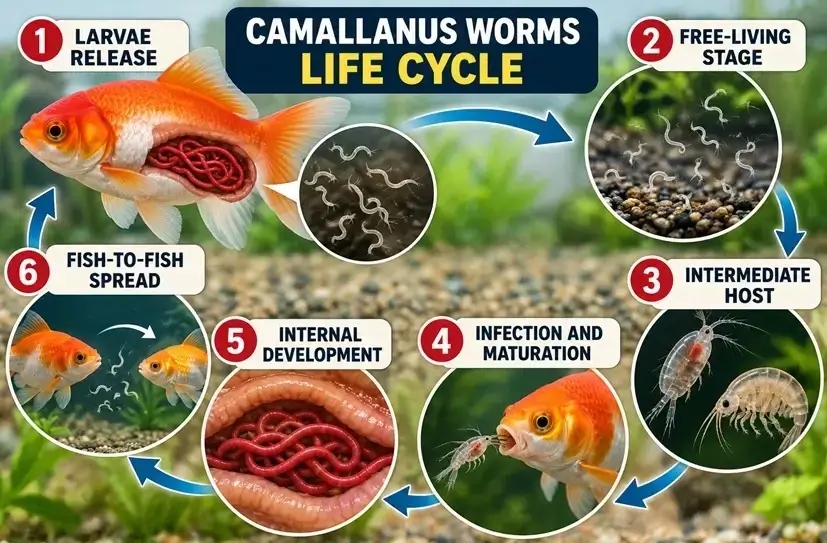
• Free-Living Stage: The larvae can remain in the water or settle into the substrate while waiting for a suitable host. Some sources report that they can remain viable for days to several weeks, depending on temperature and conditions.
• Intermediate Host: The larvae are often eaten by small crustaceans such as Cyclops or Gammarus, where they continue developing into an infective stage.
• Infection and Maturation: When a goldfish eats an infected crustacean, the larvae are released inside the digestive tract, where they attach to the intestinal wall, feed, and continue developing.
• Internal Development: The larvae mature into adult worms inside the fish. In Camallanus cotti, the full life cycle can take less than a month, although development time varies with temperature and species.
• Fish-to-Fish Spread: Camallanus cotti can sometimes infect another fish directly, without first passing through a crustacean host.
What Causes Camallanus Worms in Goldfish?
• Introducing infected fish is one of the main ways Camallanus enters an aquarium. Fish can release larvae before visible worms appear.
• Live foods can introduce the parasite, especially wild-collected Cyclops and other small crustaceans from ponds containing fish.
• Camallanus cotti can spread without a crustacean host, allowing the parasite to pass between fish within an aquarium.
• Poor water quality, overcrowding, and stress don’t cause Camallanus, but they can make infected fish less able to cope with the parasite.
Camallanus Worms Treatment
Camallanus can be treated successfully, but treating only the fish with visible worms is a mistake. Other fish in the aquarium may already be infected without showing symptoms, so the entire tank should be treated.
1. Test the Water First
Before adding medication, test ammonia, nitrite, nitrate, pH, and temperature. Poor water quality won’t cause Camallanus, but it adds unnecessary stress to an already weakened fish.
If ammonia or nitrite is present, correct the water-quality problem before or alongside treatment rather than simply adding medication to an unhealthy aquarium.
2. Treat Every Fish in the Tank
Treat all exposed fish, not just the goldfish with red worms protruding from its vent. Other fish may already carry Camallanus without showing visible symptoms.
3. Remove Activated Carbon and Increase Aeration
Remove activated carbon or other chemical filtration that can remove the medication before treatment. Keep the biological filter running unless the medication instructions specifically say otherwise.
Add an air stone or increase surface agitation during treatment. Sick fish benefit from good oxygenation, and some medications can reduce available oxygen or affect water quality during treatment.
4. Treat With Levamisole
Levamisole is one of the main medications used to treat Camallanus worms. It works by paralyzing susceptible worms, allowing the fish to expel them through the digestive tract. Levamisole can be dosed through the aquarium water, which is particularly useful when an infected fish has stopped eating.
Levamisole is available in aquarium medications such as Fritz Expel-P. If you’re using a commercial product, follow its dosing and repeat-treatment instructions rather than trying to calculate your own dose.
5. Use Fenbendazole Medicated Food as an Alternative
If the fish is still eating, fenbendazole can be given through medicated food as an alternative treatment for intestinal nematodes.
University of Florida guidance lists 1.14 g of fenbendazole per pound of food for 3 days, repeated in 2–3 weeks.
Don’t use fenbendazole as an aquarium bath. It is better suited to medicated food, as bath treatments have been associated with high fish mortality.
6. Vacuum the Substrate During the Water Change
After the required medication exposure period, vacuum the substrate thoroughly while performing the partial water change. This helps remove expelled worms, larvae, waste, and medication residue from the aquarium.
The amount and timing of the water change depend on the medication you are using, so follow the product instructions.
7. Repeat the Treatment
Don’t stop treatment simply because the visible red worms disappear.
Repeat treatment according to the medication you are using. Commercial levamisole products may call for another treatment after about a week, while other levamisole or fenbendazole protocols may use longer intervals, including 2–3 weeks.
Repeat treatment is important because a single round may not eliminate every stage of the parasite or prevent reinfection.
8. Restore the Filter After Treatment
Once the full medication course is finished and the medication instructions allow it, activated carbon can be returned to the filter to help remove remaining medication from the water.
Continue partial water changes to restore normal aquarium conditions. There is no need to perform repeated massive water changes unless the medication instructions call for them or there is a water-quality problem.
9. Monitor the Fish During Recovery
Continue good aeration, stable water quality, and normal feeding if the fish is eating. Watch for continued weight loss, weakness, persistent worms, or signs that the fish isn’t recovering normally.
If the aquarium contains shrimp, snails, or other invertebrates, check the medication label before treatment. Invertebrate safety varies between medications.
How to Prevent Camallanus Worms
• Quarantine new fish for 3–4 weeks and watch for weight loss, bloating, or red worms protruding from the vent.
• Avoid wild-collected live foods, especially Cyclops and other small crustaceans collected from waters containing fish.
• Don’t transfer plants, gravel, or equipment from an infected tank to a healthy aquarium without cleaning or disinfecting them appropriately.
• Maintain good water quality and avoid overcrowding. These won’t prevent the parasite from entering the tank, but they help keep fish in better condition if an infection occurs.
FAQ
Will Salt Kill Camallanus Worms?
No. Aquarium salt isn’t an effective treatment for Camallanus worms. Use an appropriate deworming medication such as levamisole or fenbendazole.
Are Camallanus Worms the Same as Anchor Worms?
No. Camallanus are internal roundworms, while anchor worms are crustacean parasites that attach externally to the fish’s skin. If the parasite is protruding from somewhere other than the vent, see our goldfish anchor worm guide for more information.
Can Camallanus Worms Kill Goldfish?
Yes. A heavy or long-term infection can damage the intestine, weaken the fish, and cause severe weight loss. Early treatment gives the fish a better chance of recovery.
Can Camallanus Worms Infect Humans?
No. Camallanus worms found in aquarium fish are not considered human parasites. Normal hand washing after aquarium maintenance is still good practice.
Can a Goldfish Recover From Camallanus Worms?
Yes. Goldfish can recover, particularly when the infection is treated before severe weight loss or intestinal damage develops.
Can Camallanus Worms Live in an Empty Aquarium?
Larval stages can remain in the aquarium for some time without visible worms being present. This is why treating the fish alone without cleaning the substrate and completing repeat treatments can lead to reinfection.
Should I Remove Camallanus Worms With Tweezers?
No. Don’t pull a protruding worm from the fish’s vent. You could injure the intestinal tissue. Treat the infection with an appropriate deworming medication instead.
Final Thoughts
Camallanus worms can look alarming, but they are treatable. The important part is to treat all exposed fish, complete the repeat-treatment schedule, and vacuum the substrate during water changes to reduce the chance of reinfection.
For more information on other common health problems, see our complete guide to goldfish diseases.