
The Calico Oranda Goldfish is one of the most colorful and unpredictable varieties of Oranda. Instead of displaying a single solid color, it combines patches of red, orange, black, white, blue, and sometimes yellow stripes, making every fish completely unique. No two Calico Orandas ever develop exactly the same pattern, which is one of the reasons they remain highly prized by hobbyists.
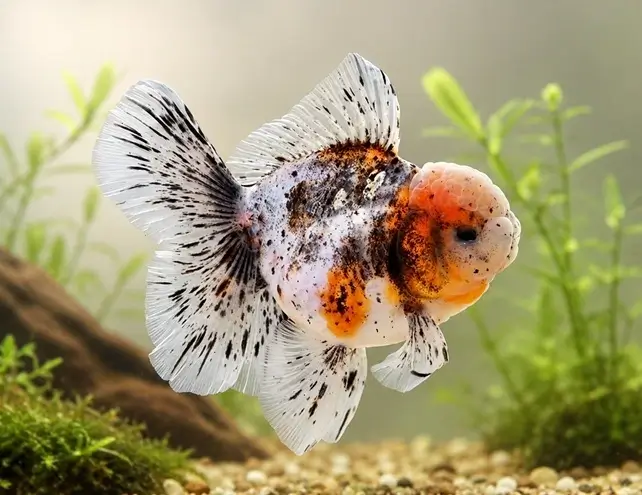
Unlike the familiar Red Cap Oranda, where the bright red head growth dominates the fish’s appearance, or the elegant Blue Oranda, which is admired for its metallic slate-blue coloration, the Calico Oranda is valued for its remarkable mixture of colors spread across both the body and fins. Much of this beauty comes from its unique nacreous scales, which reflect light differently from the metallic scales found on most other Orandas.
Adding to its appeal, the Calico Oranda rarely remains exactly the same throughout its life. Colors often intensify, fade, or rearrange as the fish matures, meaning the juvenile you purchase today may look surprisingly different a few years later. Genetics largely determine these changes, but lighting, age, and overall health also influence how the final coloration develops.
In this article, you’ll learn about the Calico Oranda Goldfish appearance, genetics, color development, care, lifespan, size, buying tips etc.
Quick Navigation
➜ Calico Oranda Quick Facts
➜ Calico Oranda Goldfish Appearance
➜ The Science Behind Calico Coloration
➜ Why Do Calico Orandas Change Color?
➜ Blue Base Calico Oranda
➜ Calico Oranda Goldfish Size & Lifespan
➜ Calico Oranda Goldfish Care
➜ Buying a Calico Oranda Goldfish
➜ Price
➜ Frequently Asked Questions
Calico Oranda Goldfish Quick Facts
| Characteristic | Details |
|---|---|
| Scientific Name | Carassius auratus |
| Common Name | Calico Oranda Goldfish |
| Scale Type | Nacreous |
| Adult Size | 6–8 inches (15–20 cm) |
| Lifespan | 10–20 years |
| Difficulty | Moderate |
| Temperament | Peaceful |
| Temperature | 68–79°F (20–26°C)
|
| Tank Size | 30 gallons minimum |
| Diet | Omnivore |
Calico Oranda Goldfish Appearance
The Calico Oranda combines the classic Oranda body shape with one of the most complex color patterns found in fancy goldfish. It has a rounded body, an upright dorsal fin, a flowing double tail, and the characteristic fleshy head growth known as the wen. What truly distinguishes it, however, is the remarkable mixture of colors scattered across its body and fins.
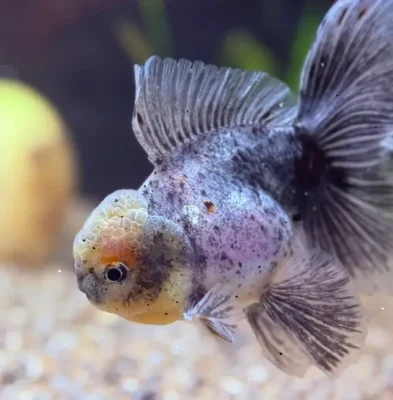
Calico Orandas develop irregular patches of red, orange, white, black, blue, and sometimes yellow. Their appearance is further enhanced by nacreous scales, which combine translucent and reflective qualities to create a soft pearly sheen. This is why many Calico Orandas appear almost luminous under good aquarium lighting.
Did You Know?
No two Calico Oranda Goldfish develop exactly the same color pattern. Even siblings raised in the same aquarium often mature into completely different-looking adults because their coloration is influenced by multiple interacting genes.
The Science Behind Calico Coloration
The beautiful colors of a Calico Oranda are far more complex than they first appear. Many hobbyists assume the fish simply inherits several different pigments, but the distinctive calico pattern is actually the result of specialized scale types, multiple pigment cells, and the way light interacts with the skin. This combination makes Calico Orandas one of the most genetically fascinating varieties of fancy goldfish.
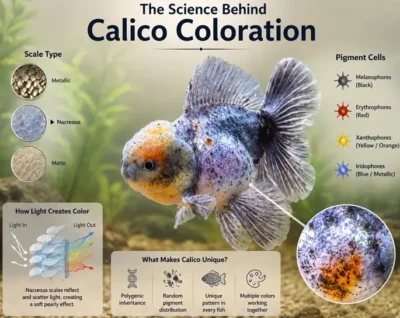
Unlike solid-colored Orandas, whose appearance is dominated by a single color, Calico Orandas display several pigments at the same time. The interaction between these pigments and their unique scales produces the soft pearly appearance that has made this variety so popular among collectors.
What Are Nacreous Scales?
The defining feature of every Calico Oranda is its nacreous scales. Unlike metallic scales that reflect light strongly or matte scales that reflect very little, nacreous scales are partially translucent. This allows light to pass through the outer layers of the scale before reflecting back, producing the soft, pearly appearance often associated with high-quality Calico Goldfish.
This unique scale type also allows several colors to blend together naturally instead of appearing as sharply separated patches, giving the fish a much more complex appearance than most solid-colored varieties.
Metallic vs Nacreous vs Matte Scales
Goldfish generally develop one of three basic scale types, each creating a completely different appearance.
➜ Metallic scales reflect light strongly and produce bright, solid colors such as those seen in Red Cap, Black, or Chocolate Orandas.
➜ Nacreous scales combine translucent and reflective qualities, creating the soft pearly effect characteristic of Calico and Sakura varieties.
➜ Matte scales contain very little reflective pigment, producing a much flatter and less vibrant appearance.
The Calico Oranda owes much of its beauty to its nacreous scales, which allow multiple pigments to interact beneath the surface of the skin.
Why Do Calico Orandas Look Blue?
One of the most striking features of many Calico Orandas is the subtle bluish background that appears beneath the red, orange, white, and black markings. Interestingly, this isn’t produced by a strong blue pigment.
Instead, the bluish appearance results from light reflecting off microscopic crystalline structures inside specialized cells called iridophores. These cells contain tiny guanine crystals that scatter and reflect light, producing the characteristic blue-gray background seen in many high-quality Calico Orandas.
The intensity of this blue effect varies from one fish to another depending on genetics, scale type, and lighting conditions.
The Pigment Cells Behind the Pattern
The spectacular calico pattern is created by several different pigment cells working together rather than a single color gene.
➜ Melanophores produce black markings.
➜ Erythrophores produce red pigmentation.
➜ Xanthophores create yellow and orange tones.
➜ Iridophores reflect light to produce metallic and bluish effects.
The final appearance depends on how these cells are distributed beneath the skin, which explains why no two Calico Orandas ever develop exactly the same pattern.
Why Every Calico Oranda Is Unique
Unlike many solid-colored fish, Calico Orandas inherit their coloration through a complex interaction of multiple genes rather than a single dominant color gene. This is known as a polygenic trait.
During development, pigment cells spread across the body in slightly different ways in every individual fish. As a result, even siblings raised under identical conditions rarely develop matching patterns.
This genetic unpredictability is one of the reasons serious breeders often raise large numbers of fry before selecting a few exceptional individuals for future breeding programs.
Did You Know?
Two Calico Orandas from the same spawning can mature into fish with completely different colors and patterns. This natural genetic variation is one of the reasons collectors value high-quality Calico Orandas so highly.
Why Do Calico Orandas Change Color?
One of the most fascinating characteristics of a Calico Oranda Goldfish is that its appearance rarely remains the same throughout life. A juvenile covered with bold black spots and a striking blue background may gradually develop more orange, lose much of its black pigmentation, or become noticeably lighter as it matures. These changes are completely normal in many fish and are usually driven by genetics rather than poor care.
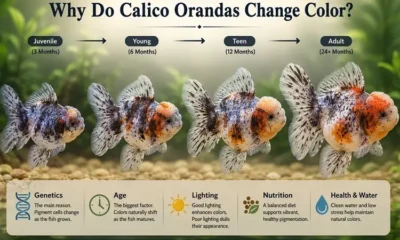
Unlike painted patterns that remain fixed, the colors of a Calico Oranda continue evolving as different pigment cells become more or less active over time. Age plays the biggest role, but lighting, nutrition, and overall health can also influence how dramatic these changes become.
Why Do Black Spots Disappear?
Many juvenile Calico Orandas develop bold black markings that gradually fade as they grow older. This happens because the activity and distribution of melanophores, the cells responsible for black pigmentation, naturally change during development.
Some fish lose only a few spots, while others may lose almost all of their black markings over several years. This gradual fading is considered completely normal and is especially common in young Calico Orandas.
Why Does the Blue Background Fade?
The beautiful bluish background seen in many Calico Orandas is created by light reflecting from specialized cells beneath the scales rather than by a strong blue pigment. As the fish matures, small changes in the skin, scales, and pigment layers can reduce this reflective effect, making the blue appear lighter or disappear altogether.
Some fish retain their blue base throughout life, while others gradually develop a gray, silver, or cream-colored background instead.
Why Do Orange and Red Areas Become Larger?
As black pigmentation fades, the underlying orange and red pigments often become much more visible. This can make the fish appear warmer in color even though no new pigment is actually being produced.
Many mature Calico Orandas therefore display larger orange or red patches than they had as juveniles.
Can a Calico Oranda Become Almost White?
Yes. Some individuals gradually lose much of their dark pigmentation as they mature, leaving behind mostly white scales with only scattered patches of orange or red. Although this surprises many new keepers, it is a perfectly normal outcome for certain bloodlines.
Because coloration is controlled by multiple genes, breeders cannot accurately predict how every juvenile will look as an adult.
Can the Colors Become Brighter?
Absolutely. While some pigments fade with age, others become more intense as the fish matures. Healthy Calico Orandas often develop richer red and orange coloration during adulthood, particularly when maintained on a balanced diet and in excellent water conditions.
However, proper care enhances the fish’s natural colors rather than changing its genetic color pattern.
Do Lighting and Water Quality Affect Color?
Lighting and aquarium conditions influence how a Calico Oranda appears, but they do not permanently change its genetics.
➜ Bright full-spectrum lighting often enhances the pearly sheen produced by nacreous scales.
➜ Stable water quality helps maintain healthy pigmentation.
➜ Chronic stress can temporarily dull existing colors.
➜ A nutritious diet supports vibrant pigmentation but cannot permanently alter genetically determined color patterns.
Can You Prevent Color Changes?
No. There is no food, supplement, or treatment capable of permanently preventing the natural color changes programmed into a Calico Oranda’s genetics. Good husbandry allows the fish to display its healthiest and brightest colors, but it cannot stop the normal biological processes that occur as the fish matures.
Experienced hobbyists understand that these gradual transformations are part of the appeal of keeping Calico Orandas. Rather than expecting the fish to remain unchanged, they enjoy watching each individual develop its own unique appearance over the years.
Did You Know?
Some championship-quality Calico Orandas looked completely ordinary as juveniles. Many experienced breeders select young fish based on body shape and genetics rather than their current color pattern because they know the coloration can change dramatically during adulthood.
Blue Base Calico Oranda
Among all Calico Oranda Goldfish, the Blue Base Calico Oranda is considered one of the most desirable varieties. Instead of having a white or cream-colored background, these fish display a soft steel-blue or slate-blue base beneath their colorful patches. This cool blue background creates a striking contrast with the red, orange, black, and white markings, giving the fish exceptional visual depth.
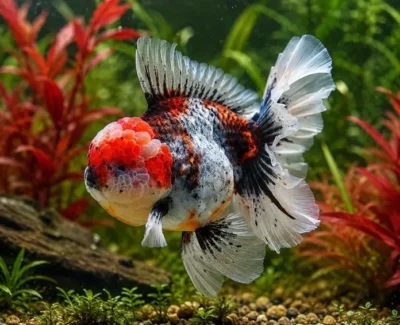
Because producing a stable blue base is genetically difficult, high-quality Blue Base Calico Orandas are far less common than standard Calicos. As a result, they are highly sought after by collectors and often command premium prices.
What Is a Blue Base Calico Oranda?
A Blue Base Calico Oranda is simply a Calico Oranda whose underlying body color appears bluish rather than white. This blue background is not produced by a true blue pigment. Instead, it results from the interaction between nacreous scales, reflective iridophores, and reduced black pigmentation beneath the skin.
The result is a beautiful steel-blue background that enhances the brighter red, orange, and black markings scattered across the fish.
Why Are Blue Base Calicos So Popular?
The blue background creates stronger contrast than a white background, making every individual color appear more vivid. Black markings look darker, orange patches become brighter, and the overall fish develops a richer, more balanced appearance.
Many experienced hobbyists consider a clean blue base one of the most attractive features a Calico Oranda can possess.
Does the Blue Base Stay Forever?
Not always. Like many other Calico characteristics, the blue background may gradually change as the fish matures. Some individuals retain their beautiful steel-blue coloration throughout life, while others slowly become lighter gray, silver, or cream.
This variation is almost entirely genetic. Excellent care allows the fish to display its best possible colors, but it cannot permanently preserve a blue base if the fish’s genetics are programmed to change with age.
Calico Oranda Goldfish Size & Lifespan
Like other Oranda varieties, the Calico Oranda develops slowly over several years. Juveniles often appear slim with only modest head growth, but as they mature, the body becomes deeper, the wen enlarges, and the color pattern continues evolving. A well-cared-for Calico Oranda not only grows larger but usually becomes far more impressive than it was as a young fish.
How Big Do Calico Oranda Goldfish Get?
Most healthy Calico Orandas reach an adult size of 6–8 inches (15–20 cm). Exceptional specimens, particularly those from premium Thai bloodlines or raised in spacious ponds, may occasionally exceed 10–12 inches (25–30 cm).
Although length is often used as a measurement, experienced hobbyists pay just as much attention to body depth, tail spread, and wen development. A deep-bodied fish with balanced proportions is generally considered more desirable than a longer but narrow specimen.
How Fast Do They Grow?
Calico Orandas experience their fastest growth during the first year of life, especially when maintained in spacious aquariums with excellent filtration and fed a nutritious, varied diet. Growth gradually slows after the second year, although the wen and body depth often continue developing for several more years.
Genetics ultimately determine the fish’s maximum potential, but proper nutrition and stable water quality allow it to reach that potential much more successfully.
Calico Oranda Goldfish Lifespan
With proper care, Calico Orandas commonly live between 10 and 20 years. Some exceptionally well-maintained fish have been known to exceed two decades, making them long-term companions rather than short-lived aquarium pets.
Longevity depends far more on husbandry than on color variety. Stable water quality, excellent filtration, regular maintenance, and a balanced diet all play a significant role in determining how long a fish lives.
Did You Know?
The beautiful calico pattern has no known effect on lifespan. A Calico Oranda can live just as long as a Red Cap, Blue, Panda, or Black Oranda when given proper care.
Calico Oranda Goldfish Care
Although the Calico Oranda’s coloration makes it unique, its care requirements are essentially the same as those of other Oranda varieties. Clean water, proper nutrition, and a spacious aquarium remain the keys to maintaining both excellent health and vibrant coloration.
Aquarium Size
➜ A minimum aquarium size of 30 gallons (115 L) is recommended for one Calico Oranda.
➜ Add approximately 20 gallons (75 L) for each additional fancy goldfish.
➜ Larger aquariums provide greater swimming space and more stable water quality.
Water Parameters
Calico Orandas thrive in stable water conditions. Sudden changes in temperature or water chemistry place unnecessary stress on the fish and may reduce its resistance to disease.
A comfortable day-to-day range sits between 68 and 79°F (20–26°C), wide enough to cover most home aquariums without a heater in average room conditions, while still supporting active digestion and steady growth at the warmer end of that range. If you’re ever treating an infection, temperature can be raised temporarily up to 80.6°F (27°C), warmer water speeds up a fish’s metabolism and immune response, which is part of why raising temperature is a standard part of treating conditions like Ich in goldfish generally. Outside of active treatment, though, there’s no need to run the tank at the very top of that range, stability matters more than chasing a specific number.
➜ Temperature: 68–79°F (20–26°C), normal day-to-day range.
➜ Treatment Temperature: Up to 80.6°F (27°C), temporary use during illness only.
➜ pH: 7.0–8.0.
➜ Ammonia: 0 ppm.
➜ Nitrite: 0 ppm.
➜ Nitrate: Ideally below 20–40 ppm.
Diet
A balanced, varied diet supports healthy growth, strong immune function, and vibrant pigmentation. While genetics determine the overall calico pattern, proper nutrition helps the existing colors appear richer and more intense.
➜ Feed high-quality sinking pellets as the staple food.
➜ Supplement with vegetables such as peas, spinach, zucchini, and broccoli.
➜ Offer occasional protein-rich treats including bloodworms, daphnia, and brine shrimp.
➜ Feed two or three small meals daily instead of one large feeding.
Tank Mates
Because Calico Orandas swim slowly, they should be housed with other peaceful fancy goldfish that share similar swimming abilities.
➜ Suitable companions include Fantails, Ryukins, Pearlscales, Telescope Goldfish, Ranchus, and other Orandas.
➜ Avoid Common Goldfish and Comets because they often outcompete Orandas during feeding.
➜ Avoid aggressive or fin-nipping fish.
Do Calico Orandas Need Special Care to Maintain Their Colors?
No. Despite many commercial claims, there is no special food or supplement capable of permanently preserving or enhancing a Calico Oranda’s natural pattern. Coloration is primarily controlled by genetics.
However, maintaining excellent water quality, feeding a nutritious diet, and providing appropriate lighting allow the fish to display its healthiest and most vibrant natural colors.
Care Tip
Rather than trying to “lock in” a juvenile’s colors, focus on keeping the fish healthy. A healthy Calico Oranda will always display its best genetically determined coloration, even if the pattern naturally changes with age.
Buying a Calico Oranda Goldfish
Buying a Calico Oranda is different from choosing many other fancy goldfish. Because the color pattern continues changing as the fish matures, experienced hobbyists rarely purchase one based solely on its current appearance. Instead, they evaluate the fish’s overall body structure, swimming ability, scale quality, and genetic potential before considering the exact color pattern.
A juvenile with an ordinary-looking pattern may develop into a spectacular adult, while a brightly colored young fish may lose much of its black or blue coloration over time. Understanding what to look for greatly increases the chances of selecting a healthy, high-quality specimen.
How to Choose a Healthy Calico Oranda
Before purchasing a Calico Oranda, spend several minutes watching it swim and interact with other fish. Healthy individuals are active, balanced, and alert.
➜ The fish should swim smoothly without floating, sinking, or rolling, our Goldfish Swimming Upside Down guide covers what it means if it doesn’t.
➜ The dorsal fin should remain fully upright.
➜ The body should appear symmetrical with no bent spine or deformities.
➜ The fins should be open, undamaged, and free from white edges or tears.
➜ The wen should be clean with no ulcers, fungus, or trapped debris.
➜ The fish should actively search for food and respond to movement outside the aquarium.
How Much Does a Calico Oranda Goldfish Cost?
The Calico Oranda price depends on its age, body shape, bloodline, color quality, and overall condition. Fish with a clean blue base, balanced color distribution, and excellent wen development usually command significantly higher prices than ordinary pet-store specimens.
| Quality | Typical Price (USD) |
|---|---|
| Pet Store Juveniles | $20–50 |
| Quality Hobby Fish | $50–150 |
| Premium Imported Fish | $150–400+ |
| Show Quality Specimens | $400 to several thousand dollars |
Prices vary considerably depending on the breeder, country, bloodline, and individual fish. Exceptional Blue Base Calico Orandas with excellent body conformation and balanced coloration are often among the most valuable.
Buying Tip
Choose the healthiest fish with the best body shape, swimming posture, and overall balance. While colors may continue changing for several years, good genetics and strong conformation remain valuable throughout the fish’s life.
Frequently Asked Questions
What Makes a Calico Oranda Different from Other Orandas?
The biggest difference is its nacreous scale type and multicolored pattern. While most Oranda varieties display one dominant color, Calico Orandas combine patches of red, orange, black, white, blue, and sometimes yellow over a pearly background. Every individual develops a unique pattern that cannot be perfectly duplicated.
Are Calico Orandas Rare?
Standard Calico Orandas are fairly common, but high-quality specimens with balanced coloration, a clean blue base, excellent body shape, and symmetrical wen development are considerably rarer. These fish are highly sought after by collectors and often command premium prices.
Why Does My Calico Oranda Keep Changing Color?
Color changes are completely normal and are usually driven by genetics. Black markings may fade, orange patches can become more prominent, and the blue background may lighten as the fish matures. Good care helps maintain vibrant colors but cannot permanently prevent genetically programmed color changes.
What Is a Blue Base Calico Oranda?
A Blue Base Calico Oranda has a soft steel-blue or slate-blue background beneath its colorful markings. This effect is created by nacreous scales and light-reflecting iridophores rather than true blue pigment. Blue Base Calicos are considered among the most desirable Calico Orandas by many breeders.
Can Two Calico Orandas Produce Solid-Colored Babies?
Yes. Because calico coloration is controlled by multiple interacting genes, breeding two Calico Orandas can produce offspring with a wide variety of colors and scale types, including metallic, calico, matte, and solid-colored juveniles.
Do Baby Calico Orandas Look Like Adults?
No. Young Calico Orandas often develop significantly different colors as they mature. Their black markings, blue background, and wen continue changing during the first two or three years, making it difficult to predict exactly how an adult fish will look.
Is Every Calico Oranda Unique?
Yes. The distribution of pigment cells differs in every individual fish, meaning no two Calico Orandas develop exactly the same combination of colors and markings. This individuality is one of the variety’s greatest attractions.
Can a Calico Oranda Lose Its Black Spots Completely?
Yes. Many Calico Orandas gradually lose some or even most of their black pigmentation as they mature. This is a natural genetic process and is not usually a sign of disease or poor care.
Does Food Make Calico Orandas More Colorful?
A nutritious diet supports healthy pigmentation and overall health, but it cannot permanently change the fish’s genetically determined color pattern. High-quality foods help existing colors appear brighter rather than creating new ones.
What Is the Difference Between a Calico Oranda and a Sakura Oranda?
Although both varieties possess nacreous scales, their coloration differs noticeably. Calico Orandas usually display distinct black markings together with red, orange, white, and blue tones, whereas Sakura Orandas have a softer translucent appearance with very little or no black pigmentation. Sakura varieties often appear pastel pink, white, or orange rather than boldly patterned.
What Is a Red Calico Oranda?
This isn’t a separate variety, it’s simply a Calico Oranda where red pigment happens to dominate the pattern, rather than an even mix of red, orange, black, and blue. Since calico coloration is polygenic, individual fish can lean heavily toward any one color depending on genetics.
What Is a Tiger Calico Oranda?
Similarly, this describes a Calico Oranda whose pattern takes on a mottled, striped appearance reminiscent of a Tiger Oranda, rather than the more scattered patchwork typical of a standard Calico. It’s still fundamentally a calico-patterned fish, just with a particular arrangement of markings that earns it the “tiger” name.
Final Thoughts
The Calico Oranda Goldfish is one of the most genetically fascinating and visually diverse varieties of Oranda. Its pearly nacreous scales, constantly evolving color pattern, and unique combination of pigments ensure that no two fish are ever exactly alike. Watching a juvenile gradually transform into a mature adult is one of the most rewarding experiences in the goldfish hobby, a bit like watching a photo slowly develop, except it takes years instead of minutes.
Whether you prefer a classic Calico pattern or hope to own a premium Blue Base specimen, remember that genetics ultimately shape the fish’s appearance. Excellent water quality, a balanced diet, and consistent care allow your Calico Oranda to display its full natural beauty, but they cannot override the remarkable genetic processes that make every fish unique.
If you’re considering adding a Calico Oranda to your aquarium, focus on choosing a healthy fish with strong body conformation, balanced proportions, and active behavior. As experienced breeders know, today’s ordinary-looking juvenile may become tomorrow’s spectacular showpiece.
Explore More Oranda Varieties
➜ Red Cap Oranda Goldfish
➜ Blue Oranda Goldfish
➜ Panda Oranda Goldfish
➜ Black Oranda Goldfish
➜ Complete Oranda Goldfish Guide
