
A goldfish that suddenly stops eating is one of the clearest signals something’s changed, since goldfish are famously enthusiastic eaters under normal conditions. Goldfish not eating almost always falls into one of two broad categories, and figuring out which one you’re dealing with first will save you a lot of guesswork.
Before anything else, ask one question: is your goldfish still active, alert, and swimming normally, just refusing food? Or is it lethargic, hiding, sitting at the bottom, or moving strangely alongside the loss of appetite?
➜ Active but not eating — usually points toward the food itself, the tank being new, or a recent water change, not illness
➜ Lethargic and not eating — more likely points toward poor water quality, disease, or a physical problem like swim bladder disorder
This guide is organized around that split, plus a dedicated section for Oranda and Ranchu keepers, since fancy varieties have different digestive risks than common goldfish and the two are frequently kept in the same tank.
Quick Navigation
➜ Goldfish Not Eating but Still Active
➜ Goldfish Spitting Out Food
➜ New Goldfish Not Eating
➜ Goldfish Not Eating and Lethargic
➜ Goldfish Not Eating and Laying at the Bottom
➜ Goldfish Not Eating After a Water Change
➜ Pond Goldfish Not Eating
➜ Oranda and Ranchu Not Eating
➜ “Pregnant” Goldfish Not Eating
➜ How Long Can a Goldfish Go Without Eating
➜ Frequently Asked Questions
Goldfish Not Eating but Still Active
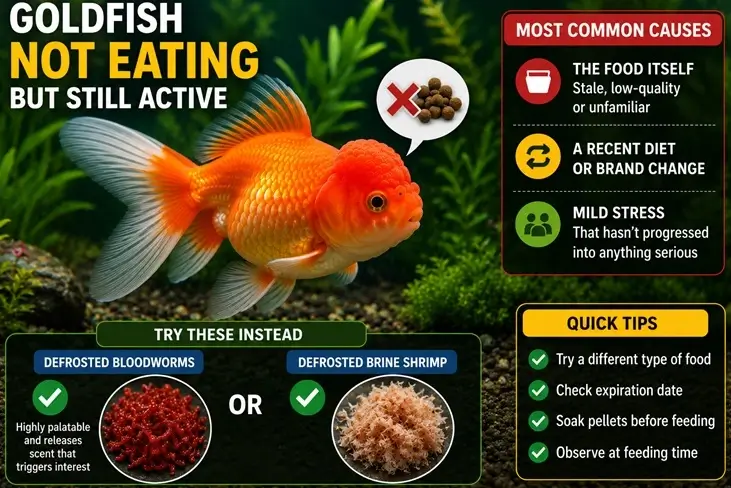
A goldfish that’s swimming normally, alert, and responsive, but simply ignoring food, is usually dealing with something less urgent than a fish that’s also lethargic. The most common causes at this stage are:
➜ The food itself, stale, low-quality, or unfamiliar
➜ A recent diet or brand change
➜ Mild stress that hasn’t progressed into anything serious
Goldfish are surprisingly picky about freshness and brand, and stale or low-quality food can get rejected outright even by a perfectly healthy fish. Before assuming the worst, rule out the food itself, try a different type, check the expiration date, or offer something highly palatable like defrosted bloodworms, defrosted brine shrimp or any food that contains more animal matter to see if interest returns.
One thing worth knowing before you reach for live food specifically: goldfish don’t have a strong hunting instinct, they learn to recognize food through repeated exposure rather than chasing anything that moves. A goldfish raised on pellets for a year has no built-in reason to recognize a live, wriggling worm as food, and may simply ignore it the same way it would ignore any other small creature sharing the tank. Defrosted (not live) bloodworms or brine shrimp tend to work better for this reason, the thawing process releases scent into the water that a goldfish can key into, which does a lot more to trigger interest than movement alone does for a fish that isn’t a natural hunter. It works the other way around too, a goldfish raised on live worms can be just as slow to recognize pellets as food the first time they’re switched over.
Goldfish Spitting Out Food
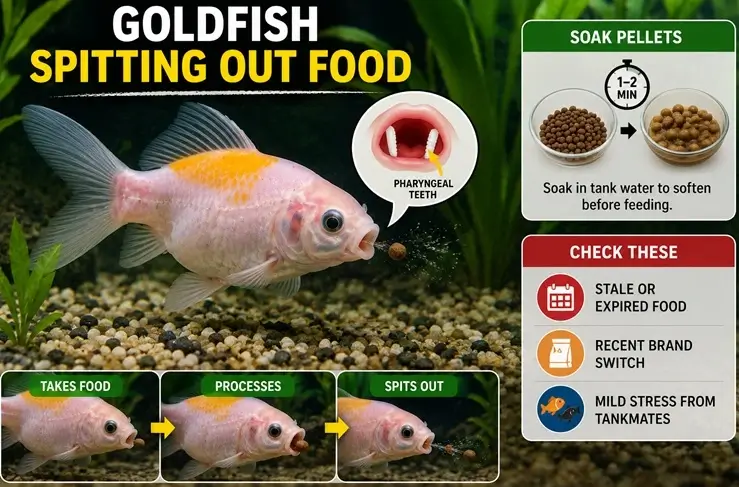
Spitting food back out repeatedly, rather than refusing it outright, is usually mechanical rather than medical. Goldfish take a pellet into their mouth and work it with pharyngeal teeth, hard plates at the back of the throat, to break it down before swallowing, and a pellet that’s too large gets spat out and retried until it’s manageable.
Soaking dry pellets in a little tank water for a minute or two before feeding softens them and often solves this immediately. If soaking doesn’t help, check these next:
➜ Stale or expired food
➜ A recent brand switch the fish doesn’t recognize
➜ Mild stress from tankmates competing at feeding time
New Goldfish Not Eating
It’s extremely common for a newly introduced goldfish to skip food entirely for two to four days while adjusting to a new tank, and this isn’t usually cause for concern on its own. The stress of transport, an unfamiliar environment, and a filter or water chemistry the fish hasn’t adapted to yet all suppress appetite temporarily. In fact, holding off on feeding for the first day or two is often recommended anyway, since uneaten food in a newly stocked or not-yet-fully-cycled tank can foul the water and make things worse. Give the fish space, dim the lights if it seems especially skittish, and don’t panic unless it stretches past 3 or 4 days or comes with other symptoms.
Goldfish Not Eating and Lethargic
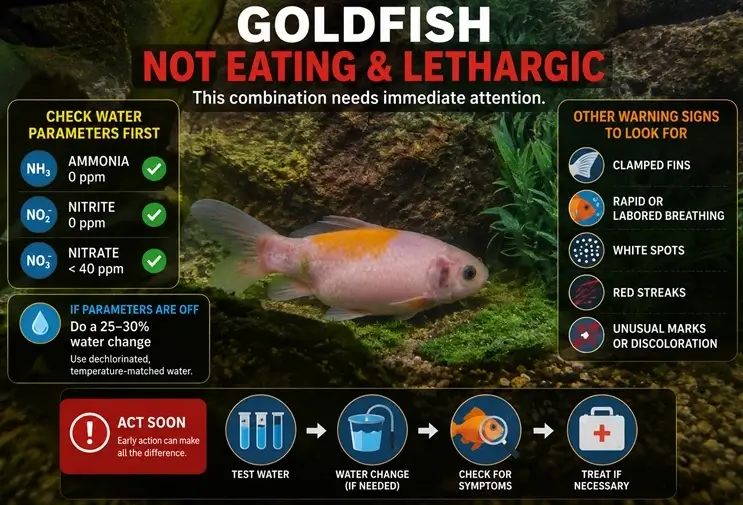
This combination is the one that deserves the most immediate attention, since lethargy paired with appetite loss is a common early signal of poor water quality or infection, not simple pickiness. Test ammonia, nitrite, and nitrate right away, ammonia and nitrite should both read 0 ppm, and nitrate is best kept under 40 ppm for common goldfish, tighter for fancy varieties. If parameters are off, a 25 to 30 percent water change with dechlorinated, temperature-matched water is the immediate fix. If water quality checks out clean and the lethargy persists, look for these other symptoms, since they point toward infection or parasites rather than an environmental cause:
➜ Clamped fins
➜ Rapid or labored breathing
➜ White spots
➜ Red streaks
➜ Unusual marks or discoloration, our Goldfish Turning Black guide covers dark patches specifically, since they’re common alongside exactly this kind of lethargy
Goldfish Not Eating and Laying at the Bottom
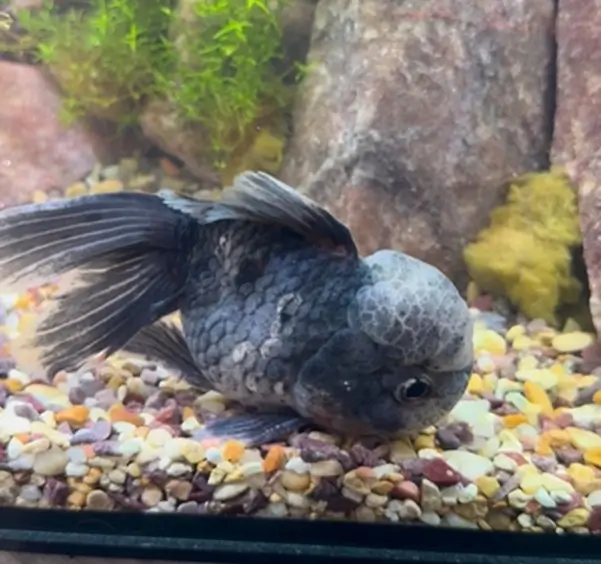
A goldfish parked at the bottom of the tank and ignoring food is worth taking seriously, though it’s worth first ruling out normal rest, goldfish do sleep, typically resting motionless near the bottom overnight, and a fish that wakes and swims normally when approached is usually fine. If it stays unresponsive during active hours, poor water quality is the most common cause, followed by constipation or swim bladder disorder from overfeeding or a digestive blockage. Our Goldfish at the Bottom of the Tank guide covers this specific combination in much more depth, including the full range of causes beyond digestion.
➜ Stop feeding for 24 to 48 hours to let the digestive system clear
➜ Offer vegetable matter like deshelled, cooked, and mashed pea once feeding resumes, the fiber helps digestion
➜ If unresponsive after fasting, add Epsom salt (not aquarium salt) at 1 tablespoon per 5 gallons, dissolved first in a cup of tank water, never added dry
➜ Re-dose only the water actually replaced during water changes, not the full tank volume
➜ If there’s no improvement after a few days, a broad-spectrum antibiotic like kanamycin-based Kanaplex is the next step, since a persistent case can point to infection rather than simple constipation
From Experience: How to Actually Medicate a Sick Goldfish
If your goldfish needs medication for a parasite or bacterial infection rather than just a water quality fix, how you dose it matters as much as which medication you choose. This is the approach that’s worked reliably in practice, and it isn’t something you’ll find spelled out clearly in most online guides.
Treating in the main tank (lower parasite or bacterial load):
➜ Turn the filter off before adding any medication. This is the most important step, and it’s easy to overlook, if the filter keeps running, it will pull the medication out of the water through the filter media before it ever gets the chance to reach the fish
➜ Keep an air stone running the whole time instead, so the medication still circulates evenly through the tank rather than sitting in one spot, and it also helps enough oxygen dissolve into the water, which matters even more for a sick fish
➜ Leave the filter off for a few hours while the medication works, then turn it back on, running the filter afterward helps the medication reach and treat parasites or bacteria hiding in the filter media itself, not just the fish
Treating in a separate quarantine tank (more serious cases):
➜ Move the fish to a small quarantine tank with an air stone running
➜ Add the medication and leave it for a few hours, the same as above
➜ Afterward, do a complete water change with properly matched parameters, medicated water becomes toxic over time, and you can’t leave a fish sitting in it indefinitely, especially one that’s already struggling to breathe from illness
➜ Repeat this cycle, dose, wait a few hours, full water change, as many times as needed until the fish actually improves
Even if you’re treating a fish separately in quarantine, don’t neglect the main tank, whatever caused the illness in the first place is usually still present there, so it needs its own water changes or treatment too. And as a general rule any time you add medication to a tank, plan on a 25 to 30 percent water change the following day to clear out the medication’s own toxicity, more than that, even a full change, is fine if you’re willing to put in the extra effort. Finally, any sick fish needs to be well-oxygenated throughout treatment, an air stone isn’t optional here, illness and medication both put extra strain on a fish’s ability to breathe.
Goldfish Not Eating After a Water Change
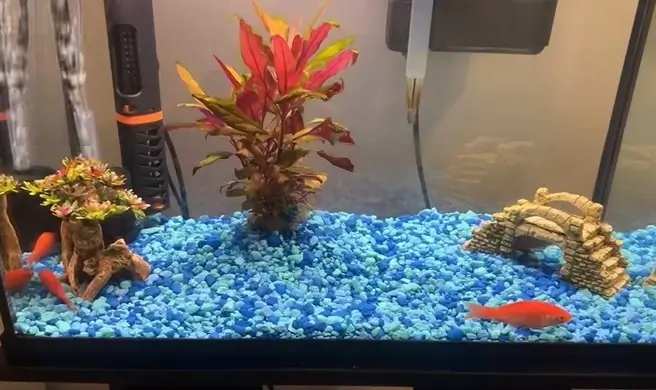
A goldfish going off food shortly after a water change is usually reacting to something in the new water rather than anything wrong with the fish itself. The most common culprits:
➜ Chlorine or chloramine that wasn’t fully neutralized with a dechlorinator
➜ A temperature mismatch between the old and new water
➜ A pH swing disrupting the tank’s chemistry balance
Double-check that the replacement water was properly conditioned and closely matched in temperature before the change, and give the fish a day or two to settle, appetite loss from this cause usually resolves on its own once water chemistry stabilizes.
Pond Goldfish Not Eating
For outdoor pond goldfish, appetite loss is very often simply seasonal rather than a health problem. As water temperature drops in autumn and winter, a goldfish’s metabolism slows dramatically, and below roughly 39 to 41°F they enter a dormant, hibernation-like state where feeding should stop entirely, since undigested food in a cold, slow gut can cause serious problems. In the shoulder season, around 59°F, offer only small amounts of easily digestible, plant-based food, and base feeding decisions on the fish’s actual activity level rather than the calendar. A pond goldfish that stops eating as the weather cools is behaving normally, not sick, but one that stops eating during a stable warm season deserves the same water quality and illness checks as an indoor fish.
Oranda and Ranchu Not Eating
Fancy varieties like Oranda and Ranchu carry two extra risk factors that common, single-tail goldfish don’t have to deal with. First, their more compact, rounded body shape means internal organs, including the swim bladder, sit closer together with less room to spare, so a digestive blockage from overly dry, unsoaked pellets is more likely to cause real buoyancy problems in a fancy variety than in a slim-bodied Comet. Sinking pellets, soaked briefly before feeding, are generally the safer choice over flake or floating food for this reason.
Second, in Oranda specifically, wen overgrowth, the raspberry-like hood on top of the head, can gradually encroach on the eyes or mouth and make it physically harder for the fish to locate or reach food, worth checking if appetite has been declining slowly over weeks rather than stopping suddenly. If you keep Oranda or Ranchu alongside common goldfish in the same tank, watch feeding time closely, faster common goldfish can out-compete slower fancy varieties for food without it being obvious at a glance.
“Pregnant” Goldfish Not Eating
Goldfish don’t actually get pregnant, they’re egg-layers, not livebearers, so what people are usually noticing is a gravid female, one visibly full of developing eggs, rather than a pregnancy in the mammal sense. A gravid female’s rounder body shape works the same way a digestive blockage does, the growing egg mass takes up internal space and can press against the swim bladder or digestive tract, and it’s plausible for appetite to dip somewhat as she nears spawning simply from that internal crowding. This isn’t usually a cause for concern on its own, but the same water quality checks apply if a gravid female seems lethargic rather than just less interested in food.
How Long Can a Goldfish Go Without Eating
A healthy adult goldfish can comfortably go 3 to 7 days without food, and can technically survive up to around two weeks in good conditions, though that’s not something to aim for. Water temperature matters more than most people expect, in cooler water their metabolism slows and they can go noticeably longer without issue, while in warm water they burn through energy reserves faster.
Juvenile, sick, or already malnourished fish shouldn’t be fasted deliberately. If you’re going away and worried about feeding, community consensus among experienced keepers is that a short fast is safer than leaving food with an inexperienced house-sitter, since overfeeding and the resulting ammonia spike is a far bigger risk than a few missed meals.
Frequently Asked Questions
What are the signs of a sick goldfish?
Beyond appetite loss, watch for:
➜ Clamped fins
➜ Rapid or labored breathing
➜ Unusual dark or red marks
➜ White spots
➜ Cloudy eyes
➜ Unusual amounts of time hiding or at the bottom during active hours
Any combination of these alongside lost appetite points toward illness rather than simple pickiness.
Can a dying goldfish be saved?
It depends entirely on the cause and how early it’s caught. Water quality problems and mild constipation are often fully reversible with quick action, while advanced infection or organ failure has a much lower recovery chance. Acting on the first signs, rather than waiting, gives the best odds either way.
Can goldfish survive 4 days without food?
Yes, easily, a healthy adult goldfish can comfortably go three to seven days without eating, so four days alone isn’t a concern if the fish is otherwise active and showing no other symptoms.
Can I feed my goldfish once every 2 days?
Yes, this is a reasonable feeding schedule for a healthy adult goldfish, and some keepers prefer it specifically to avoid overfeeding. Younger, growing fish generally do better with more frequent, smaller feeds.
Is boiled egg good for goldfish?
A small amount of boiled egg yolk is sometimes used as an occasional treat and can help entice a picky eater, but it shouldn’t replace a proper goldfish diet, it’s too rich and fatty to be a regular food.
Why is my goldfish not moving but still alive?
This usually points toward the same lethargy causes covered above, poor water quality, swim bladder disorder, or infection. If it doesn’t respond at all when you approach the tank, treat it as urgent rather than waiting to see if it improves.
Does salt water help a sick goldfish?
It depends entirely on which salt and what it’s treating. Aquarium salt (sodium chloride) helps with external issues like parasites, minor wounds, and slime coat production, but it won’t do anything for constipation or swim bladder problems, and using it for those instead of Epsom salt is a common mistake. Epsom salt (magnesium sulfate) is the one that actually helps with digestive and buoyancy issues, at roughly 1 tablespoon per 5 gallons, dissolved first.
What is the best food for goldfish?
A good-quality sinking pellet as the daily staple, supplemented occasionally with defrosted bloodworms, brine shrimp, or blanched vegetables, covers most goldfish well. Fancy varieties like Oranda and Ranchu do better with sinking food specifically, since floating flakes and pellets increase the risk of gulping air and developing swim bladder issues.
Do goldfish sleep at night?
Yes, goldfish rest, typically becoming still and settling near the bottom or in a sheltered spot once the lights go out. This is normal and different from the unresponsive bottom-sitting covered above, a resting goldfish will still react and swim normally if you approach the tank, while a sick one generally won’t.
What does a stressed goldfish look like?
Common signs include clamped fins, hiding more than usual, faster or more erratic swimming, hovering near the filter outflow or surface, and, relevant here, a temporary drop in appetite. New tank introductions, recent water changes, and aggressive tankmates are among the most common stress triggers, and most stress-related appetite loss resolves on its own within a few days once the underlying cause is addressed. Our Goldfish Swimming Erratically guide covers stress-driven behavior like glass surfing and darting in more depth if that’s part of what you’re seeing.
Why is my goldfish not moving but still alive?
This usually points toward the same lethargy causes covered above, poor water quality, swim bladder disorder, or infection. If it doesn’t respond at all when you approach the tank, treat it as urgent rather than waiting to see if it improves.
Final Thoughts
Most goldfish appetite loss traces back to something fixable, water quality, food freshness, or simple adjustment stress, rather than a serious illness. The active-versus-lethargic split is the fastest way to narrow down which category you’re dealing with before reaching for medication or panicking. For Oranda and Ranchu keepers specifically, the wen and compact body shape add a couple of extra things worth checking that don’t apply to common goldfish. For the full picture of day-to-day care, see our Oranda goldfish care guide. If appetite loss is showing up alongside a specific swimming or behavior symptom, our Goldfish Swimming Upside Down, Goldfish at the Top of the Tank, and Goldfish at the Bottom of the Tank guides each cover their own specific symptom in full detail.
