
Fancy goldfish are among the world’s most recognizable ornamental fish, admired for their flowing double tails, rounded bodies, vibrant colors, and extraordinary features that simply don’t exist in wild fish. Fancy goldfish types number well into the dozens, some develop fleshy head growths called wens, others have telescoping eyes, bubble-filled eye sacs, or eyes that permanently point toward the sky. These remarkable traits are the result of more than a thousand years of selective breeding rather than natural evolution.
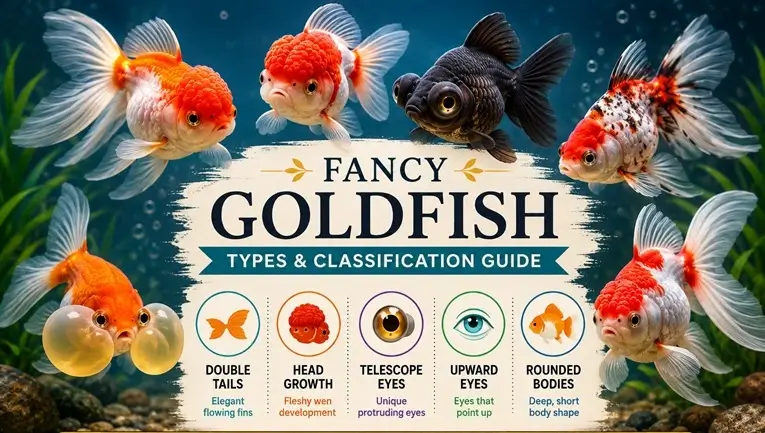
Unlike streamlined single-tailed common goldfish bred for speed and endurance, fancy goldfish have compact bodies, paired tails, and unique ornamental features that prioritize beauty over athleticism. Today, aquarists recognize more than twenty major fancy goldfish varieties, ranging from beginner-friendly Fantails and Orandas to highly specialized collector fish like Tosakin and Jikin.
This guide covers **20 of the most recognized fancy goldfish types**, explains what makes each variety unique, shows you how to identify them using simple physical characteristics, compares their care requirements, and helps you choose the right variety for your aquarium. Whether you’re looking for your first fancy goldfish or trying to distinguish a Ranchu from a Lionhead, this guide provides everything you need in one place.
Quick Answer
Fancy goldfish are selectively bred varieties of Carassius auratus characterized by double tails, rounded bodies, and ornamental features such as head growth (wen), telescope eyes, bubble eyes, or upward-facing eyes. The most popular fancy goldfish types include Oranda, Ranchu, Ryukin, Fantail, Black Moor, Telescope, Pearlscale, Lionhead, Bubble Eye, Celestial Eye, Veiltail, Tosakin, Jikin, Shukin, and Izumo Nankin.
Fancy Goldfish Quick Comparison Table
Compare all 20 fancy goldfish varieties at a glance before exploring each breed in detail.
| Variety | Difficulty | Size | Wen | Eyes | Dorsal Fin | Tail | Pond |
|---|---|---|---|---|---|---|---|
| Oranda | Easy | Large | ✓ | Normal | ✓ | Fan | Indoor |
| Ranchu | Moderate | Medium | ✓ | Normal | ✗ | Rounded | Indoor |
| Ryukin | Easy | Large | ✗ | Normal | ✓ | Fan | Sometimes |
| Fantail | Easy | Medium | ✗ | Normal | ✓ | Fan | Sometimes |
| Black Moor | Moderate | Medium | ✗ | Telescope | ✓ | Double | Indoor |
| Telescope | Moderate | Medium | ✗ | Telescope | ✓ | Double | Indoor |
| Butterfly Telescope | Moderate | Medium | ✗ | Telescope | ✓ | Butterfly | Indoor |
| Pearlscale | Moderate | Medium | ✗ | Normal | ✓ | Double | Indoor |
| Lionhead | Moderate | Medium | ✓ | Normal | ✗ | Rounded | Indoor |
| Bubble Eye | Advanced | Small | ✗ | Bubble | ✗ | Double | Indoor |
| Celestial Eye | Advanced | Small | ✗ | Upward | ✗ | Double | Indoor |
| Veiltail | Moderate | Large | ✗ | Normal | ✓ | Flowing | Indoor |
| Pompon | Moderate | Small | ✗ | Normal | Varies | Double | Indoor |
| Tosakin | Advanced | Small | ✗ | Normal | ✓ | Circular | Indoor |
| Lionchu | Moderate | Medium | ✓ | Normal | ✗ | Rounded | Indoor |
| Wakin | Easy | Large | ✗ | Normal | ✓ | Double | Yes |
| Watonai | Moderate | Large | ✗ | Normal | ✓ | Flowing | Yes |
| Jikin | Advanced | Large | ✗ | Normal | ✓ | X-shaped | Indoor |
| Izumo Nankin | Advanced | Medium | ✗ | Normal | ✗ | Fan | Indoor |
| Shukin | Advanced | Medium | ✗ | Normal | ✗ | Flowing | Indoor |
Quick Navigation
➜ Fancy Goldfish Quick Comparison Table
➜ What Is a Fancy Goldfish?
➜ What Makes a Goldfish “Fancy”?
➜ Why Fancy Goldfish Are Popular
➜ History of Fancy Goldfish
➜ Fancy Goldfish vs Common Goldfish
➜ The 20 Most Popular Fancy Goldfish Types
➜ Which Fancy Goldfish Is Right for You?
➜ How Fancy Goldfish Are Classified
➜ Best Fancy Goldfish for Beginners
➜ Rarest Fancy Goldfish Varieties
➜ Most Expensive Fancy Goldfish
➜ Quick Identification Chart
➜ Frequently Asked Questions
What Is a Fancy Goldfish?
A fancy goldfish is a selectively bred form of the common goldfish (Carassius auratus) developed for ornamental features rather than survival in the wild. Although fancy goldfish can look dramatically different from one another, every variety belongs to the same species. Whether it’s an Oranda with a large fleshy wen, a Telescope with protruding eyes, or a Bubble Eye with fluid-filled eye sacs, they’re all domesticated forms of the common goldfish shaped by centuries of careful selective breeding.
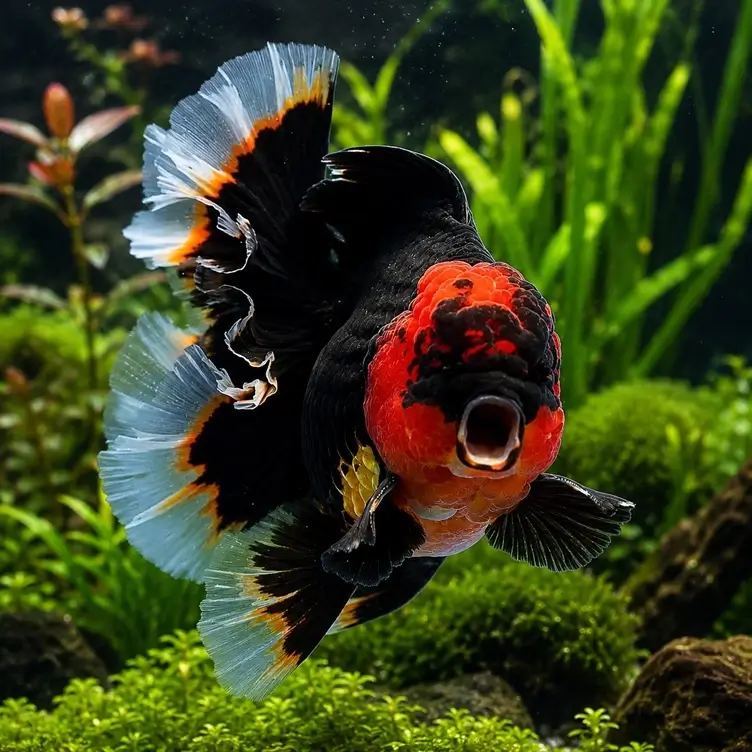
Unlike common goldfish, which have long streamlined bodies built for speed, fancy goldfish typically have compact, deep bodies and graceful double tails. Many varieties also develop unusual characteristics such as fleshy head growths, telescope eyes, bubble-filled eye sacs, pearl-like scales, or upward-facing eyes. These traits make fancy goldfish some of the most distinctive freshwater fish in the aquarium hobby.
Although people often use the words Fancy Goldfish, Fancy Goldfish Types, Fancy Goldfish Varieties, and Fancy Goldfish Breeds interchangeably, they all refer to ornamental forms of the same species rather than different species of fish.
Did You Know?
Every fancy goldfish is still Carassius auratus. An Oranda, Ranchu, Ryukin, Bubble Eye, and Jikin may look completely different, but genetically they’re all domesticated varieties of the same species.
What Makes a Goldfish “Fancy”?
Nearly every fancy goldfish can be identified by a combination of a few distinctive physical features. While no single variety possesses every trait, most share one or more of the characteristics below.
Double Tail
The defining feature of most fancy goldfish is a paired or split caudal fin. Instead of the single tail seen on common and comet goldfish, fancy varieties develop two symmetrical tail lobes that create the graceful appearance they are famous for.
Besides improving appearance, the double tail also slows swimming speed, which is why fancy goldfish are best kept with other slow-moving fancy varieties rather than fast single-tailed goldfish.
Rounded Body Shape
Fancy goldfish usually have a short, deep, egg-shaped body instead of the long streamlined body seen in common goldfish.
Some varieties exaggerate this body shape even further.
➜ Pearlscale develops an almost perfectly spherical body.
➜ Ryukin develops a pronounced shoulder hump.
➜ Ranchu and Lionhead have smooth egg-shaped profiles with no dorsal fin.
The deeper body contributes to their graceful appearance but also makes many fancy varieties slower swimmers.
Head Growth (Wen)
Several fancy goldfish develop a fleshy growth known as a wen. This tissue gradually enlarges as the fish matures and may eventually cover the top of the head, cheeks, and gill plates.
Varieties that develop a wen include:
➜ Oranda
➜ Ranchu
➜ Lionhead
➜ Lionchu
Because the wen is living tissue, maintaining excellent water quality is important to reduce the risk of bacterial infections.
Specialized Eye Types
Fancy goldfish include some of the most unusual eye structures found in freshwater aquarium fish.
➜ Telescope Eyes – large protruding eyes extending outward.
➜ Bubble Eyes – delicate fluid-filled sacs beneath each eye.
➜ Celestial Eyes – eyes permanently directed upward.
Although visually striking, these adaptations reduce vision and make these varieties more vulnerable to injury.
Unique Tail Shapes
Not all fancy goldfish tails look alike.
Different varieties have evolved distinctive tail forms including:
➜ Fan-shaped tails
➜ Butterfly tails
➜ Long flowing veil tails
➜ Rounded Ranchu tails
➜ Circular Tosakin tails
➜ X-shaped Peacock (Jikin) tails
Tail shape is one of the easiest ways to identify many fancy goldfish varieties.
Selective Breeding
Fancy goldfish are entirely the product of selective breeding.
Beginning in ancient China and later refined in Japan, breeders spent centuries selecting fish with unusual colors, longer fins, rounded bodies, distinctive eye shapes, and elaborate head growths. Modern breeders continue refining these traits today, creating new bloodlines and color patterns while preserving traditional varieties.
Why Fancy Goldfish Are So Popular
Fancy goldfish have remained among the world’s most popular aquarium fish for centuries because they combine beauty, personality, and remarkable variety in a single species. No other freshwater fish displays such a wide range of body shapes, tail designs, colors, and ornamental features while remaining relatively peaceful and beginner-friendly.
Many owners also notice that fancy goldfish quickly learn feeding routines, recognize their keepers, and actively swim toward the front of the aquarium when someone approaches. Their interactive behavior often surprises first-time owners and is one reason many aquarists develop long-term attachments to them.
Another reason for their popularity is the incredible diversity available. Hobbyists can choose from elegant long-finned Veiltails, compact Pearlscales, graceful Ranchu, striking Black Moors, colorful Orandas, or extremely rare collector varieties like Tosakin and Jikin, all while keeping fish that belong to the same species.
Finally, there is a fancy goldfish for nearly every experience level. Hardy varieties such as Fantail, Ryukin, Wakin, and Oranda are excellent choices for beginners, while Bubble Eye, Celestial Eye, Tosakin, and Jikin provide rewarding challenges for experienced keepers and collectors.
History of Fancy Goldfish
The story of fancy goldfish spans more than one thousand years and represents one of the oldest examples of selective breeding by humans.
265–420 AD (Jin Dynasty) – Natural red and golden color mutations begin appearing in wild carp populations.
960–1279 AD (Song Dynasty) – Selective breeding becomes established in China, producing the earliest ornamental goldfish.
1368–1644 AD (Ming Dynasty) – Goldfish become popular indoor ornamental fish. As predators are removed from the environment, unusual traits that would rarely survive in nature can now be preserved and intentionally bred.
Early 1600s – Goldfish are introduced into Japan, where breeders develop famous varieties including Ranchu, Tosakin, Jikin, and Wakin.
1600s–1800s – Fancy goldfish spread throughout Europe before eventually reaching North America.
Today – Selective breeding continues worldwide, producing improved bloodlines and new color variations while preserving traditional Japanese and Chinese varieties.
Did You Know?
Many of the features that make fancy goldfish beautiful—such as double tails, telescope eyes, and bubble eyes—would make survival in the wild extremely difficult. These traits have survived only because generations of breeders carefully selected and protected them in captivity.
Fancy Goldfish vs. Common Goldfish
Although they belong to the same species, fancy and common goldfish differ considerably in appearance, swimming ability, care requirements, and intended purpose.
| Feature | Fancy Goldfish | Common Goldfish |
|---|---|---|
| Body Shape | Round, deep-bodied | Long and streamlined |
| Tail | Double | Single |
| Swimming Speed | Slow to Moderate | Fast |
| Head Growth | Present in some varieties | Absent |
| Special Eye Types | Present in some varieties | Normal |
| Hardiness | Moderate | Very Hardy |
| Best Environment | Aquariums or specialty ponds | Large ponds and aquariums |
Because common goldfish are much faster swimmers, they usually outcompete fancy goldfish during feeding. For this reason, most aquarists recommend keeping fancy goldfish together with other fancy varieties instead of mixing them with common or comet goldfish.
The 20 Most Popular Fancy Goldfish Types
Although every fancy goldfish belongs to the same species (Carassius auratus), centuries of selective breeding have produced fish with dramatically different body shapes, tails, eyes, head growths, and swimming styles. Some varieties are ideal for beginners, while others are prized by collectors for their rarity and unique appearance.
Below are the 20 most recognized fancy goldfish varieties found in the aquarium hobby today.
1) Oranda Goldfish
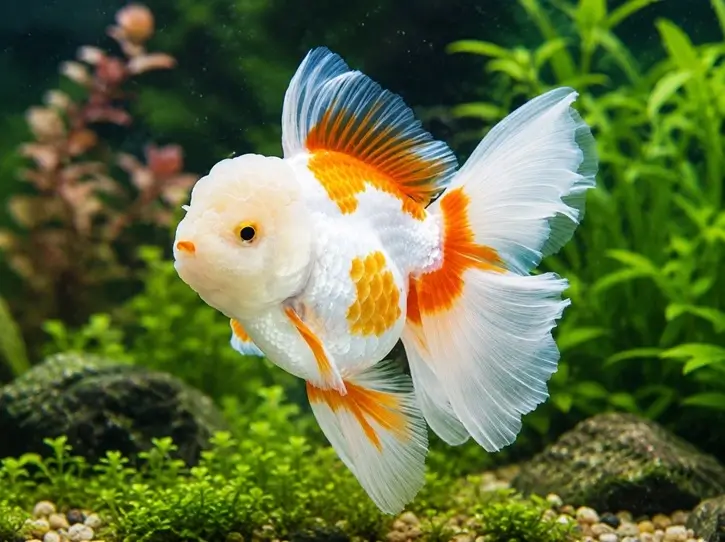
The Oranda Goldfish is one of the most popular and widely recognized fancy goldfish varieties. It combines a rounded body, graceful double tail, and the distinctive fleshy head growth known as a wen, giving it an elegant appearance that appeals to both beginners and experienced keepers.
Young Orandas often have little or no wen, with the head growth gradually developing over the first two to three years of life. Because the wen is living tissue, maintaining excellent water quality is important to prevent bacterial infections.
Key Features
➜ Prominent fleshy head growth (wen)
➜ Rounded body with a graceful double tail
➜ Peaceful and beginner friendly
Popular varieties include Red Cap Oranda, Panda Oranda, Black Oranda, Blue Oranda, Chocolate Oranda, Calico Oranda, Sakura Oranda, and Thai Oranda.
Did You Know?
A mature show-quality Oranda can develop such a large wen that experienced breeders occasionally trim it to prevent it from covering the fish’s eyes.
2) Ranchu Goldfish
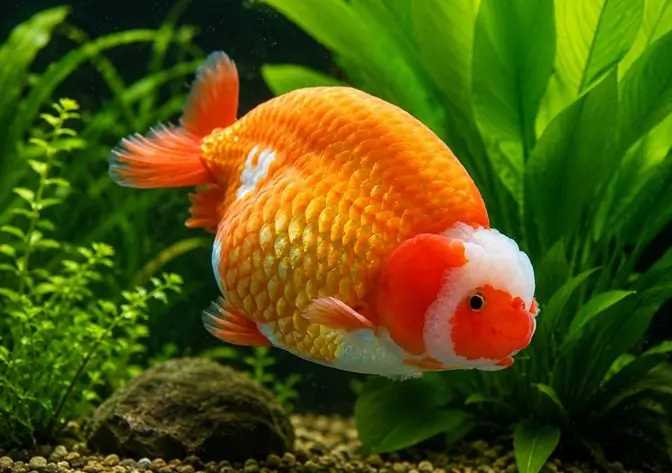
The Ranchu Goldfish is often called the “King of Goldfish” in Japan. Unlike the Oranda, it completely lacks a dorsal fin, giving the fish a smooth curved back that flows gracefully into its tail.
The Ranchu also develops a fleshy wen, but its elegant egg-shaped body and distinctive swimming posture make it one of the most sought-after fancy goldfish among collectors.
Key Features
➜ No dorsal fin
➜ Large fleshy wen
➜ Egg-shaped body with smooth curved back
Did You Know?
Traditional Japanese Ranchu competitions judge the fish almost entirely from above rather than from the side.
3) Ryukin Goldfish
The Ryukin Goldfish is instantly recognizable by its tall shoulder hump located just behind the head. Combined with a deep body and elegant double tail, this gives the fish one of the boldest silhouettes among all fancy goldfish.
Despite its rounded body, the Ryukin is one of the strongest swimmers in the fancy goldfish group and adapts well to both aquariums and suitable outdoor ponds.
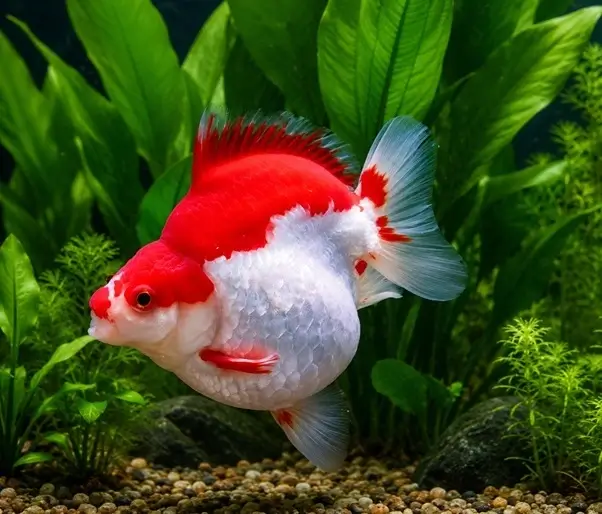
Key Features
➜ Pronounced shoulder hump
➜ Strong swimmer
➜ Hardy beginner-friendly variety
4) Fantail Goldfish
The Fantail Goldfish is widely considered the best beginner fancy goldfish. It has a rounded body, upright dorsal fin, and a broad symmetrical double tail that gives the variety its name.
Because Fantails are hardier and swim faster than most fancy varieties, they tolerate beginner mistakes better while still displaying the classic fancy goldfish appearance.
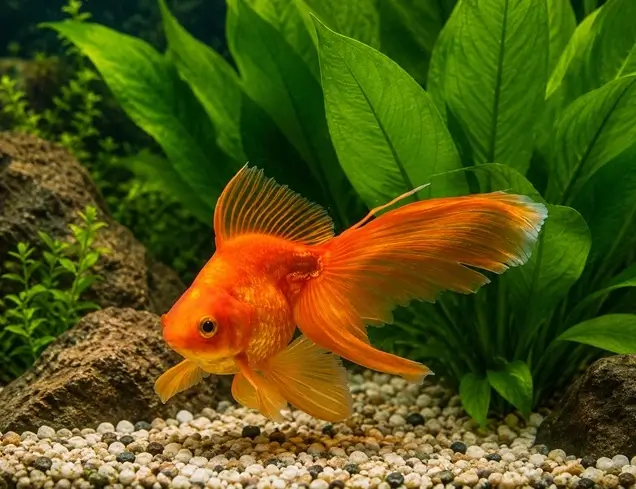
Key Features
➜ Fan-shaped double tail
➜ Upright dorsal fin
➜ Excellent beginner variety
5) Black Moor Goldfish
The Black Moor is actually a black color form of the Telescope Goldfish rather than an entirely separate breed. Its velvet-black body, protruding telescope eyes, and slow graceful swimming make it one of the hobby’s most recognizable fancy goldfish.
Young Black Moors often begin life bronze or brown before gradually developing their characteristic jet-black coloration.
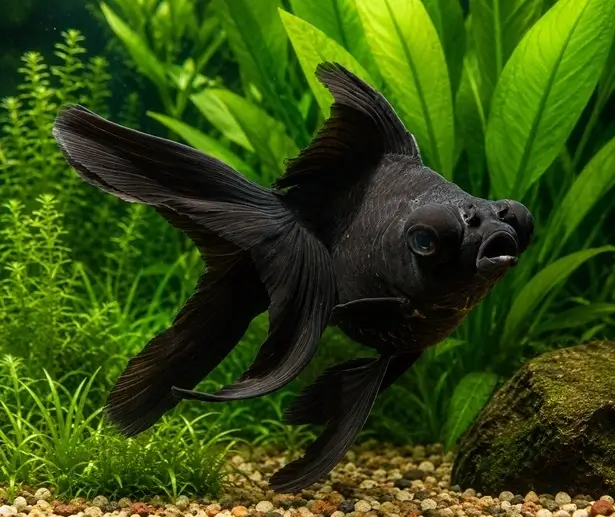
Key Features
➜ Velvet black coloration
➜ Telescope eyes
➜ Double tail
Did You Know?
Black Moors may lose some of their deep black coloration as they age or when kept under intense lighting.
6) Telescope Goldfish
The Telescope Goldfish is named after its dramatically enlarged eyes, which project outward from the sides of the head. It serves as the foundation for several other varieties, including the Black Moor and Butterfly Telescope.
Although these protruding eyes create a unique appearance, they also reduce vision and are more easily damaged by sharp decorations or aggressive tankmates.
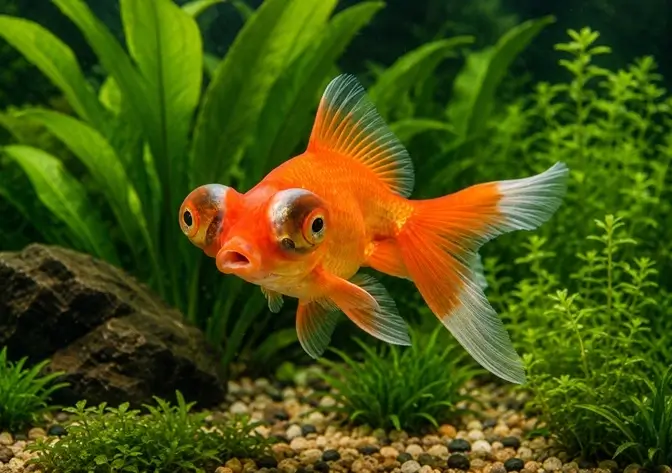
Key Features
➜ Large protruding eyes
➜ Double tail
➜ Requires smooth decorations
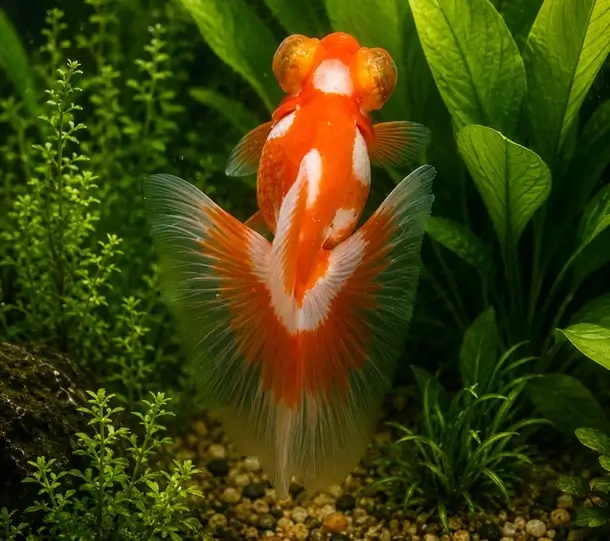
7) Butterfly Telescope Goldfish
The Butterfly Telescope is a spectacular variation of the Telescope Goldfish. When viewed from above, its broad flowing tail spreads outward like the wings of a butterfly, making it especially popular in shallow ponds and top-view aquariums.
The butterfly tail is independent of color, meaning black, red, calico, panda, and many other color combinations are possible.
Key Features
➜ Butterfly-shaped tail
➜ Telescope eyes
➜ Best appreciated from above
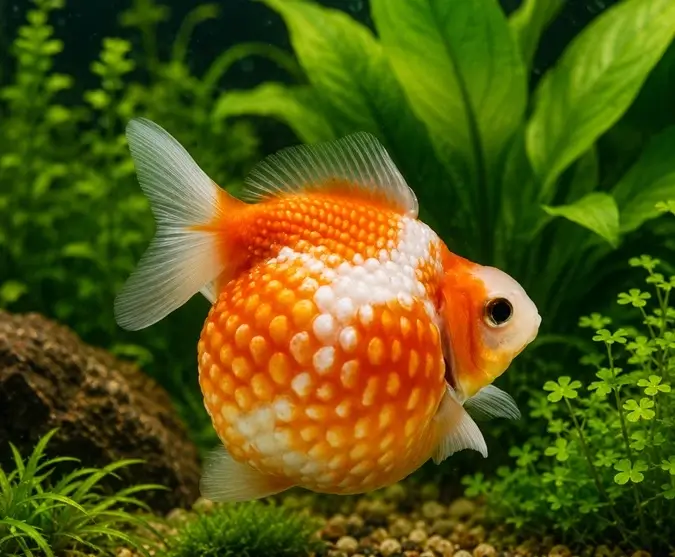
8) Pearlscale Goldfish
The Pearlscale Goldfish is one of the easiest fancy goldfish to recognize thanks to its distinctive raised scales, which resemble small white pearls covering the body. Combined with its nearly spherical shape and graceful double tail, the Pearlscale has a unique appearance unlike any other goldfish variety.
Its compact body also makes it one of the slower swimmers among fancy goldfish. Because of its rounded shape, Pearlscales are slightly more prone to buoyancy and swim bladder problems than longer-bodied varieties.
Key Features
➜ Raised pearl-like scales
➜ Nearly spherical body
➜ Slow, graceful swimmer
Did You Know?
A special variety known as the Hama Nishiki or Crowned Pearlscale develops both pearl-like scales and a fleshy head growth, making it one of the rarest Pearlscale strains.
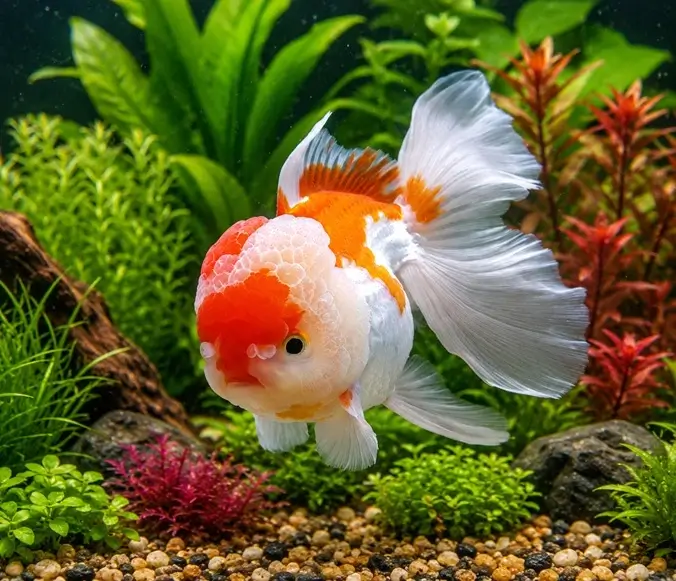
9) Lionhead Goldfish
The Lionhead Goldfish is often mistaken for the Ranchu because both develop a fleshy wen and completely lack a dorsal fin. The easiest way to distinguish them is by looking at the back. A Lionhead has a flatter back, while a Ranchu has a smooth curved arch from head to tail.
Its large head growth gives the fish the appearance of a lion’s mane, which inspired the variety’s name centuries ago.
Key Features
➜ Large fleshy wen
➜ No dorsal fin
➜ Flat-backed body profile
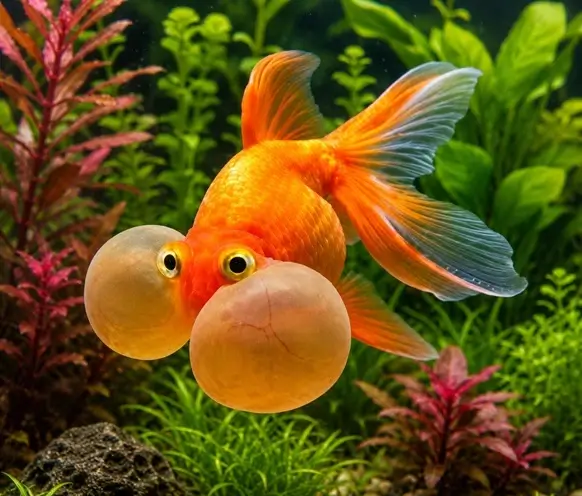
10) Bubble Eye Goldfish
The Bubble Eye Goldfish is one of the most unusual aquarium fish ever developed. Instead of normal cheeks, this variety grows two large fluid-filled sacs beneath its eyes that continue enlarging as the fish matures.
Although beautiful, these delicate sacs can easily rupture if damaged by sharp decorations, aggressive tank mates, or rough handling. For that reason, Bubble Eyes require carefully designed aquariums with smooth décor and gentle filtration.
Key Features
➜ Fluid-filled eye sacs
➜ No dorsal fin
➜ Advanced care requirements
Did You Know?
If a Bubble Eye sac accidentally ruptures, it usually refills over time, although it may never return to its original size or symmetry.
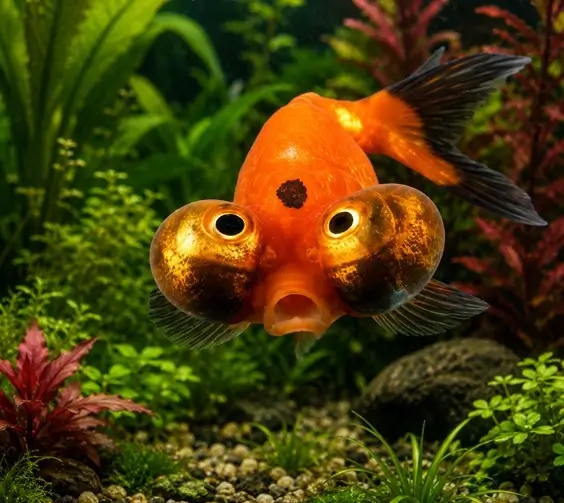
11) Celestial Eye Goldfish
The Celestial Eye Goldfish develops permanently upward-facing eyes that continue rotating upward as the fish matures. This unusual adaptation gives the fish its unmistakable appearance but also limits its ability to see food directly in front of it.
Because of their restricted vision, Celestial Eyes should only be housed with slow, peaceful fancy goldfish in aquariums free of sharp decorations.
Key Features
➜ Permanently upward-facing eyes
➜ No dorsal fin
➜ Delicate, slow swimmer
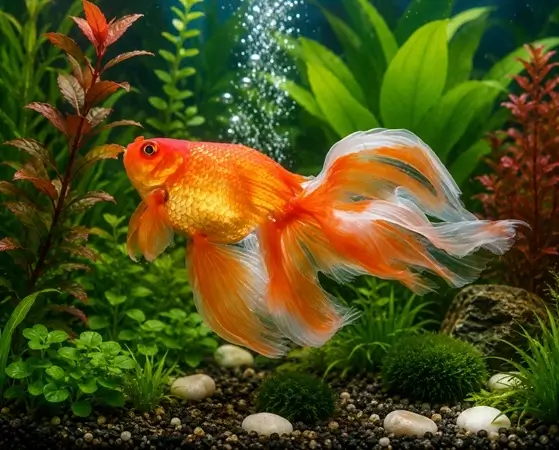
12) Veiltail Goldfish
The Veiltail Goldfish is considered one of the most elegant fancy goldfish ever developed. Its exceptionally long flowing fins create a graceful appearance unlike any other variety. Despite often being confused with long-finned Fantails or Orandas, a true Veiltail has a distinctive square-edged tail, an exceptionally tall dorsal fin, and a rounded body without the prominent shoulder hump seen in Ryukins.
Developed in Philadelphia during the late 1800s, the Veiltail remains one of the rarest traditional fancy goldfish and is highly prized by breeders.
Key Features
➜ Exceptionally long flowing fins
➜ Tall erect dorsal fin
➜ True square-edged veil tail
Did You Know?
Although many fancy goldfish develop long fins with age, only a true Veiltail possesses the specific tail structure required by show standards.
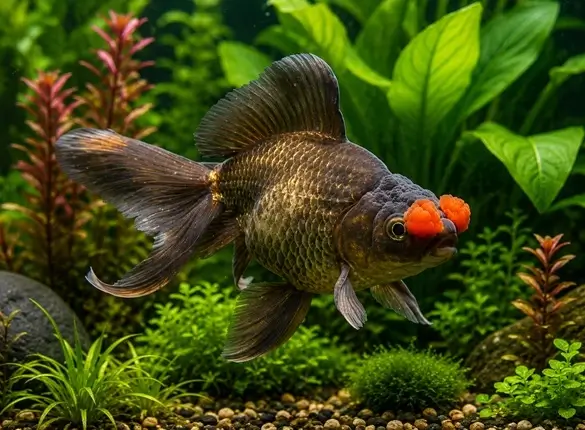
13) Pompon Goldfish
The Pompon Goldfish takes its name from the distinctive fleshy nasal outgrowths that resemble small pom-poms positioned above its mouth. These soft growths are entirely different from the wen found on Orandas and Ranchus.
Although less common than many other fancy goldfish, the Pompon has become increasingly popular among collectors looking for unusual varieties.
Key Features
➜ Distinctive nasal pom-poms
➜ Rounded body
➜ Peaceful temperament
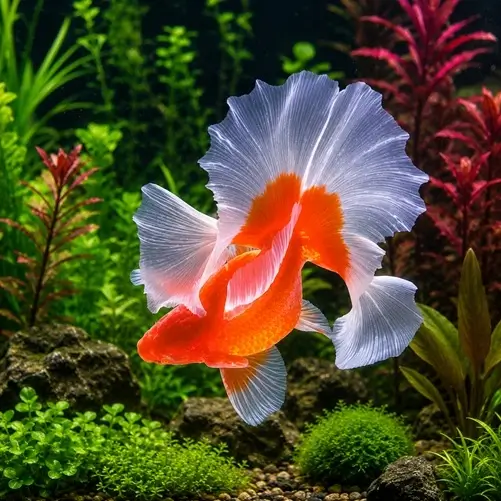
14) Tosakin Goldfish
The Tosakin is one of Japan’s rarest and most celebrated fancy goldfish varieties. Unlike almost every other double-tailed goldfish, the Tosakin develops a broad fused tail that spreads horizontally into a near-perfect circle when viewed from above.
Because its tail is both delicate and difficult to develop correctly, Tosakins are traditionally raised in shallow bowls or top-view ponds where their spectacular tail can be fully appreciated. They remain one of the most challenging varieties for breeders and collectors.
Key Features
➜ Circular horizontal tail
➜ Best viewed from above
➜ Rare Japanese collector variety
Did You Know?
Many experienced breeders consider the Tosakin the most difficult fancy goldfish to breed successfully because developing its perfect circular tail requires years of selective breeding.
15) Lionchu Goldfish
The Lionchu Goldfish is a relatively modern fancy goldfish developed by combining the best characteristics of the Lionhead and Ranchu. It features the Lionhead’s large fleshy wen together with the Ranchu’s smooth curved back, creating a balanced body shape that has become increasingly popular among fancy goldfish enthusiasts.
Although still uncommon compared to Orandas and Ranchus, the Lionchu has gained recognition as an attractive exhibition variety with excellent swimming ability for a dorsal-less goldfish.
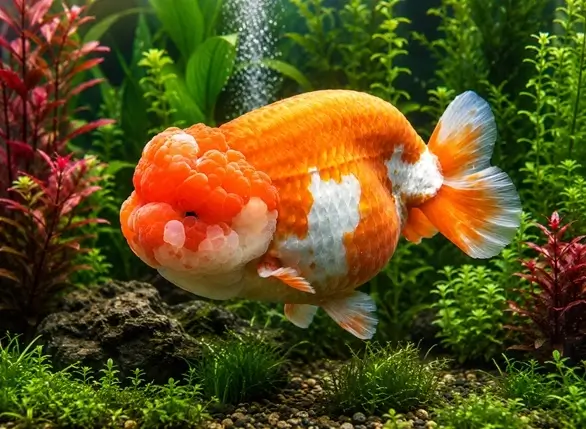
Key Features
➜ Large fleshy wen
➜ No dorsal fin
➜ Hybrid combining Lionhead and Ranchu traits
16) Wakin Goldfish
The Wakin Goldfish is considered the bridge between common goldfish and modern fancy goldfish. It retains the streamlined body of the common goldfish but replaces the single tail with an elegant double tail, making it one of the earliest fancy goldfish varieties ever developed.
Its excellent swimming ability, hardiness, and adaptability make it one of the few fancy varieties well suited to both outdoor ponds and large aquariums.
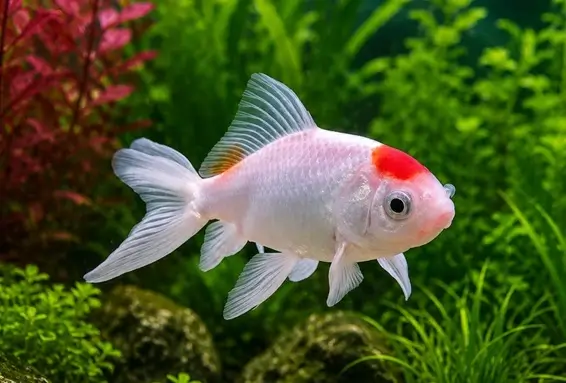
Key Features
➜ Streamlined body
➜ Double tail
➜ Excellent pond variety
Did You Know?
Many historians consider the Wakin the ancestor of several modern Japanese fancy goldfish varieties.
17) Watonai Goldfish
The Watonai Goldfish is believed to have originated from crosses involving Wakin and Ryukin bloodlines. It combines the Wakin’s streamlined body with exceptionally long flowing fins, producing one of the most elegant pond-friendly fancy goldfish available today.
Because it remains an active swimmer, the Watonai is often recommended for large ponds where its graceful tail can be fully appreciated.
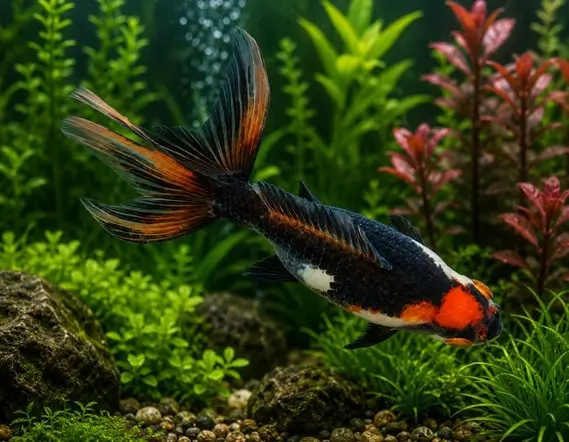
Key Features
➜ Long flowing fins
➜ Strong swimmer
➜ Suitable for ponds
18) Jikin Goldfish
The Jikin Goldfish, also known as the Peacock Tail Goldfish, is one of Japan’s national treasures. It is famous for its unique four-lobed tail that forms a striking “X” shape when viewed from behind, together with its carefully maintained red-and-white color pattern known as the Twelve Red Points.
Because breeding true Jikins requires strict selection over many generations, genuine specimens remain exceptionally rare outside Japan.
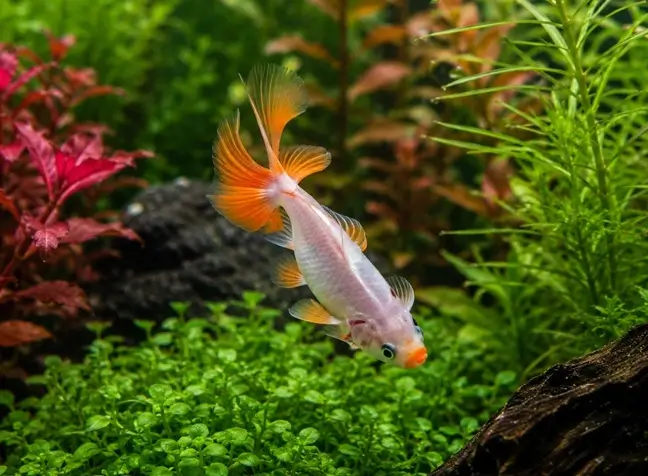
Key Features
➜ Four-lobed Peacock tail
➜ Strict red-and-white color pattern
➜ Rare Japanese variety
Did You Know?
The traditional Jikin color pattern allows red pigment on only twelve specific areas of the body, making high-quality specimens extremely valuable.
19) Izumo Nankin Goldfish
The Izumo Nankin is one of Japan’s rarest native fancy goldfish varieties and is regarded as a regional treasure in Shimane Prefecture. It has a smooth egg-shaped body, no dorsal fin, and a beautifully rounded fan-shaped tail designed to be admired from above.
Unlike Ranchu or Lionhead goldfish, the Izumo Nankin develops little or no head growth, giving it a clean, elegant profile. Genuine specimens rarely leave Japan, making this one of the hardest fancy goldfish varieties to obtain internationally.
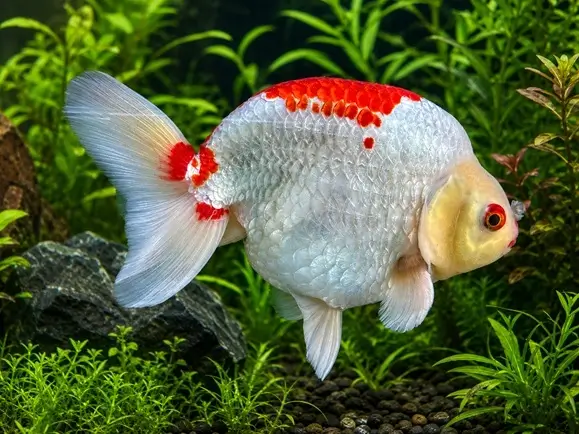
Key Features
➜ No dorsal fin
➜ Smooth egg-shaped body
➜ Fan-shaped tail
➜ Extremely rare outside Japan
20) Shukin Goldfish
The Shukin is a rare Japanese fancy goldfish that combines a streamlined egg-shaped body with long flowing fins and the graceful appearance of traditional dorsal-less goldfish. Although seldom seen outside specialist collections, it is admired for its elegant swimming style and balanced proportions.
Because of its rarity, most aquarists encounter the Shukin only through dedicated breeders or Japanese goldfish exhibitions, where it is appreciated as one of the lesser-known traditional fancy goldfish varieties.
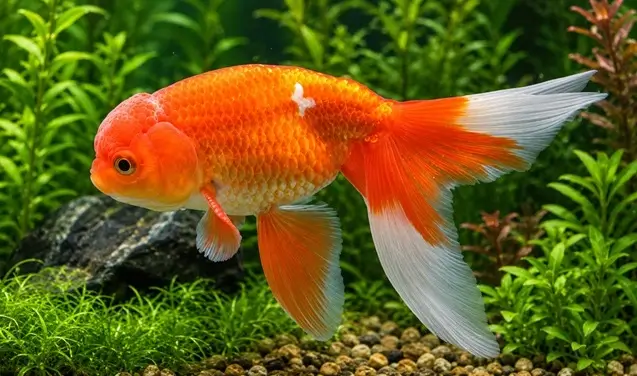
Key Features
➜ No dorsal fin
➜ Long flowing fins
➜ Elegant egg-shaped body
➜ Rare collector’s variety
Which Fancy Goldfish Is Right for You?
The best fancy goldfish for you depends on your experience level, aquarium size, and whether you prefer hardy beginner fish or rare collector varieties. Some breeds are forgiving and easy to care for, while others require pristine water quality, specialized aquariums, and more experience.
If you’re purchasing your first fancy goldfish, start with hardy varieties such as the Fantail, Ryukin, Oranda, or Wakin. More delicate varieties like Bubble Eye, Celestial Eye, Tosakin, Jikin, and Izumo Nankin are better suited to experienced keepers.
| Variety | Best For | Care Level |
|---|---|---|
| Fantail | Beginners | Easy |
| Ryukin | Beginners | Easy |
| Oranda | Beginners | Easy |
| Wakin | Beginners | Easy |
| Ranchu | Intermediate | Moderate |
| Lionhead | Intermediate | Moderate |
| Pearlscale | Intermediate | Moderate |
| Black Moor | Intermediate | Moderate |
| Telescope | Intermediate | Moderate |
| Bubble Eye | Experienced | Advanced |
| Celestial Eye | Experienced | Advanced |
| Tosakin | Collectors | Advanced |
| Jikin | Collectors | Advanced |
| Izumo Nankin | Collectors | Advanced |
| Shukin | Collectors | Advanced |
How Fancy Goldfish Are Classified
With dozens of varieties and countless color combinations, identification can look overwhelming at first. In practice, nearly every variety can be sorted using a handful of physical traits.
By Head Growth (Wen)
➜ With wen: Oranda, Ranchu, Lionhead, Lionchu
➜ Without wen: Fantail, Ryukin, Telescope, Black Moor, Pearlscale, Bubble Eye, Celestial Eye, Veiltail, Tosakin, Wakin, Watonai, Jikin, Izumo Nankin, Shukin
If your goldfish has a fleshy “cap” on its head, it’s almost certainly an Oranda, Ranchu, Lionhead, or Lionchu.
By Eye Type
➜ Normal eyes: Fantail, Ryukin, Oranda, Ranchu, Lionhead, Izumo Nankin, Shukin
➜ Telescope eyes: Telescope, Black Moor, Butterfly Telescope
➜ Bubble eyes: Bubble Eye
➜ Upward-facing eyes: Celestial Eye
By Dorsal Fin
➜ With dorsal fin: Oranda, Ryukin, Fantail, Telescope, Black Moor, Pearlscale, Veiltail, Wakin, Watonai
➜ Without dorsal fin: Ranchu, Lionhead, Lionchu, Bubble Eye, Celestial Eye, Izumo Nankin, Shukin
By Body Shape
➜ Deep-bodied: Fantail, Oranda, Ryukin
➜ Egg-shaped: Ranchu, Lionhead, Lionchu, Izumo Nankin, Shukin
➜ Spherical: Pearlscale
➜ Streamlined: Wakin, Watonai
By Tail Type
➜ Fan-shaped: Fantail, Oranda, Ryukin, Izumo Nankin
➜ Square-edged, non-forked, extremely long: Veiltail
➜ Butterfly-shaped: Butterfly Telescope
➜ Low, rounded Ranchu tail: Ranchu
➜ Broad, horizontal circular tail: Tosakin
➜ Long, flowing: Shukin, Watonai
➜ Four-lobed “X” peacock tail: Jikin
By Swimming Ability
➜ Strong swimmers: Ryukin, Fantail, Wakin, Watonai
➜ Moderate swimmers: Oranda, Ranchu, Lionhead
➜ Weak swimmers: Bubble Eye, Celestial Eye, Pearlscale, Veiltail, Tosakin, Izumo Nankin, Shukin
By Difficulty Level
➜ Beginner: Fantail, Ryukin, Oranda, Wakin
➜ Intermediate: Ranchu, Black Moor, Telescope, Lionhead, Pearlscale, Lionchu, Watonai
➜ Advanced: Bubble Eye, Celestial Eye, Tosakin, Jikin, Izumo Nankin, Shukin
By Pond Suitability
Most fancy goldfish are best kept indoors, but a few hardier varieties can adapt to outdoor ponds in suitable climates:
➜ Wakin
➜ Watonai
➜ Ryukin, in appropriate conditions
➜ Fantail, in mild climates
Delicate varieties like Bubble Eye, Celestial Eye, Pearlscale, Tosakin, Izumo Nankin, and Shukin are generally better suited to a controlled indoor aquarium.
Best Fancy Goldfish for Beginners
If you’re new to goldfish keeping, hardy and forgiving varieties make early mistakes far less costly:
➜ Fantail
➜ Ryukin
➜ Oranda
➜ Wakin
Rarest Fancy Goldfish Varieties
While Orandas, Fantails, Ryukins, and Black Moors are commonly available in aquarium stores, several fancy goldfish varieties are produced only by specialist breeders and are rarely seen outside Japan or dedicated collector circles. Their rarity is often due to limited breeding programs, strict bloodline standards, or the difficulty of producing show-quality specimens.
The following varieties are considered among the rarest fancy goldfish in the world.
| Variety | Why It’s Rare | Availability |
|---|---|---|
| Tosakin | Extremely difficult tail development and breeding. | Very Rare |
| Jikin | Strict Japanese breeding standards and protected bloodlines. | Very Rare |
| Izumo Nankin | Native Japanese regional variety rarely exported. | Very Rare |
| Shukin | Limited specialist breeding. | Rare |
| Lionchu | Produced in relatively small numbers. | Uncommon |
Did You Know?
Many of Japan’s rarest fancy goldfish are preserved through dedicated breeding clubs rather than commercial fish farms, helping maintain traditional bloodlines that have existed for centuries.
Most Expensive Fancy Goldfish
Fancy goldfish prices vary enormously depending on bloodline, age, coloration, body shape, and overall quality. While common pet-store specimens may cost only a few dollars, championship-quality fish from respected breeders can sell for hundreds or even thousands of dollars.
Generally, the most expensive fancy goldfish include:
➜ Show-quality Ranchu
➜ Thai Oranda
➜ High-grade Lionchu
Champion Ranchu imported from Japan have occasionally sold for several thousand dollars because of their exceptional conformation and breeding value.
Other Rare Fancy Goldfish Strains
Beyond the 20 major varieties covered in this guide, several uncommon strains and specialty forms are occasionally encountered among collectors.
Eggfish
The Eggfish is an old Chinese dorsal-less goldfish with a smooth egg-shaped body. Several modern dorsal-less varieties are believed to trace part of their ancestry to traditional Eggfish bloodlines.
Froghead Goldfish
An extremely uncommon Chinese variety resembling a Bubble Eye but lacking the characteristic eye sacs. Frogheads are rarely seen outside specialist collections.
Butterfly Black Moor
This is not a separate breed but a Black Moor that also possesses the broad butterfly tail of a Butterfly Telescope, combining two desirable characteristics into one fish.
Calico Telescope
A color variation of the Telescope Goldfish featuring attractive calico markings instead of the more familiar black coloration.
Quick Identification Chart
Use the table below to identify your fancy goldfish based on its most obvious physical characteristics.
| If Your Goldfish Has… | It’s Probably… |
|---|---|
| Large fleshy head growth (wen) | Oranda, Ranchu, Lionhead, Lionchu |
| Telescope eyes | Telescope, Black Moor, Butterfly Telescope |
| Bubble-like eye sacs | Bubble Eye |
| Eyes permanently pointing upward | Celestial Eye |
| Raised pearl-like scales | Pearlscale |
| Large shoulder hump | Ryukin |
| Long flowing veil-like fins | Veiltail |
| Circular tail viewed from above | Tosakin |
| Four-lobed “X” tail | Jikin |
| No dorsal fin and no wen | Shukin, Izumo Nankin |
| No dorsal fin with a wen | Ranchu, Lionhead, Lionchu |
Identification Tip
The fastest way to identify a fancy goldfish is to look for four features in order: head growth, eye type, dorsal fin, and tail shape. Once you recognize those characteristics, identifying even rare varieties becomes much easier.
Frequently Asked Questions
What is the best fancy goldfish for beginners?
Fantail, Ryukin, Oranda, and Wakin are generally considered the best beginner fancy goldfish. They are hardy, relatively forgiving, and adapt well to aquarium life while still displaying the beautiful double tails and rounded bodies that make fancy goldfish so popular.
Which fancy goldfish gets the biggest?
Orandas, Ryukins, Wakin, Watonai, and Jikin are among the largest fancy goldfish varieties. Under excellent care they commonly reach 8–12 inches (20–30 cm), with exceptional pond specimens growing even larger.
Can fancy goldfish live with common goldfish?
It’s generally not recommended. Common and Comet goldfish are much faster swimmers and usually outcompete fancy goldfish during feeding. Over time, slower fancy varieties may become stressed or underfed. Housing fancy goldfish with other fancy varieties usually produces the best results.
How long do fancy goldfish live?
With proper care, most fancy goldfish live between 10 and 15 years. Exceptional specimens occasionally exceed 20 years when provided with spacious aquariums, excellent filtration, nutritious diets, and consistent water quality.
Which fancy goldfish is the easiest to care for?
Fantails and Ryukins are generally considered the easiest varieties because they are hardy, active swimmers, and less susceptible to health problems than more specialized breeds like Bubble Eyes or Celestial Eyes.
Which fancy goldfish is the rarest?
Among the rarest fancy goldfish are:
➜ Tosakin
➜ Jikin
➜ Izumo Nankin
➜ Shukin
These varieties are usually available only through specialist breeders and remain difficult to obtain outside Japan and other parts of Asia.
Which fancy goldfish is the most expensive?
Show-quality Ranchu, Tosakin, Jikin, Thai Oranda, and exceptional Lionchu can sell for hundreds or even thousands of dollars depending on bloodline, conformation, coloration, and show potential.
Which fancy goldfish is the most delicate?
Bubble Eye and Celestial Eye are generally regarded as the most delicate varieties because their specialized eye structures are easily damaged and their vision is limited. Tosakin also requires advanced care because of its fragile tail.
Do all fancy goldfish have a double tail?
Almost all fancy goldfish develop some form of double tail, although the exact shape varies considerably. Fantails have broad fan-shaped tails, Veiltails have long flowing fins, Butterfly Telescopes display butterfly-shaped tails, Tosakins develop circular tails, and Jikins have distinctive four-lobed Peacock tails.
What is the difference between an Oranda and a Ranchu?
Both develop a fleshy head growth called a wen, but an Oranda has an upright dorsal fin while a Ranchu completely lacks one. Ranchu also have a smoother curved back and are traditionally judged from above in Japanese competitions.
What’s the difference between a Lionhead and a Ranchu?
Both lack a dorsal fin and develop a large wen. The easiest difference is the back profile. Ranchu have a smooth arched back, while Lionheads have a flatter back and generally develop a larger head growth.
Which fancy goldfish are best for ponds?
Wakin, Watonai, Ryukin, and Fantail are the best choices for outdoor ponds because they are stronger swimmers and generally more robust than delicate varieties such as Bubble Eye, Celestial Eye, Pearlscale, or Tosakin.
Are fancy goldfish difficult to keep?
Not necessarily. Many beginner-friendly varieties such as Fantails, Ryukins, and Orandas are relatively easy to care for. The difficulty increases with highly specialized varieties like Bubble Eyes, Celestial Eyes, Tosakins, and rare Japanese collector fish.
Is every fancy goldfish an Oranda?
No. An Oranda is only one variety of fancy goldfish. Every Oranda is a fancy goldfish, but fancy goldfish also include Ranchu, Ryukin, Fantail, Telescope, Pearlscale, Lionhead, Bubble Eye, Jikin, Tosakin, and many other varieties.
Final Thoughts
Fancy goldfish represent more than a thousand years of selective breeding, transforming the ordinary wild goldfish into one of the most diverse groups of ornamental freshwater fish in the world. From hardy beginner favorites like the Fantail and Ryukin to collector varieties such as Tosakin, Jikin, and Izumo Nankin, every fancy goldfish has its own unique appearance and personality.
Although there are dozens of recognized strains and color variations, nearly every fancy goldfish can be identified by examining just a few physical characteristics: the presence of a head growth (wen), the type of eyes, whether the fish has a dorsal fin, its body shape, and the shape of its tail. Once you understand these characteristics, identifying even uncommon varieties becomes much easier.
Whether you’re setting up your first goldfish aquarium or expanding a collection of rare Japanese bloodlines, understanding the differences between fancy goldfish varieties helps you choose fish that match both your experience level and aquarium conditions.
As you continue exploring the hobby, be sure to read our detailed care guides for individual varieties, including the Oranda Goldfish, Ranchu Goldfish, Black Oranda, and Thai Oranda, where you’ll find in-depth information on aquarium setup, feeding, breeding, common health problems, and long-term care.
